

This article was automatically translated from the original Turkish version.
Lenz’s Law is a fundamental principle in electromagnetism important that governs electromagnetic induction. Discovered in 1834 by German physicist Heinrich Friedrich Emil Lenz, this law is used to determine the direction of the induced electricity current. Lenz’s Law is based on Faraday’s Law of Electromagnetic Induction and states that the induced current flows in a direction that opposes the change causing it. This principle is grounded in the conservation of energy and Newton’s third movement law.

Heinrich Lenz
According to Lenz’s Law, the induced electric current current in a conductor opposes the change in the magnetic field that produced it. This creates a counteracting reaction that resists the change in magnetic flux. In other words, the induced current acts in a manner that prevents the change in the magnetic field.
The mathematical expression of Lenz’s Law is derived from Faraday’s Law of Electromagnetic Induction but includes a negative sign to represent the opposing nature of the induced effect. Faraday’s Law defines the induced electromotive force (emf) due to a change in magnetic field as:
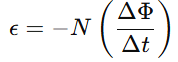
Where:
The negative sign represents the core principle of Lenz’s Law: opposition to change. That is, the induced current generates a magnetic field in the opposite direction to the change in the original magnetic field.
According to Lenz’s Law, several methods can produce a change in magnetic flux:
1. Changing the Orientation of the Coil Relative to the Magnetic Field: Coil induces a change in magnetic flux when there is relative motion between the coil and the magnetic field.
2. Moving the Coil Into or Out of the Magnetic Field: The magnetic flux changes as the coil enters or exits the magnetic field.
3. Altering the Area of the Coil Within the Field: Increasing or decreasing the area of the coil exposed to the magnetic field causes a change in flux road.
4. Movement of the Magnet: Moving a magnet toward or away from the coil alters the magnetic flux.
Lenz’s Law
Lenz experimentally verified the validity of his law through three key experiment:
1. First Experiment: When a current is induced in a coil, an increase in the magnetic field within the coil is observed. Lenz found that the induced current generates a force opposing this increase.
2. Second Experiment: When a magnet is brought near a coil, motion of the magnet induces a current that flows in a direction opposing the change in magnetic field.
3. Third Experiment: When a coil is moved closer to a magnetic field, the magnetic flux through the coil increases, determining the direction of the induced current.
Lenz’s Law is applied in numerous areas of daily life and industry, enabling the proper functioning of technological devices opportunity.
1. Electromagnetic Brakes: These brakes utilize Lenz’s Law to reduce the speed of moving parts; the induced current generates a force opposing the motion.
2. Induction Cooktops: These cooktops operate according to Lenz’s Law by inducing currents in the cooking vessel, which then heat up due to electrical resistance.
3. Electric Generators: Electric generators convert mechanical energy into electrical energy using motion in a magnetic field, with Lenz’s Law ensuring efficient energy direction.
4. Eddy Current Braking Systems: These systems use Lenz’s Law to generate opposing currents that slow down moving components.
5. Metal Detectors and Card Readers: These devices rely on Lenz’s Law to detect metal objects and read data from cards such as.
Lenz’s Law is a fundamental principle that determines the direction of electromagnetic fields and currents, grounded in the conservation of energy. It is essential both theoretically and practically. Lenz’s discovery enabled us to understand the direction of the response to changes in magnetic fields, and this principle underpins many modern technologies. Ultimately, Lenz’s Law is a vital scientific principle governing energy conversion and the interaction of magnetic fields.
Byju's. "Lenz's Law." Accessed February 13, 2025. https://byjus.com/physics/lenzs-law/.
Electrical4U. "Lenz's Law of Electromagnetic Induction." Accessed February 13, 2025. https://www.electrical4u.com/lenz-law-of-electromagnetic-induction/.
Isaac Physics. "Lenz's Law." Accessed February 13, 2025. https://isaacphysics.org/concepts/cp_lenzs_law.
Openstax. "Lenz's Law," *OpenStax University Physics Volume 2,* Accessed February 13, 2025. https://openstax.org/books/university-physics-volume-2/pages/13-2-lenzs-law.
Unacademy. "Lenz's Law." Accessed February 13, 2025. https://unacademy.com/content/neet-ug/study-material/physics/lenzs-law/.

Core Principle of Lenz’s Law
How Is a Change in Magnetic Field Achieved?
Experiments Demonstrating Lenz’s Law
Applications of Lenz’s Law