


Birth | 15 April 1452, Vinci / Italy | ||||||||
|---|---|---|---|---|---|---|---|---|---|
Death | 2 May 1519, Amboise / France | ||||||||
Field | Engineer Anatomist Inventor Sculptor Painter | ||||||||
Famous Works | Mona Lisa, The Last Supper, Vitruvian Man, Madonna of the Rocks | ||||||||
Notable Feature | Renaissance's 'Universal Genius', Interdisciplinary Approach Integrating Art and Science | ||||||||
Area of Influence | Art, Anatomy, Mechanical Engineering, Optics, Flight Technology | ||||||||
Leonardo da Vinci is a multifaceted figure of the Italian Renaissance who made contributions in the fields of art, science, engineering, and natural studies. Known as a painter, sculptor, engineer, anatomist, architect, mathematician, musician, and inventor, Leonardo combined his curiosity about the workings of nature with an observation-based scientific method. Thanks to this interdisciplinary approach, he became a pivotal figure in both art and science and is regarded as one of the strongest representatives of the concept of the “Renaissance man.”
Leonardo was born on 15 April 1452 in the town of Vinci, part of the Republic of Florence. His father, Ser Piero, was a Florentine notary, and his mother, Caterina, was a woman of low social status. Denied certain privileges such as university education due to his illegitimate birth, he was not constrained in his creativity. During his childhood, he developed a habit of carefully observing nature.
Around 1469, he entered the workshop of the renowned artist Andrea del Verrocchio in Florence as an apprentice. There he received foundational training in painting, sculpture, metalwork, architecture, anatomy, and mechanics. It is said that Leonardo painted an angel in Verrocchio’s painting “The Baptism of Christ,” so masterfully that it astonished even his teacher. In 1482, he entered the service of Duke Ludovico Sforza of Milan, serving both as a court artist and engineer. He had the opportunity to observe the scientific and technological advancements of his time firsthand. He left Milan in 1499 after the French occupation of the city. He later worked on various projects in Florence, Rome, and Bologna. In 1516, at the invitation of King Francis I of France, he moved to Amboise and settled in the Château de Clos Lucé, where he died on 2 May 1519.
Leonardo’s artistic philosophy was based on deep observation of nature and the subtle portrayal of human emotion. In his works, he integrated scientific knowledge with artistic creativity. One of his most distinctive features was his use of the sfumato technique, which created soft transitions between colors and surfaces. This allowed him to depict facial contours without sharp lines, giving figures a realistic and lifelike appearance. He also employed the chiaroscuro technique to generate dramatic effects through contrasts of light and shadow.
His anatomically informed figure drawings ensured natural movement in compositions, while the expressions, postures, and gazes of his figures conveyed psychological tension. His use of perspective created a sense of depth and spatial illusion in his paintings. His art reflects not only aesthetic elements but also a philosophical and scientific mode of thought.
In his sculptural works, Leonardo reflected his interest in human anatomy and three-dimensional form. The planned but unfinished bronze equestrian statue in Milan demonstrates his mastery in sculpture. In architecture, he produced designs for ideal city plans, circular churches, and multifunctional buildings. His multi-layered urban models, developed in response to plague outbreaks, were highly advanced for his time. He also studied sound, water, plant morphology, and geology, leaving behind numerous observations and drawings on these subjects.
Leonardo produced numerous designs for mechanical devices. His notebooks contain drawings of flying machines resembling helicopters, parachutes, diving suits, automatic weapons, and armored vehicles. He also developed projects for bridges, canal systems, and hydraulic machines. Although most of these designs were never built, they are regarded as evidence of his technical imagination and his observation-based approach.
This mural, painted on the refectory wall of the Santa Maria delle Grazie Monastery in Milan, depicts a key theme in Christian iconography: the moment when Jesus announces that one of his apostles will betray him. Each apostle’s reaction is rendered with individual emotional expression. The use of central perspective emphasizes spatial depth and the arrangement of figures on the scene.

The Last Supper. (flickr)
This painting, displayed at the Louvre Museum in Paris, is Leonardo’s most famous portrait. Although the identity of the sitter is not certain, the prevailing view is that she is Lisa Gherardini, a Florentine woman. The work is a characteristic example of the sfumato technique. The model’s enigmatic expression, her gaze that avoids direct contact, and the atmospheric landscape behind her combine to give the painting depth and mystery.

Mona Lisa. (Pixabay)
This drawing attempts to relate the proportions of the human body to geometric forms. Inspired by the writings of the ancient Roman architect Vitruvius, this image reflects Leonardo’s interest in anatomy and mathematical ratios. It is a symbolic work representing the union of art and science.

Vitruvian Man. (PublicDomainPictures)
This painting from Leonardo’s late period features a masterfully balanced composition of three figures. Mary sits on the lap of her mother, Saint Anne, while the infant Jesus strokes a lamb. This three-generational structure allegorically explores themes of human love and sacrifice. A strong emotional bond is established through the figures’ physical contact and gazes.
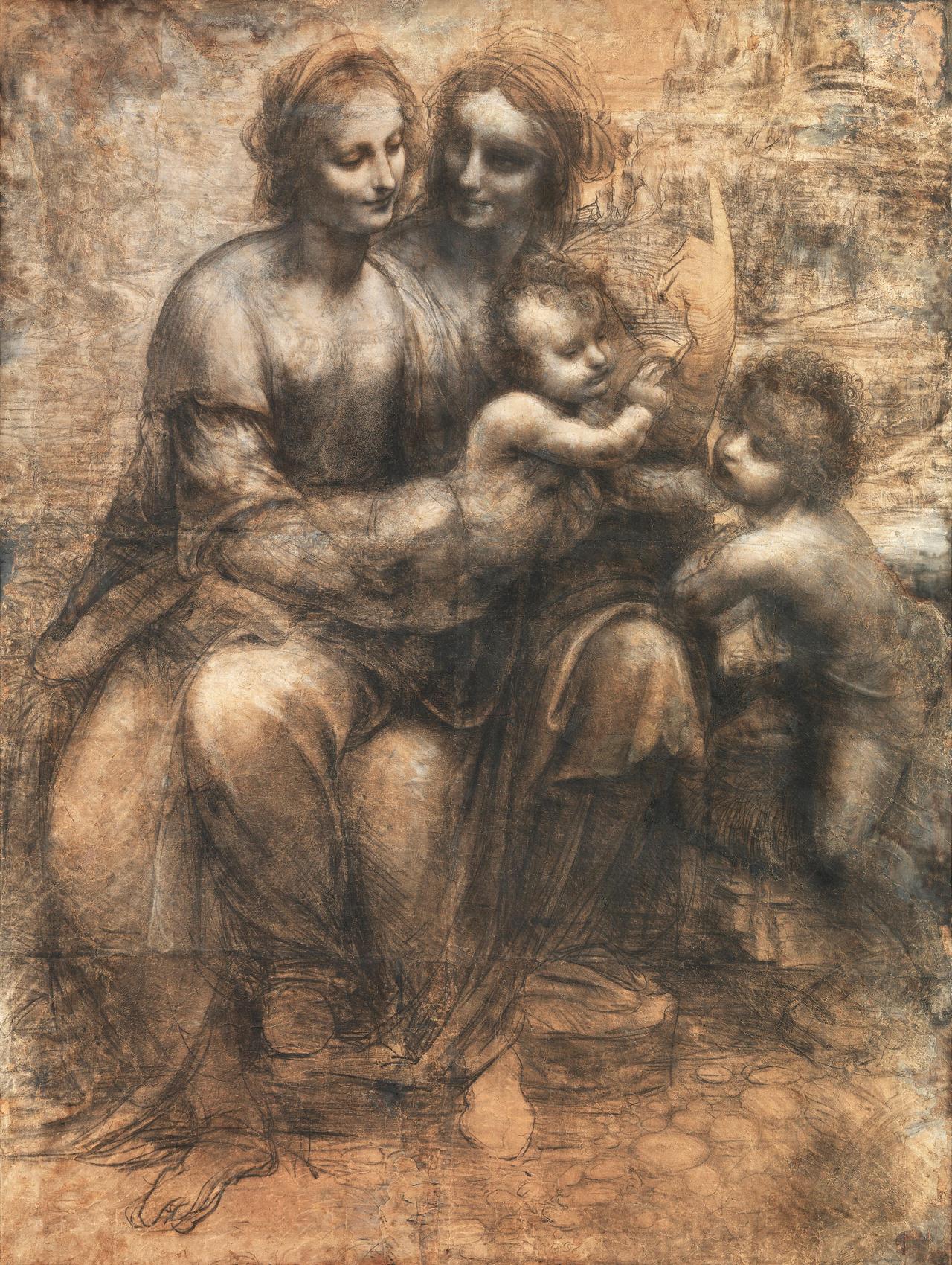
The Virgin and Child with Saint Anne. (rawpixel)
There are two versions of this subject. Both depict the Virgin Mary, the infant Jesus, the young John the Baptist, and an angel. The figures are set against a dramatic rocky landscape. The composition draws attention through its detailed rendering of natural elements, illustrating how Leonardo integrated his observations of nature into his artistic production.

Virgin of the Rocks. (rawpixel)
One of Leonardo’s early works, this painting depicts Mary offering a flower to the infant Jesus. There is a warm interaction between the figures. The maternal expression on Mary’s face and the child’s interest in nature reveal Leonardo’s emphasis on emotional expression.
One of Leonardo’s large-scale unfinished works, it shows the wise men gathered around Mary and the infant Jesus, expressing a variety of emotional states within a crowded composition. The positions of the figures, along with architectural ruins and horse figures, create a layered narrative. The perspective lines in the painting direct all gazes toward the central figures.

Adoration of the Magi. (flickr)
Leonardo left behind approximately 13,000 pages of handwritten notes and drawings. These documents cover anatomy, geometry, physics, botany, zoology, engineering, art theory, and numerous observations. Among his most famous notebooks are the Codex Atlanticus, the Codex Arundel, and the Codex Leicester.
He wrote most of his notes not only in his own unique shorthand system but also using a technique called mirror writing, in which he wrote from right to left and reversed the letters. The exact purpose of this writing style remains uncertain. Some speculate he sought to keep his knowledge secret; others believe he wished to conceal his scientific ideas from the Catholic Church; still others suggest that, being left-handed, he aimed to prevent ink smudging. Contemporary sources confirm that Leonardo wrote and drew with his left hand.
Mirror writing, beyond being a technical preference, has been regarded as a barrier to accessing Leonardo’s notebooks. As a result, his manuscripts today constitute an important subject of study for researchers, both in terms of content and form.
Leonardo da Vinci’s work has influenced not only the field of art but also disciplines such as engineering, anatomy, urban planning, hydrology, and aviation. His observation-based and holistic approach serves as a model for today’s interdisciplinary research. His artworks are exhibited today in major museums such as the Louvre, the Uffizi Gallery, and the National Gallery. His notebooks remain foundational sources in the study of the history of science, art, and technology.
Cartwright, Mark. "Leonardo da Vinci." *World History Encyclopedia*. Accessed August 11, 2025.https://www.worldhistory.org/trans/tr/1-18002/leonardo-da-vinci/
Flickr. "Leonardo, Last Supper JPG." Accessed August 11, 2025.https://www.flickr.com/photos/profzucker/52082255757/in/photostream/
Flickr. “Leonardo, Adoration of the Magi JPG.” Accessed August 11, 2025.https://www.flickr.com/photos/profzucker/49927361171/in/photostream/
Leonardo-da-Vinci. "Leonardo Da Vinci Biography In Details." Leonardo-da-Vinci.org. Accessed August 11, 2025.https://leonardoda-vinci.org/biography.html
Museum of Science. "Activity: Mirror Writing." mos.org. Accessed August 11, 2025.https://www.mos.org/leonardo/activities/mirror-writing.html
Museum of Science. "Da Vinci — The Artist." mos.org. Accessed August 11, 2025.https://www.mos.org/leonardo/artist.html
Museum of Science. "Da Vinci — The Genius." mos.org. Accessed August 11, 2025.https://www.mos.org/leonardo/index.html
Museum of Science. "Da Vinci — The Inventor." mos.org. Accessed August 11, 2025.https://www.mos.org/leonardo/inventor.html
Museum of Science. "Da Vinci — The Scientist." mos.org. Accessed August 11, 2025.https://www.mos.org/leonardo/scientist.html
Pixabay. “Art Painting Mona Lisa Classic JPG.” Accessed August 11, 2025.https://pixabay.com/photos/art-painting-mona-lisa-classic-74050/
Public Domain Pictures. “Vitruvian Man Illustration JPG.” Public Domain Pictures. Accessed August 11, 2025.https://www.publicdomainpictures.net/jp/view-image.php?image=284942&picture=vitruvian
Rawpixel. “Renaissance Art – Leonardo da Vinci Illustration JPG.” Rawpixel. Accessed August 11, 2025.https://www.rawpixel.com/image/3043683/free-illustration-image-vinci-leonardo-renaissance
Rawpixel. “Renaissance People Illustration – Leonardo da Vinci JPG.” Accessed August 11, 2025.https://www.rawpixel.com/image/3849742/illustration-image-art-people
Rawpixel. “Renaissance People Illustration – Vinci JPG.” Accessed August 11, 2025.https://www.rawpixel.com/image/3848168/illustration-image-art-people
Sarton, G., and Vinci, L. D. “Leonardo da Vinci.” *Dört Öge* 2 (2012): 11–36. Accessed August 11, 2025.https://dergipark.org.tr/tr/pub/dortoge/issue/40198/478554
The National Gallery. "An Angel in Green with a Vielle." National Gallery. Accessed August 11, 2025.https://www.nationalgallery.org.uk/paintings/associate-of-leonardo-da-vinci-possibly-francesco-napoletano-an-angel-in-green-with-a-vielle
The National Gallery. "The Burlington House Cartoon." National Gallery. Accessed August 11, 2025.https://www.nationalgallery.org.uk/paintings/leonardo-da-vinci-the-burlington-house-cartoon
The National Gallery. "The Virgin and Child." National Gallery. Accessed August 11, 2025.https://www.nationalgallery.org.uk/paintings/follower-of-leonardo-da-vinci-the-virgin-and-child
The National Gallery. "The Virgin of the Rocks." National Gallery. Accessed August 11, 2025.https://www.nationalgallery.org.uk/paintings/leonardo-da-vinci-the-virgin-of-the-rocks

Birth | 15 April 1452, Vinci / Italy | ||||||||
|---|---|---|---|---|---|---|---|---|---|
Death | 2 May 1519, Amboise / France | ||||||||
Field | Engineer Anatomist Inventor Sculptor Painter | ||||||||
Famous Works | Mona Lisa, The Last Supper, Vitruvian Man, Madonna of the Rocks | ||||||||
Notable Feature | Renaissance's 'Universal Genius', Interdisciplinary Approach Integrating Art and Science | ||||||||
Area of Influence | Art, Anatomy, Mechanical Engineering, Optics, Flight Technology | ||||||||
Life and Education
Artistic Philosophy and Techniques
Sculpture, Architecture, and Other Talents
Inventions and Mechanical Designs
Major Artworks
The Last Supper (Il Cenacolo / The Last Supper, 1495–1498)
Mona Lisa (La Gioconda, 1503–1506)
Vitruvian Man (Vitruvian Man, 1490)
The Virgin and Child with Saint Anne (The Virgin and Child with Saint Anne, 1503–1519)
Virgin of the Rocks (Virgin of the Rocks, 1483–1486 / 1495–1508)
Benois Madonna (1478–1480)
Adoration of the Magi (Adoration of the Magi, 1481, unfinished)
Notebooks and Manuscripts
Legacy and Influence
