

This article was automatically translated from the original Turkish version.
+1 More
Author(s) | Timur Soykan | ||||||||
|---|---|---|---|---|---|---|---|---|---|
Publisher(s) | Kırmızı Kedi Yayınevi | ||||||||
Number of Pages | 380 | ||||||||
Printing Date | May 2016 | ||||||||
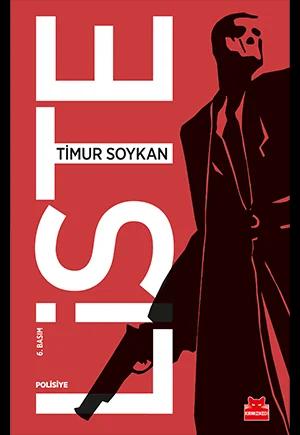
Liste is a crime thriller novel by Timur Soykan, published in 2016. The work examines power structures political corruption and the collapse of the justice system in Türkiye through the lens of a murder case. The novel combines classic crime fiction elements with themes of political context and social critique. The plot revolves around a murder committed within a state institution; a mysterious “list” found in the victim’s hand lies at the heart of the story. This list is not merely evidence but also represents the network of interests secret dealings and systemic decay within the state.
The novel begins with the suspicious death of a young police officer. The discovery of a secret “list” following the murder completely alters the course of the investigation. The protagonist a police officer strives to unravel the power dynamics behind the crime only to confront a deeply entrenched corrupt system intertwined with justice.
The novel is a fictional narrative that explores the relationships between the state the mafia capital and the media revealing the invisible connections among these forces through a perceptive and critical narrative style. These themes unfold organically within the plot as the characters’ actions and conflicts make social power relations visible. While portraying the intersection of individual interests with institutional functioning within a literary framework the author alludes to the mutual dependency dynamics within Türkiye’s recent political and economic system.
The plot of the novel is shaped around the ethical dilemmas conflicts of interest and personal reckonings faced by the characters. As the story progresses on a plane where individual decisions intersect with their social consequences it interrogates the concepts of justice power relations and moral responsibility.
The novel foregrounds themes of justice power corruption moral decay and confrontation with reality. The symbol of the “list” metaphorically reflects the relationship between knowledge and power and the manipulation and transformation of justice. The narrative style is simple direct and structured with elements of tension.
The narrative employs short sentences to create a dynamic pace. The element of tension is sustained throughout; dialogues are natural and characters are constructed as social archetypes. The motif of the “list” used throughout the plot forms both the dramatic center and the symbolic meaning of the novel.
Kırmızı Kedi Yayınevi. "Liste." Accessed October 25, 2025.
Soykan, Timur. *Liste*. İstanbul: Kırmızı Kedi Yayınevi, May 2016.

Author(s) | Timur Soykan | ||||||||
|---|---|---|---|---|---|---|---|---|---|
Publisher(s) | Kırmızı Kedi Yayınevi | ||||||||
Number of Pages | 380 | ||||||||
Printing Date | May 2016 | ||||||||
Plot
Themes
Literary Style and Narrative