
+2 More

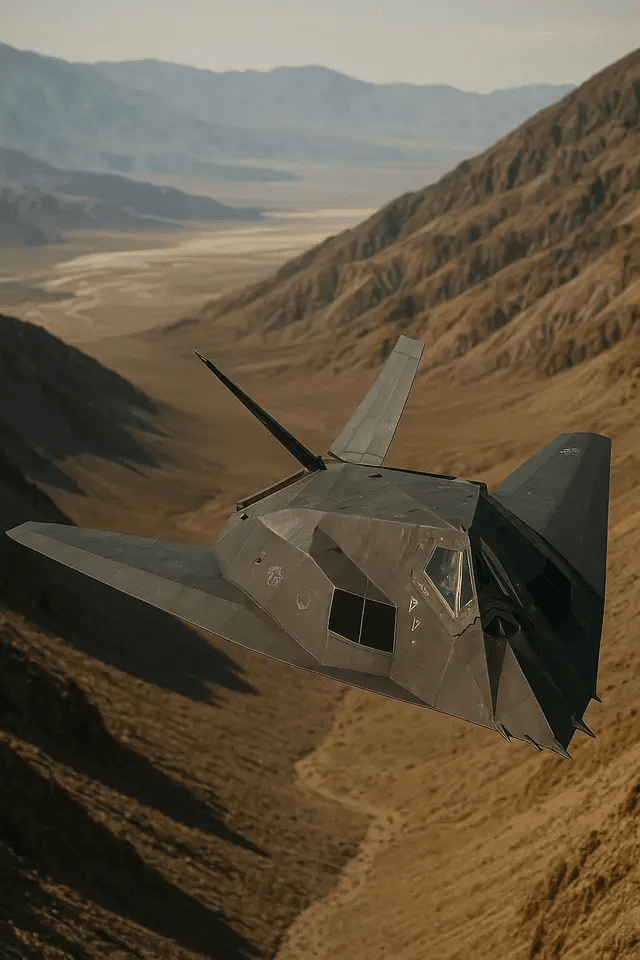
Lockheed F-117 Nighthawk
Manufacturer(s) | Lockheed Corporation | ||||||||
|---|---|---|---|---|---|---|---|---|---|
First Flight(s) | June 18 1981 | ||||||||
Introduction to Service | October 1983 (classified) 1990 (public announcement) Aircraft Type: Single-seat, twin-engine, stealth tactical attack aircraft | ||||||||
Models | F-117A Nighthawk (only one model produced) | ||||||||
The Lockheed F-117 Nighthawk is a single-seat, twin-engine, stealth tactical attack aircraft developed by Lockheed Corporation's "Skunk Works" division in the late Cold War era. Known for its unusual and angular design, the F-117 was designed to secretly infiltrate high-risk, heavily defended targets and carry out precision strikes. It was secretly put into service in the early 1980s, and its existence was kept from the public for a long time. The aircraft made its mark in aviation history during the Gulf War.
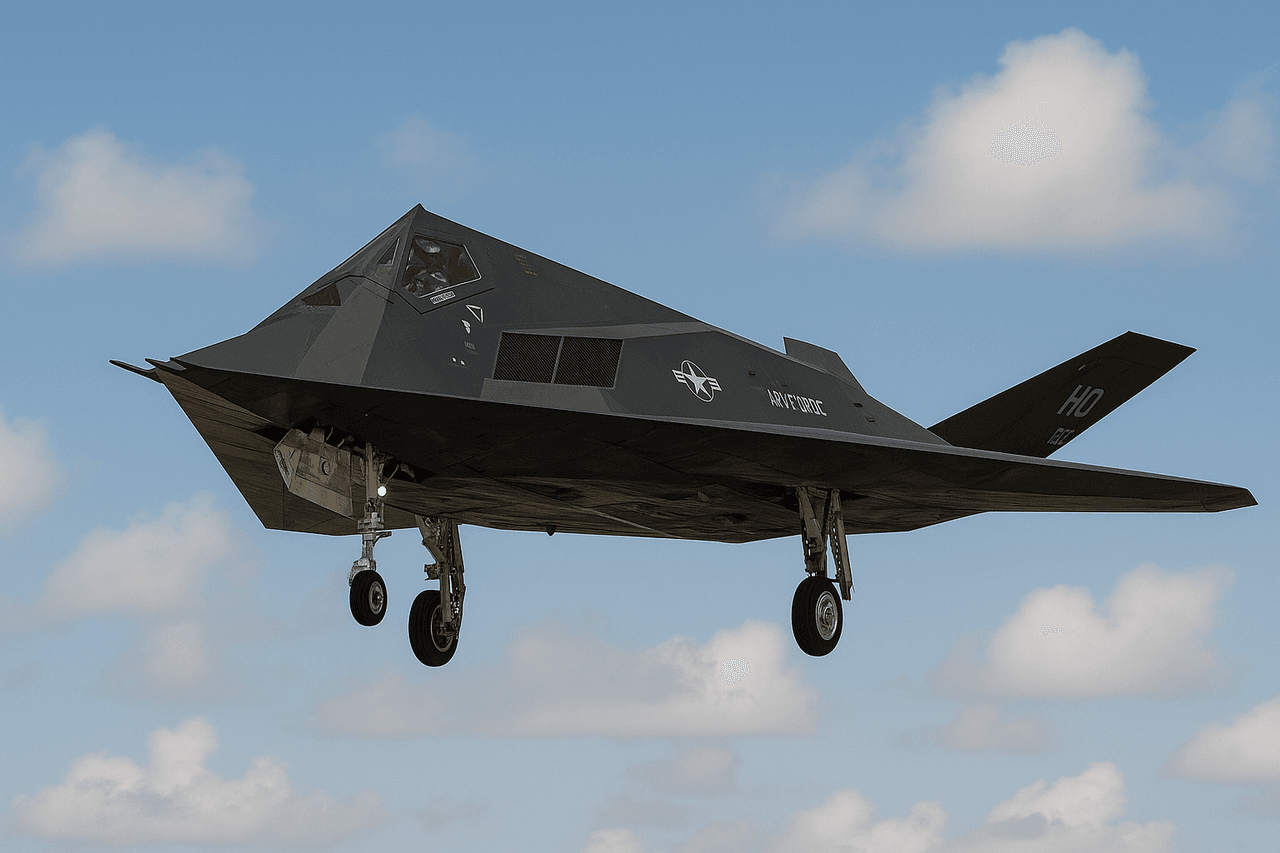
It was created with artificial intelligence.
The development of the F-117 dates back to the mid-1970s. The U.S. Air Force (USAF) launched an experimental program called "Have Blue" in response to the need for a stealth aircraft that could counter the effectiveness of Soviet air defense systems. Lockheed's Skunk Works division produced two prototypes under this project, testing radar invisibility principles. The results obtained from the Have Blue program formed the basis for developing an operational stealth aircraft.
Leveraging the experience from the Have Blue program, Lockheed Skunk Works began designing the first operational stealth aircraft, named the F-117. Lead designer Ben Rich and his team, using mathematician Denys Overholser's theory of "Low Observable Surfaces," developed an angular fuselage shape composed of faceted panels designed to reflect radar waves at specific angles. The first F-117 prototype made its maiden flight in 1981 and was secretly inducted into USAF service in 1983 at the Tonopah Test Range. The aircraft's existence remained classified for many years.
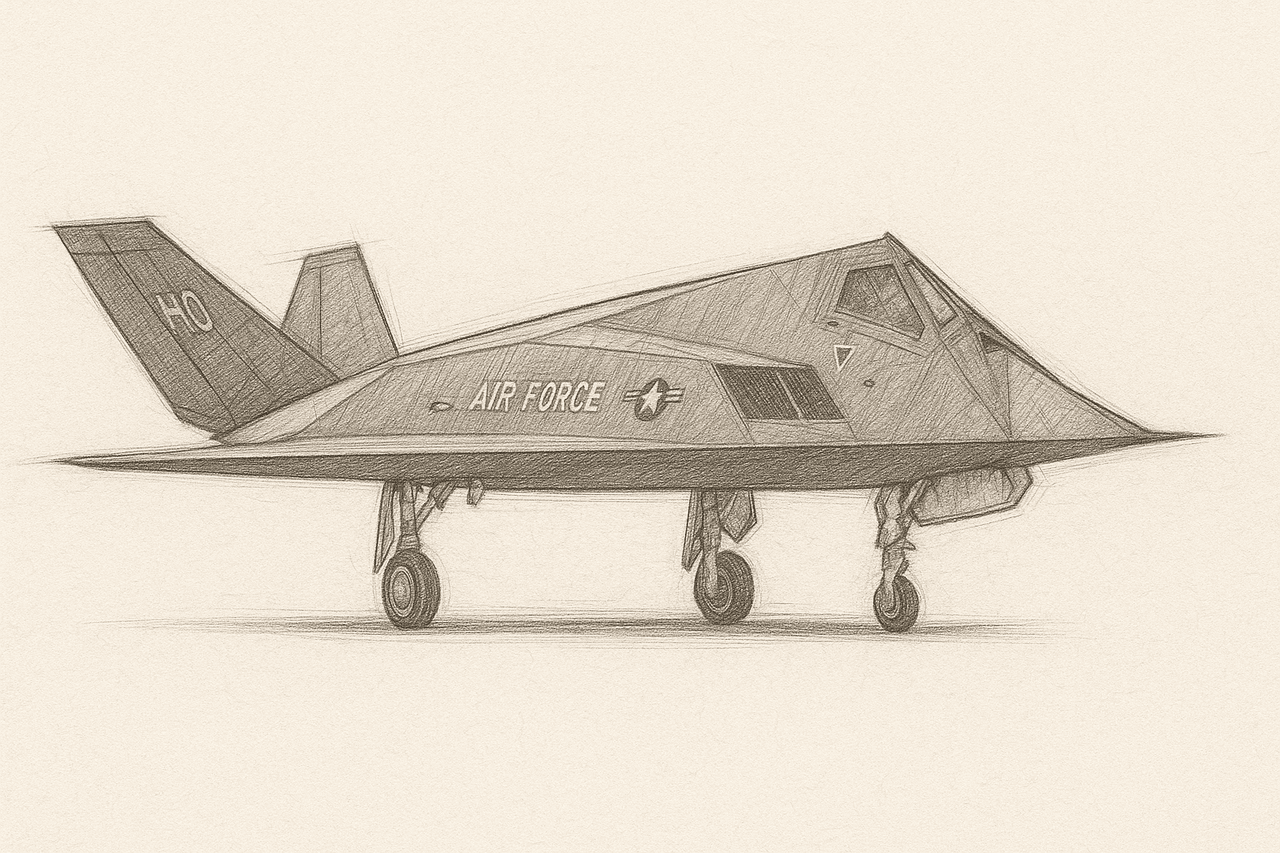
It was created with artificial intelligence.
The distinguishing feature of the F-117 is its multi-faceted body structure, designed to hinder radar detection. This design reduces detection on radar screens by scattering incoming radar waves in different directions instead of reflecting them back to their source. Radar-absorbent materials (RAM) used on the aircraft's surfaces ensure the absorption of radar signals. The F-117 does not have a traditional radar system; passive sensors such as a forward-looking infrared (FLIR) system and a laser designator are used for target acquisition and navigation.
Lockheed F-117 Nighthawk (YouTube : Haci Productions)
The F-117 Nighthawk saw its first operational use in December 1989 during Operation Just Cause in Panama. However, the aircraft's capabilities became evident during the 1991 Gulf War. Despite Iraq's air defense systems, F-117s carried out numerous successful attacks on strategic targets in Baghdad, playing a significant role in the course of the war. It was subsequently used in various military operations, including the Kosovo War ("Operation Allied Force") and the 2003 Iraq War ("Operation Iraqi Freedom"). F-117s typically operated during nighttime missions and in areas with dense enemy air defenses.
The USAF retired the F-117 Nighthawk fleet in 2008. This decision was influenced by the aircraft's high maintenance costs, the complexity of pilot training, and the introduction of next-generation stealth fighters like the F-22 Raptor and F-35 Lightning II, which possessed more advanced stealth capabilities. The F-117's pioneering role in stealth technology and its operational successes have secured it a notable place in aviation history. The aircraft's distinctive design and secret past continue to attract interest in popular culture. Some F-117 aircraft are kept in limited flight-ready status for potential future needs.
Defence Turk. "Emekli Olmuştu! Hayalet Uçak F-117 Nighthawk'lar Hala Göklerde." Accessed May 25, 2025. https://www.defenceturk.net/emekli-olmustu-hayalet-ucak-f-117-nighthawklar-hala-goklerde
HowStuffWorks. "How the F-117A Nighthawk Stealth Fighter Works." Accessed May 25, 2025. https://science.howstuffworks.com/lockheed-f-117a-nighthawk-stealth-fighter.htm. Lockheed Martin. "F-117 Nighthawk." Accessed May 25, 2025. https://www.lockheedmartin.com/en-us/news/features/history/f-117.html.
Lockheed Martin. "F117 Fast Facts_FINAL.pdf." Accessed May 25, 2025. https://www.lockheedmartin.com/content/dam/lockheed-martin/aero/documents/F-117/F117%20Fast%20Facts_FINAL.pdf.
National Museum of the US Air Force. "Lockheed F-117A Nighthawk." Accessed May 25, 2025. https://www.nationalmuseum.af.mil/Visit/Museum-Exhibits/Fact-Sheets/Display/Article/198056/lockheed-f-117a-nighthawk/.
Sacramento Air & Space Museum. "F-117 Nighthawk." Accessed May 25, 2025. https://www.sacmuseum.org/visit/exhibit/f-117-nighthawk/.
YouTube. "F-117 Nighthawk Stealth Strike Aircraft." Accessed May 25, 2025. https://www.youtube.com/watch?v=n_7Pdi86x2Q.

Lockheed F-117 Nighthawk
Manufacturer(s) | Lockheed Corporation | ||||||||
|---|---|---|---|---|---|---|---|---|---|
First Flight(s) | June 18 1981 | ||||||||
Introduction to Service | October 1983 (classified) 1990 (public announcement) Aircraft Type: Single-seat, twin-engine, stealth tactical attack aircraft | ||||||||
Models | F-117A Nighthawk (only one model produced) | ||||||||
No Discussion Added Yet
Start discussion for "Lockheed F-117 Nighthawk" article
Development Process and the "Have Blue" Program
F-117's Design and Secret Entry into Service
Design Features and Stealth Technology
Technical Specifications
Operational History
Retirement and Beyond
This article was created with the support of artificial intelligence.