

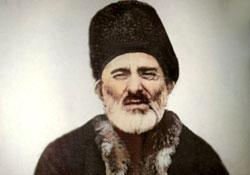

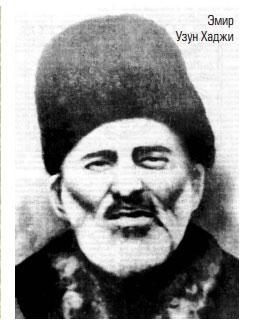
Long-Hacı Saltinski
Doğum tarihi | 1848-01-01 | ||||||||
|---|---|---|---|---|---|---|---|---|---|
Eş | Salikhat-hacı Hadıjat Bakhu | ||||||||
Ölüm tarihi | 1920-03-30 | ||||||||
Yaş | 72 | ||||||||
Çocuk | Patimat Mahomed | ||||||||
Babası | Dibir Muhammed | ||||||||
Uzun Hacı Saltinski was born in 1848 in the village of Salti, in the Gunib region of Dagestan, into an Avar family. Raised within the Nakshibendi order, Uzun Hacı received his education for eleven years under Sheikh Abdurrahman Hacı el Suguri, one of the principal ideologues of the Dagestan uprising of 1877.
From his youth onward, he was repeatedly arrested and exiled due to his actions against the Russian Tsarist regime. Nearly fifteen years of his life were spent in Siberia and prisons. During his imamate, he frequently escaped from these places using his sharp intellect and cunning. On one such escape, he completed the Hajj pilgrimage and returned to Chechnya with a group of Chechen pilgrims, continuing his religious guidance activities. His reputation for these traits became well known among the Russians as well.
Following the collapse of the Russian Tsarist regime in 1917 and the subsequent amnesty for political prisoners, Uzun Hacı became more actively involved in politics. He participated in the founding of Cemaatül İslamiyye, a community composed of national intellectuals and Muslim religious leaders. He supported Necmeddin Gotsinski, who was appointed Sheikh al-Islam of the North Caucasian National Administration, and even led the assembly of religious scholars that proclaimed Necmeddin Gotsinski as Imam of North Caucasus in 1918.
In 1918, alongside Necmeddin Gotsinski, he led a popular force of ten thousand people into Temir-Khan-Shura, the central town of Dagestan, and dismantled the local government aligned with Soviet Russia and Bolshevism. With strong support from the Caucasian Corps under the command of Met Yusuf İzzet Pasha, he continued his struggle until the government of the North Caucasian Republic was established. After becoming Imam of North Caucasus, he placed himself under the protection of Ottoman Sultan Mehmed V (Mehmed Reşad). He built a state structure advanced enough to mint and circulate currency in his own name as Imam.
With the declaration of independence by this administration, the White Army—one of the most powerful armies of the era under General Denikin and loyal to the Tsarist regime—reoccupied the entirety of Chechnya and regions of Ingushetia and Dagestan as far as Derbent. Uzun Hacı took advantage of the conflict between the Red Army and the White Army and defeated General Denikin. Later, after Denikin turned his forces against the Bolsheviks and suffered successive defeats, he fled to Europe.
During the Russian Civil War, as Bolshevik dominance became evident and Russian political unity was consolidated, the Red Army launched a full-scale offensive into the Caucasus. Uzun Hacı fell ill at the outset of this occupation and died on 30 March 1920, being buried in the village of Vedeno. The Imamate of the Caucasus became inactive shortly after his death, when the Bolsheviks fully occupied North Caucasus, remaining nonfunctional until its revival following the collapse of the Soviet Union in 1991.
North Caucasus Republic Official Website. "Uzun Hacı Saltinski." North Caucasus Republic Official Website. Accessed May 3, 2025. https://www.kuzeykafkasyacumhuriyeti.org/biyografi/uzun-haci-saltinski.html.
İKSAD Yayıncılık. *Tarihi, Sosyo-Kültürel Yapısı ve Siyasal Yönleriyle Çeçenler*. Ankara: İKSAD Yayıncılık, 2020. Accessed May 3, 2025. https://iksadyayinevi.com/wp-content/uploads/2020/12/TARIHI-SOSYO-KULTUREL-YAPISI-VE-SIYASAL-YONLERIYLE-CECENLER.pdf.

Long-Hacı Saltinski
Doğum tarihi | 1848-01-01 | ||||||||
|---|---|---|---|---|---|---|---|---|---|
Eş | Salikhat-hacı Hadıjat Bakhu | ||||||||
Ölüm tarihi | 1920-03-30 | ||||||||
Yaş | 72 | ||||||||
Çocuk | Patimat Mahomed | ||||||||
Babası | Dibir Muhammed | ||||||||
No Discussion Added Yet
Start discussion for "Long-Hacı Saltinski" article