


This article was automatically translated from the original Turkish version.
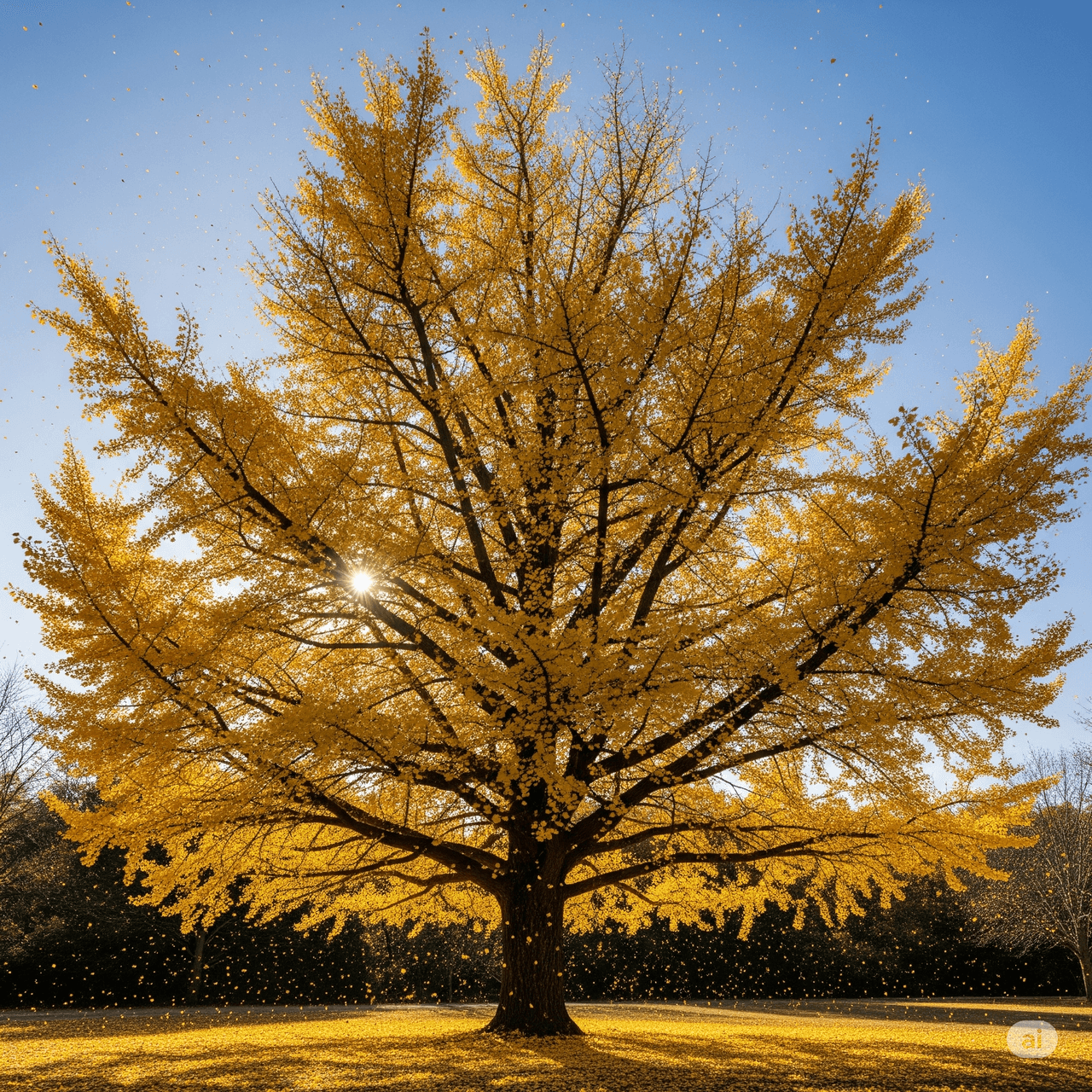
Mabet Tree (Ginkgo Biloba)
Family | Ginkgoaceae | ||||||||
|---|---|---|---|---|---|---|---|---|---|
Team(s) | Ginkgoales | ||||||||
Origin(s) | Çin | ||||||||
Status | Endangered | ||||||||
Lifetime | Asırlık | ||||||||
Leaf | Yelpaze | ||||||||
Pollen | Rüzgâr | ||||||||
Sperm | Motil | ||||||||
Seed | Sarı | ||||||||
Extract | EGb761 | ||||||||
The ginkgo tree (Ginkgo biloba L.) is the sole surviving member of the order Ginkgoales, whose geological history extends back to the Permian period and whose fossil record shows uninterrupted continuity. Although its natural distribution is restricted to moist valleys in southwestern China, it has persisted in East Asia through temple cultivation spanning over a millennium and since the 18th century in temperate urban landscapes worldwide. Its unusual anatomical features—dichotomously veined fan-shaped leaves, motile spermatozoa for fertilization, and distinct long-shoot short-shoot differentiation—elevate it to the status of a “living fossil” both taxonomically and evolutionarily. Its classification as “Endangered (EN)” on the IUCN Red List reflects the scarcity of wild populations, genetic differentiation data and slow life cycle, positioning the ginkgo in a distinct place on the global conservation agenda.
Ginkgo biloba belongs to the group of gymnosperms (Gymnospermae), alongside conifers (Pinopsida) and cycads (Cycadopsida) within the seed plants (Spermatophyta).
Combined datasets of single-copy nuclear gene sequences place Ginkgo and Cycadales within a shared clade, while both groups diverged earlier than the common ancestor of conifers and gnetophytes. Numerous plastid locus sequences support this proximity morphologically, through the conservation of motile spermatozoa and the unique vesselless xylem architecture.

Leaf Shedding (Generated by Artificial Intelligence)
The oldest fossil leaves attributable to the family Ginkgoceae date to the Early Permian (approximately 290 million years ago). Genera such as Ginkgoites, Baiera, and Sphenobaiera from the Middle Jurassic and the Early Cretaceous species Ginkgo apodes fill phylogenetic gaps and describe the transition to the modern species’ short-shoot long-shoot morphology. Semi-transparent cuticle layers have enabled the extraction of physiological data such as stomatal density, which has served as a reference for reconstructing paleo-atmospheric CO₂ levels. After the Miocene, genetic diversity within the family declined sharply, leaving only G. biloba extant; during Pleistocene interglacial periods, it survived in refugia within the southern Indo-Himalayan region of China.
The haploid genome, approximately 10.6 Gb in size, is among the largest in gymnosperms and contains repetitive retrotransposon elements exceeding 75%. Despite genome-wide duplications, its low mutation rate is consistent with phenotypic stasis. The biosynthetic pathways for terpene trilactones (ginkgolides and bilobalide) and flavonoids are encoded by large multi-copy gene families, whereas lignin synthesis genes show limited diversity compared to conifers.
Fan-shaped leaves exhibit dichotomous venation, dividing into equal branches. The sparse palisade mesophyll layer optimizes photosynthetic capacity under low light conditions. Secondary xylem contains tracheid lumina measuring 30–45 µm; the tair-pit structure enhances embolism tolerance but reduces hydraulic conductivity compared to conifers.

Leaf and Wood Anatomy (Generated by Artificial Intelligence)
As a dioecious species, male individuals produce pendulous strobili composed of microsporangia, while female individuals bear compact, upright accessory structures that initially appear to carry single ovules. Double fertilization is absent; instead, multi-ciliated motile spermatozoa represent an archaic reproductive strategy. Seeds consist of three layers: a fleshy yellow sarcotesta, a woody sclerotesta, and a thin endotesta; the embryo remains largely dormant at seed maturity.

Reproductive System and Development (Generated by Artificial Intelligence)
Natural populations are currently confined to valleys along the Zhejiang-Guizhou border in China, growing on granitic bedrock at elevations between 400 and 1,100 meters, within a moist subtropical vegetation type receiving 1,350–2,000 mm of annual precipitation. Its long lifespan (>1,500 years) and fire- and pollution-tolerant bark have facilitated widespread use in urban environments. Leaf shedding is synchronized, with pollen release occurring in April–May and seed maturation in September–October, resulting in a single annual reproductive window.
Since the Song Dynasty of China (CE 960), Ginkgo has held sacred status in Buddhist and Taoist temple gardens. It was first introduced to Dutch botanical gardens in the 18th century and subsequently spread to arboreta across Europe and North America. Trees located 1 km from the Hiroshima atomic bomb blast survived radiation and thermal shock, earning the metaphor of “tree of hope.”
Standardized leaf extracts containing 24% flavonoid glycosides and 6% terpene trilactones (e.g., EGb 761) have been extensively studied in multi-center trials for cognitive impairment, vascular dysfunction and free radical damage. Clinical meta-analyses show limited benefit for dementia, but anti-platelet activating factor activity suggests potential cardiovascular benefits. However, ginkgolides A–C inhibit CYP2C9, increasing the risk of interaction with anticoagulants; ginkgolic acid levels must be kept below 5 ppm as mandated by pharmacopoeias.
Wild populations have declined due to timber harvesting, land conversion for agriculture and low regeneration rates. Genome-wide resequencing of 545 samples identified three genetic refugia (southwest, central and southeast coastal); intense gene flow between protected temple populations and wild groups confirms their “semi-wild” status. Despite its IUCN EN classification, national protected forest designations, ex situ seed banks and large-scale ginkgo monoculture plantations (e.g., 2,500 ha in Linyi, Jiangsu) contribute to the species’ persistence. Controlled pruning and biomass harvesting for sustainable commercial leaf production stimulate shoot regeneration and reduce pressure on natural populations.
Guo, J., Wang, Y., Li, J., Zhang, J., Wu, Y., & Wang, G. (2023). Overview and Recent Progress on the Biosynthesis and Regulation of Flavonoids in Ginkgo biloba L. *International Journal of Molecular Sciences*, *24*(19), 14604. https://doi.org/10.3390/ijms241914604.
He, B., Gu, Y., Xu, M., Wang, J., Cao, F., & Xu, L. (2015). Transcriptome analysis of Ginkgo biloba kernels. *Frontiers in Plant Science*, *6*. https://doi.org/10.3389/fpls.2015.00819.
Yao, Z., Feng, Z., Wu, C., Tang, L., Wu, X., Chen, D., Wang, Q., Fan, K., Wang, Y., & Li, M. (2023). Analysis of Genetic Diversity and Construction of a Core Collection of Ginkgo biloba Germplasm Using EST-SSR Markers. *Forests*, *14*(11), 2155. https://doi.org/10.3390/f14112155.
Zhou, Z., & Zheng, S. (2003). The missing link in Ginkgo evolution. *Nature*, *423*(6942), 821–822. https://doi.org/10.1038/423821a.

Mabet Tree (Ginkgo Biloba)
Family | Ginkgoaceae | ||||||||
|---|---|---|---|---|---|---|---|---|---|
Team(s) | Ginkgoales | ||||||||
Origin(s) | Çin | ||||||||
Status | Endangered | ||||||||
Lifetime | Asırlık | ||||||||
Leaf | Yelpaze | ||||||||
Pollen | Rüzgâr | ||||||||
Sperm | Motil | ||||||||
Seed | Sarı | ||||||||
Extract | EGb761 | ||||||||
No Discussion Added Yet
Start discussion for "Mabet Tree (Ginkgo Biloba)" article
Taxonomy and Evolution
Phylogenetic Position
Fossil Record
Genome and Molecular Evolution
Morphology, Biology and Ecology
Leaf and Wood Anatomy
Reproductive System and Development
Habitat, Distribution and Ecological Interactions
Uses and Conservation Status
Ethnobotany and Cultural History
Phytochemistry and Pharmacological Research
Threats, Conservation Strategies and Sustainable Management