This article was automatically translated from the original Turkish version.
+1 More
Resplendent Quetzal(Pharomachrus mocinno) is a rare Neotropical bird species endemic to the cloud forests of Central America, belonging to the order Trogoniformes and family Trogonidae. Defined by its iridescent plumage and the characteristic long tail covert feathers in males, this species plays a critical role in biodiversity as a seed disperser. Classified as Near Threatened by the International Union for Conservation of Nature, it also represents a profound cultural heritage as the national symbol of Guatemala.
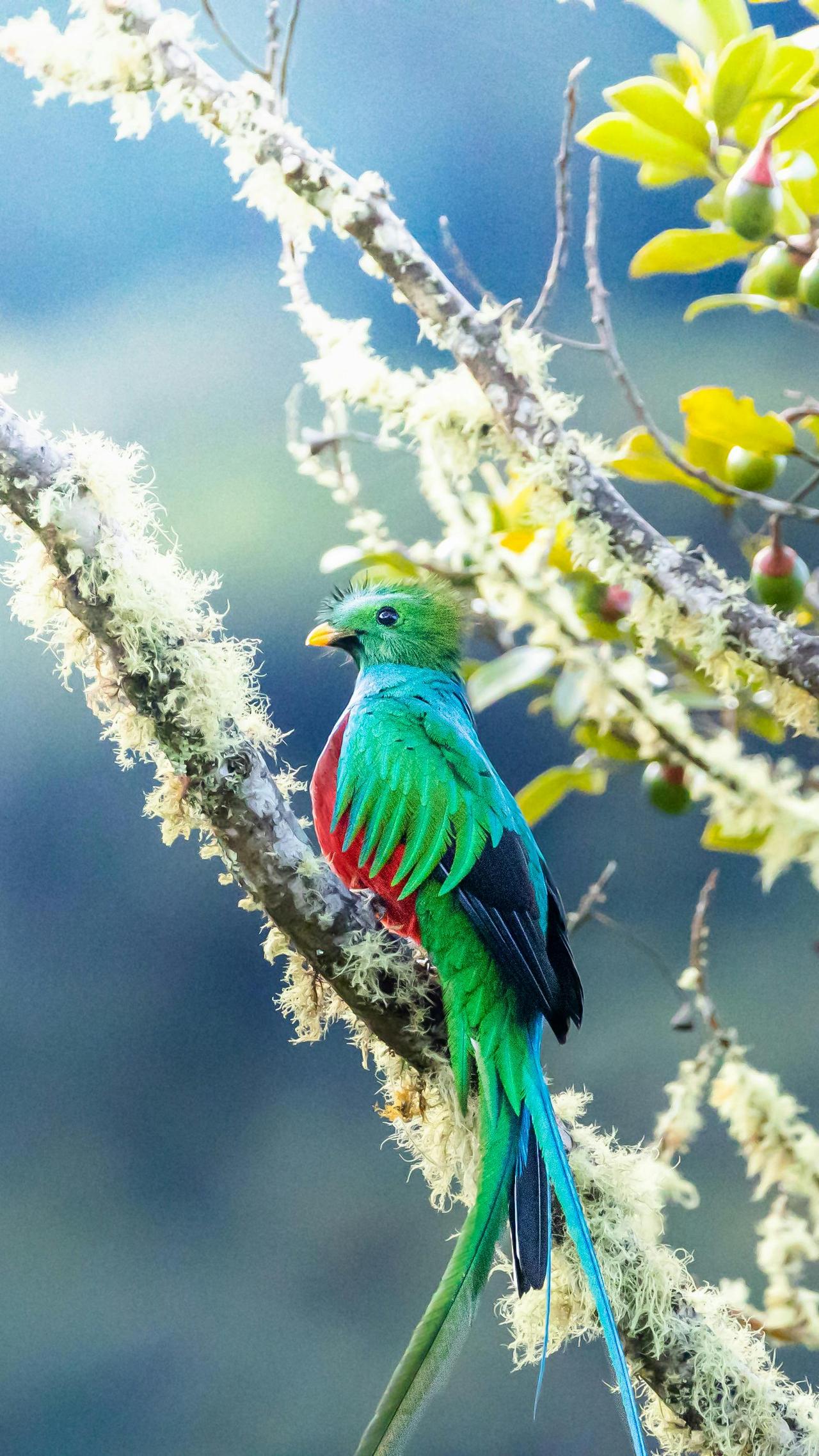
Pharomachrus Mocinno
The species was first described in 1832 by Mexican naturalist Pablo de la Llave based on specimens collected in Guatemala. The genus name Pharomachrus derives from ancient Greek words meaning mantle/covering and long, referring to the bird’s morphological features. Two subspecies are currently recognized: P. m. mocinno, which ranges from southern Mexico to northern Nicaragua, and P. m. costaricensis, found in Costa Rica and Panama. The subspecies P. m. costaricensis, described in 1869 by German ornithologist Jean-Louis Cabanis, differs from its northern relatives by a smaller body size and distinct plumage characteristics.
Phylogenetic and morphometric studies indicate that these two taxa diverged approximately three to six million years ago with the formation of the Nicaraguan Depression and may have evolved into two separate biological species due to genetic drift.
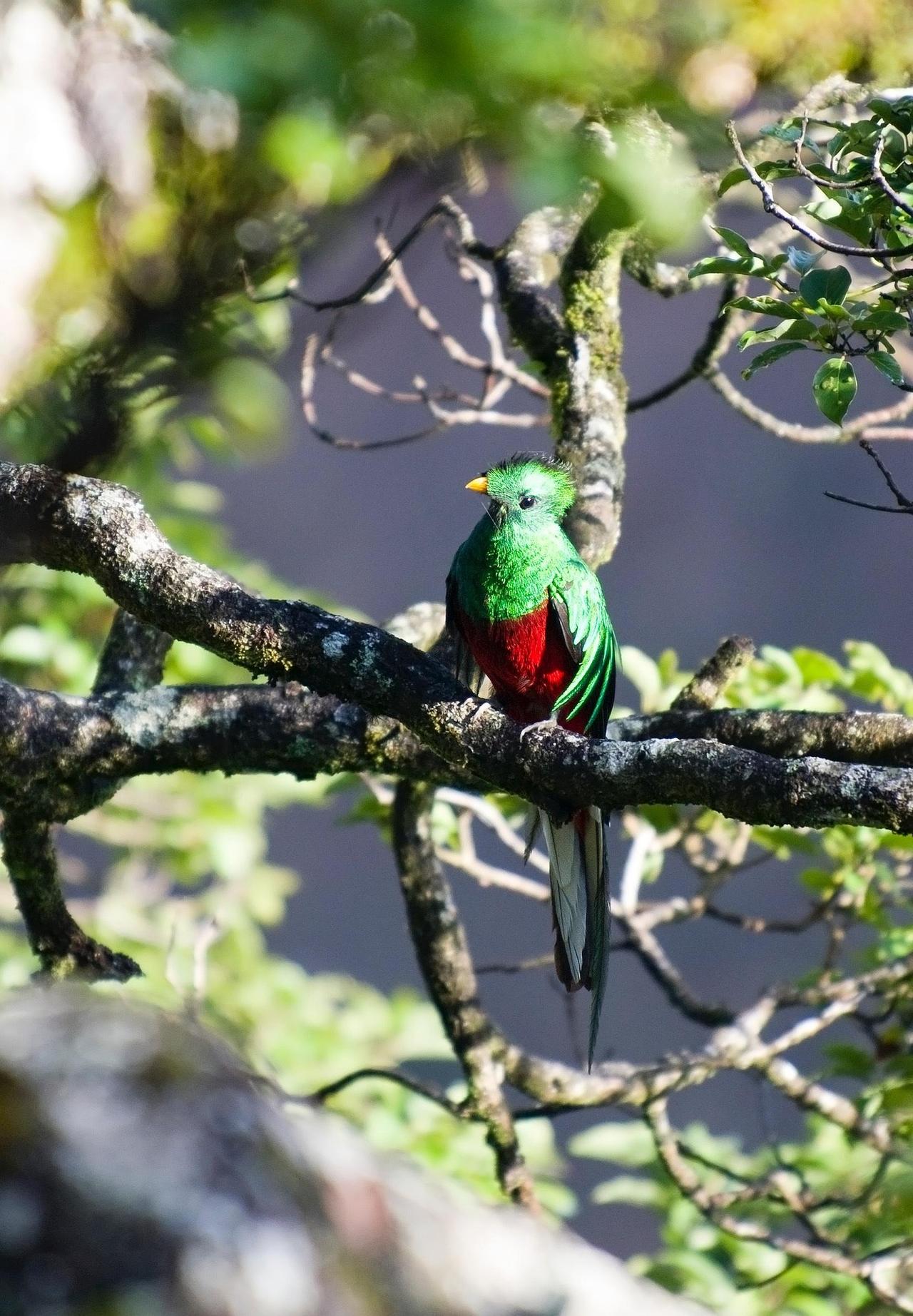
Pharomachrus mocinno is a representative of the Trogonidae family, with a body length from beak to tail base of approximately 35–41 cm. The most distinctive feature of males is their long, iridescent green tail covert feathers, which can reach up to 90 cm in length.【1】
The upper parts of the body, including the head, neck, and chest, exhibit metallic green or gold-green iridescence, while the underparts are bright red. In females, the head is dusky gray or bronze-toned, and the red underparts are duller than in males. The foot structure follows the heterodactyl arrangement characteristic of Trogoniformes: the first and second toes point backward, while the third and fourth point forward. This adaptation enables the bird to grip decaying tree trunks while excavating nest cavities. The bird’s skin is thin and fragile, causing its feathers to shed easily.
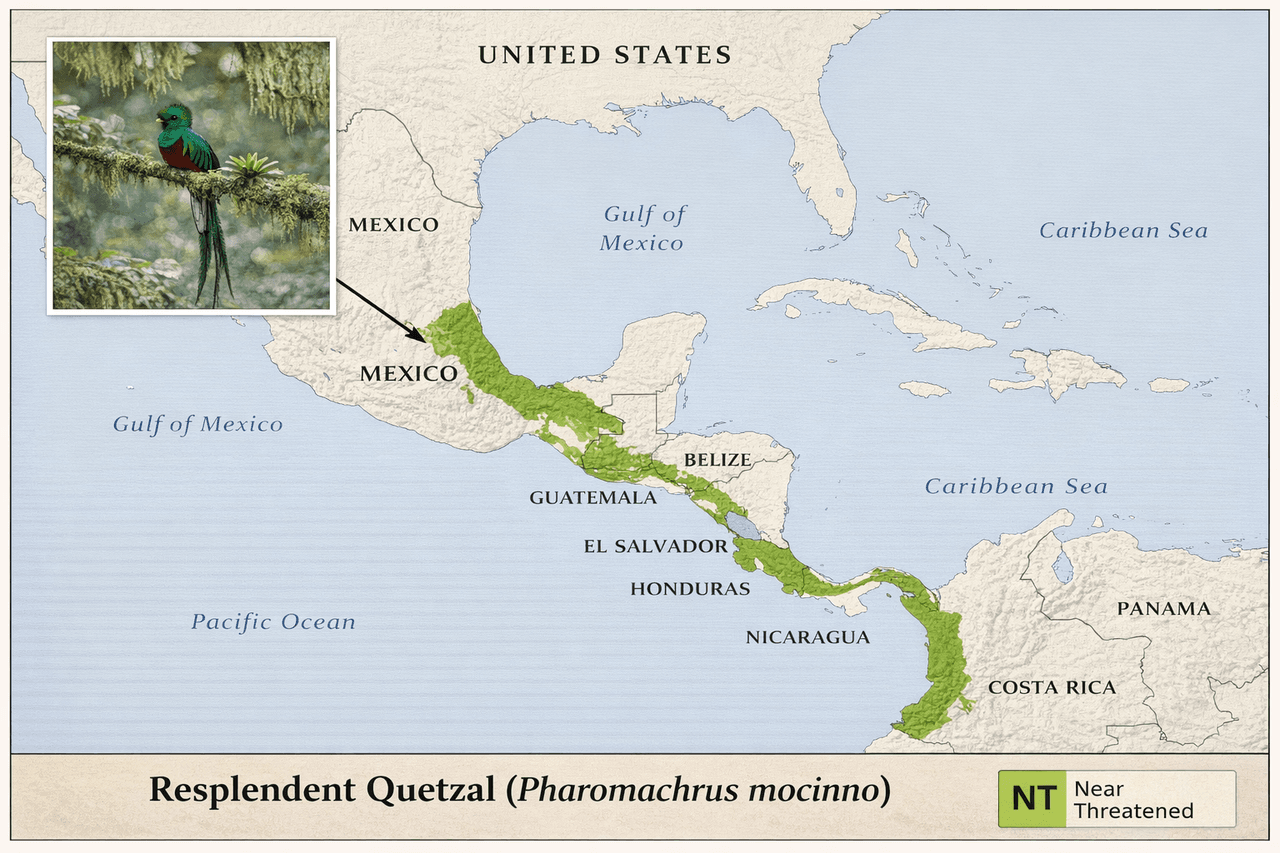
Geographic Distribution of the Resplendent Quetzal (Pharomachrus mocinno) in Central America
(Generated by Artificial Intelligence)
The species’ distribution is restricted to well-preserved cloud forests extending from southern Mexico to Panama, exhibiting an insular pattern. It typically inhabits cool, humid montane forests between 1,000 and 3,000 meters elevation. Active in the forest canopy throughout its life cycle, the species undertakes seasonal altitudinal migrations dependent on fruit availability. The high humidity of cloud forests is critical for maintaining the epiphytic vegetation and tree species that form the quetzal’s primary food sources.
Feeding Ecology and Chick-Rearing Strategies Adult quetzals primarily follow a frugivorous diet, feeding especially on fruits of the Lauraceae family. They employ a foraging strategy known as sallying, capturing fruit mid-air and returning to a perch to consume it. After ingesting the fruit seeds, they regurgitate them alive approximately 15–30 minutes later, contributing to forest regeneration. During the first six days of incubation, parents feed chicks insects, small lizards, and frogs to meet their high protein needs; after the sixth day, the diet rapidly shifts to predominantly fruit-based.
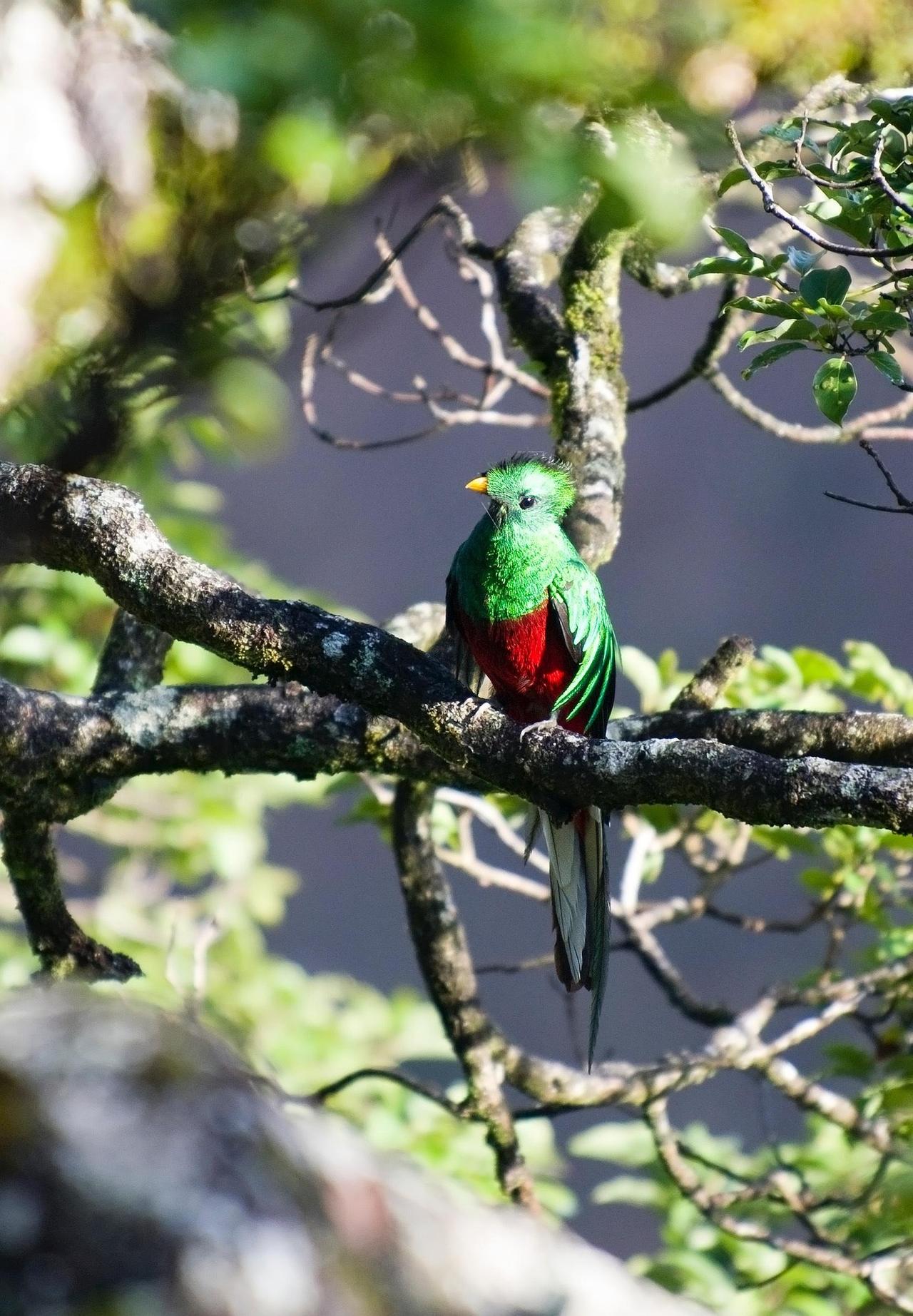
Resplendent Quetzal
The breeding season typically spans from March to June. Quetzals nest in old tree cavities, often originally excavated by woodpeckers, or in decaying tree trunks. Both parents share nest construction and incubation duties; females usually incubate at night and midday, while males take over early morning and late afternoon. The female typically lays two pale blue, spherical eggs directly on the bare nest floor. After an incubation period of 17–18 days, the hatchlings emerge blind and featherless, becoming capable of flight after approximately three weeks.
The species’ vocal communication is divided into four main call types based on behavioral context: territorial, alarm, contact, and courtship calls. Territorial calls, emitted by males at dawn and dusk, consist of repeated high-pitched two-note syllables optimized for long-distance communication. Alarm calls are produced by both sexes when disturbed, while contact and courtship calls are lower in amplitude and used for short-range, specific communication. Acoustic analyses have revealed that P. m. mocinno individuals produce territorial calls at higher frequencies than the smaller-bodied P. m. costaricensis, indicating an inverse relationship with body size.
Since the time of the Maya civilization, the Resplendent Quetzal has been regarded as a symbol of freedom, associated in Maya mythology with the feathered serpent deity Q'uq'umatz due to the sacredness of its feathers. In ancient times, quetzal feathers were considered more valuable than gold and were reserved exclusively for nobility and priests. Today, the bird appears on Guatemala’s national flag and has lent its name to the country’s currency. Local beliefs that the bird cannot survive in captivity have cemented its status as one of the most powerful symbols of liberty.
The primary threat to the species is the fragmentation and destruction of cloud forests due to agricultural expansion and harvesting of firewood. Habitat loss disrupts the quetzal’s seasonal migration routes and makes suitable nesting cavities increasingly scarce. Climate change-induced upward movement of the cloud base risks compressing the species’ habitat into a narrower elevational range. Conservation efforts focus on expanding protected areas and preserving ecological connectivity between forest fragments to maintain genetic flow. Autonomous acoustic monitoring systems are being developed as a non-invasive method to track population dynamics.
Bolaños-Sittler, Pablo, Jérôme Sueur, Jérôme Fuchs, and Thierry Aubin. "Nadir ve Öncü Tür Pharomachrus mocinno'nun (Aves: Trogonidae) Seslendirilmesi: Taksonomisi, Evrimi ve Korunması İçin Çıkarımlar." Bioacoustics 29, no. 6 (2020): 654–669. Accessed March 12, 2026. https://doi.org/10.1080/09524622.2019.1647877
Carleton, Scott Alan, and Kimberly G. Smith. "Adult Nest Attendance and Diet of Nestling Resplendent Quetzals (*Pharomachrus mocinno*) in the Talamanca Mountains of Southern Costa Rica." *Ornitología Neotropical* 27 (2016): 257-263. Accessed March 12, 2026. https://doi.org/10.58843/ornneo.v27i0.116
Hoffmann, Domenic. "Quetzal Kuş Yabani Kuş." Pixabay. Accessed March 12, 2026. https://pixabay.com/tr/photos/quetzal-ku%c5%9f-yabani-ku%c5%9f-2139297/
Maw, David. "Quetzal Kuş Doğa Renkli." Pixabay. Accessed March 12, 2026. https://pixabay.com/tr/photos/quetzal-ku%c5%9f-do%c4%9fa-renkli-9850080/
Montanaro, Jean Paul. "A Colorful Bird Perched on Tree Branch." Pexels. Accessed March 12, 2026. https://www.pexels.com/photo/a-colorful-bird-perched-on-tree-branch-14406490/
Pena, E. "Pharomachrus mocinno." Animal Diversity Web, 2001. Accessed March 12, 2026. https://animaldiversity.org/accounts/Pharomachrus_mocinno/
[1]
E. Pena, "Pharomachrus mocinno," Animal Diversity Web, 2001, accessed 12 March 2026, https://animaldiversity.org/accounts/Pharomachrus_mocinno/

No Discussion Added Yet
Start discussion for "Magnificent Quetzal (Pharomachrus mocinno)" article
Taxonomic Classification and Evolutionary Analysis
Morphological Structure and Physical Adaptations
Habitat Requirements and Geographic Distribution
Reproductive Biology and Parental Care
Vocal Repertoire and Communication Systems
Cultural Heritage and Symbolic Significance
Threats and Conservation Strategies