


This article was automatically translated from the original Turkish version.
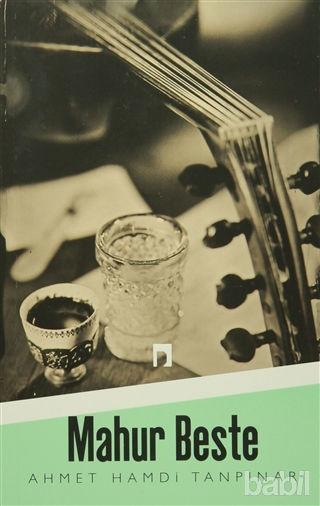
Author(s) | Ahmet Hamdi Tanpınar | ||||||||
|---|---|---|---|---|---|---|---|---|---|
Period(s) | Republic | ||||||||
Publication Date | 1944 | ||||||||
Type(s) | Novel | ||||||||
Mahur Beste, is a novel by Ahmet Hamdi Tanpınar, one of the leading figures in Turkish literature, that profoundly examines the inner world of the individual and their relationship with society. The work is regarded as a reflection of Tanpınar’s literary vision and aesthetic concerns. Although the exact date of composition is unknown, it is generally believed to have been written in the 1940s due to its thematic similarities with his other works. The novel was published posthumously in 1975 by Dergâh Yayınları.
Mahur Beste is set in the final years of the Ottoman Empire and explores the inner conflicts of individuals, their relationships with society, and shifting value systems. The novel foregrounds the crises and identity searches of people caught between tradition and modernity. The protagonist struggles to find his sense of self and place within this duality.
Tanpınar deeply investigates the individual’s inner world and their relationship with society in Mahur Beste. The novel is shaped by Bergson’s concept of “subjective time” and Freud’s theory of the unconscious. Behçet Bey’s life is presented as an integrated whole, interwoven with the lives of those around him. This approach illustrates how personal experiences are shaped within a social context.
The narrator observes events from a third-person singular perspective. This narrative style supports the author’s effort to reflect the social, psychological, and philosophical dimensions of society. The title Mahur Beste refers to a melody composed by a relative of Behçet Bey for his abandoned wife; however, this motif is not directly connected to the novel’s central theme.
Tanpınar employs a lyrical and poetic language in the novel to explore the inner lives of his characters. Symbolism and metaphor are central to the narrative. The descriptions aim to draw the reader into the characters’ psychological states and the atmosphere of the era.
In Mahur Beste, Tanpınar addresses the influence of the Ottoman ulema class on the state and society. The words of Ata Molla Bey underscore this class’s former power and dominance over social life. The novel reflects the pains of Ottoman society during its modernization process and the efforts of individuals to adapt to these changes.
Mahur Beste is a significant work in which Tanpınar explores the relationship between the individual and society, the subjective experience of time, and the conflicts of modernization. The novel is regarded as one of the earliest examples in Turkish literature to treat the inner world of the individual with philosophical and psychological depth. It laid the groundwork for Tanpınar’s subsequent novels and pioneered new narrative techniques in the Turkish novel.
Aykanat, Duygu. “Ahmet Hamdi Tanpınar’ın Mahur Beste Romanında Zaman ve Mekân Algısı.” Akademik Sosyal Araştırmalar Dergisi 6, no. 84 (2021): 476–487. .
Büyükkurt, Merve. “Tanpınar’ın Mahur Beste’sinde Toplumsal Değişim ve Modernleşmenin Birey Üzerindeki Etkisi.” Uluslararası Sosyal Araştırmalar Dergisi 13, no. 71 (2020): 1084–1090. https://dergipark.org.tr/en/download/article-file/1934950.
Fikriyat. "Ahmet Hamdi Tanpınar’ın Mahur Beste Romanı Hakkında 10 Bilgi." Accessed May 6, 2025. https://www.fikriyat.com/galeri/edebiyat/ahmet-hamdi-tanpinarin-mahur-beste-romani-hakkinda-10-bilgi/2.
Gürsoy, Ülkü. “Ahmet Hamdi Tanpınar’s Mahur Beste Novel: An Evaluation.” Çukurova Üniversitesi Türkoloji Araştırmaları Dergisi 17 (2005): 113–123. https://turkoloji.cu.edu.tr/YENI%20TURK%20EDEBIYATI/ulku_gursoy_mahur_beste_degerlendirme.pdf.
Tanpınar, Ahmet Hamdi. Mahur Beste. İstanbul: Dergâh Yayınları, 1975.
Türe, Gözde. “Mahur Beste’de Musiki Estetiği ve Bireyin Ruhsal Yansımaları.” Uluslararası Türkçe Edebiyat Kültür Eğitim Dergisi 10, no. 3 (2021): 1563–1580. https://dergipark.org.tr/en/download/article-file/3488199.

Author(s) | Ahmet Hamdi Tanpınar | ||||||||
|---|---|---|---|---|---|---|---|---|---|
Period(s) | Republic | ||||||||
Publication Date | 1944 | ||||||||
Type(s) | Novel | ||||||||
Summary of the Plot
Themes and Narrative Techniques
Narrative and Style
Historical and Social Context