

This article was automatically translated from the original Turkish version.
Origin | Hinduism and Indian marriage traditions | ||||||||
|---|---|---|---|---|---|---|---|---|---|
Basic Component | A chain made of gold and black beads | ||||||||
Structural Representation | The sacred union between Shiva (husband) and Shakti (wife) | ||||||||
Protective Function | Shiva Principle, Shakti Principle | ||||||||
Ideal Length | Must descend to the anahata-chakra (heart chakra) | ||||||||
Regional Names/Varieties | Maharashtrians, Kasithaali, Dhaaremani, Thaali, Dejhur | ||||||||
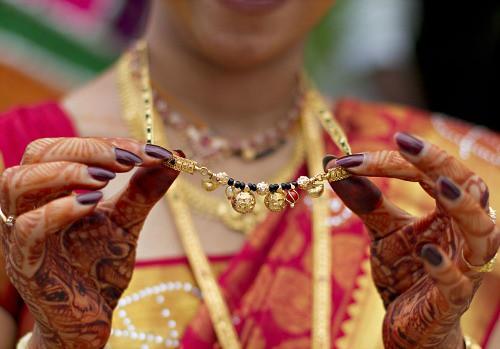
Mangalsutra is a traditional ornament symbolizing the marital status of a woman in Hinduism. In Hindu Dharma, it is regarded as the soubhagyalankar (ornament of marital status) and its placement around the bride’s neck by the groom during the wedding ceremony is obligatory. 【1】 The mangalsutra holds an equivalent significance to the wedding ring in Western wedding traditions, representing the bond of marriage. Although designs and forms vary, gold is a common element in all types of mangalsutra. The design is typically chosen in accordance with the groom’s family cultural traditions. 【2】
The fundamental structure of the mangalsutra consists of a chain made of gold and black beads. The two rows of black beads represent the Shiva Principle and the Shakti Principle respectively. These two rows of beads also symbolize the concept of duality (dvait) and the coherence of action. It is specified that the ideal length of the ornament should reach the wearer’s Anahata chakra; this length supports the awakening of the chakra and facilitates the dissolution of the woman’s Raja dominant activity, in the form of action energy (kriya-shakti), into her own Sattva component. The gold components of the mangalsutra help alleviate distress caused by negative energies through their ability to attract and radiate the Tej Principle. The use of black beads serves the function of attracting Raja-Tama dominant waves in the environment and dispersing these harmful energies through the Tej Principle waves emitted by the gold. 【3】

Mangalsutra Wedding Chain (Generated by Artificial Intelligence.)
The mangalsutra is regarded as a symbol of the union and wholeness between Shiva (husband) and Shakti (wife). Gold represents Shakti (feminine energy), while the chain connecting the black beads symbolizes Shiva (masculine energy). One of the primary purposes of this ornament is to guide the woman to act with the awareness that her husband embodies the divine essence of Shiva. The mangalsutra aims to foster continuous awareness of the woman’s duties, responsibilities, and moral codes (Dharma), encouraging her to adhere to the constraints of marriage and remain within ethical boundaries. 【4】
The ornament also reinforces societal recognition of a woman’s married status and the respect due to married women. The two small spherical caps (vati) found on the mangalsutra possess a unique shape that attracts a higher proportion of the Divine Principle and generates subtle absorption waves within their hollow interiors.

Regional and Community-Specific Variants of Mangalsutra (Generated by Artificial Intelligence.)
The mangalsutra appears in unique interpretations and designs across different regions of India. The mangalsutra worn by Maharashtrians includes gold and black beads along with two hollow hemispherical caps (vati) symbolizing the union of the bride’s and groom’s families. In Gujarati and Marwari communities, a diamond pendant adorns a double row of black seed beads interspersed with gold beads.
Konkanis and Goans use a gold chain called Kasithaali, adorned with coral and gold beads and featuring an idol of the goddess of prosperity Lakshmi; they also wear a Dhaaremani, consisting of large gold beads, and a disc-shaped mangalsutra. In Bihar, married women follow the tradition of wearing a necklace similar to the mangalsutra known as Taagpaag.【5】
Tamils wear a thick cord called thaali, which may feature religious designs specific to their community or engraved family crests and monograms. Telugu brides wear two distinct thaali: one is a simple gold chain with a half-moon pendant, and the other is a black bead chain.【6】
Christian communities in South India (particularly in Kerala and Karnataka) prefer a mangalsutra with a raised cross engraved on a pendant shaped like a banana leaf. Among Kashmiri Pandits, a piece called dejhur, made of gold and either hexagonal or unshaped, is given to the bride by her family one day before the wedding and worn as heavy earrings on the earlobe; the red thread on this piece is later replaced by a gold chain called aath.【7】
Hindu Janajagruti Samiti. "What Do the Two Strings of Black Beads in the Mangalsutra Represent?" Hinduism Knowledge Articles. Accessed November 26, 2025.
Times of India. "A guide to mangalsutras worn across the country." Times of India, March 18, 2016. Accessed November 26, 2025.
nparekhcards. "MANGALSUTRAS FROM DIFFERENT STATES OF INDIA – MANY FORMS, ONE UNIQUE MEANING." Flickr. Accessed November 26, 2025.
[1]
Times of India, “A guide to mangalsutras worn across the country,” Times of India, 18 Mart 2016, erişim 26 Kasım 2025, https://timesofindia.indiatimes.com/life-style/fashion/buzz/a-guide-to-mangalsutras-worn-across-the-country/articleshow/51452581.cms
[2]
Hindu Janajagruti Samiti, “What Do the Two Strings of Black Beads in the Mangalsutra Represent?” Hinduism Knowledge Articles, erişim: 26 Kasım 2025, https://www.hindujagruti.org/hinduism/knowledge/article/what-do-the-two-strings-of-black-beads-in-the-mangalsutra-represent.html
[3]
Hindu Janajagruti Samiti, “What Do the Two Strings of Black Beads in the Mangalsutra Represent?” Hinduism Knowledge Articles, erişim: 26 Kasım 2025, https://www.hindujagruti.org/hinduism/knowledge/article/what-do-the-two-strings-of-black-beads-in-the-mangalsutra-represent.html
[4]
Hindu Janajagruti Samiti, “What Do the Two Strings of Black Beads in the Mangalsutra Represent?” Hinduism Knowledge Articles, erişim: 26 Kasım 2025, https://www.hindujagruti.org/hinduism/knowledge/article/what-do-the-two-strings-of-black-beads-in-the-mangalsutra-represent.html
[5]
Times of India, “A guide to mangalsutras worn across the country,” Times of India, 18 Mart 2016, erişim 26 Kasım 2025, https://timesofindia.indiatimes.com/life-style/fashion/buzz/a-guide-to-mangalsutras-worn-across-the-country/articleshow/51452581.cms
[6]
Times of India, “A guide to mangalsutras worn across the country,” Times of India, 18 Mart 2016, erişim 26 Kasım 2025, https://timesofindia.indiatimes.com/life-style/fashion/buzz/a-guide-to-mangalsutras-worn-across-the-country/articleshow/51452581.cms
[7]
Times of India, “A guide to mangalsutras worn across the country,” Times of India, 18 Mart 2016, erişim 26 Kasım 2025, https://timesofindia.indiatimes.com/life-style/fashion/buzz/a-guide-to-mangalsutras-worn-across-the-country/articleshow/51452581.cms
Origin | Hinduism and Indian marriage traditions | ||||||||
|---|---|---|---|---|---|---|---|---|---|
Basic Component | A chain made of gold and black beads | ||||||||
Structural Representation | The sacred union between Shiva (husband) and Shakti (wife) | ||||||||
Protective Function | Shiva Principle, Shakti Principle | ||||||||
Ideal Length | Must descend to the anahata-chakra (heart chakra) | ||||||||
Regional Names/Varieties | Maharashtrians, Kasithaali, Dhaaremani, Thaali, Dejhur | ||||||||
Structural and Belief-Based Components of Mangalsutra
Divine and Spiritual Significance
Regional and Community-Specific Variants of Mangalsutra