This article was automatically translated from the original Turkish version.
+2 More
Location | Spil Mountain Manisa | ||||||||
|---|---|---|---|---|---|---|---|---|---|
Period(s) | Hellenistic Ottoman Saruhanids Byzantine | ||||||||
Structure(s) | Inner Castle (Sandıkkale) Outer Castle | ||||||||
Technique | Rubble stone with brick inclusions | ||||||||
Feature(s) | 13 towers cistern remains 7 gates | ||||||||
Manisa Castle is located on the northern slopes of Spil (Sipil) Mountain, south of the city center of Manisa, and consists of two main sections: the “Inner Castle” (Sandıkkale) and the “Outer Castle”. The castle’s design harmonizes with the region’s historical and topographical structure, both in terms of its natural setting and construction techniques.
Manisa Kalesi (Manisa Provincial Directorate of Culture and Tourism)
The exact date of the castle’s construction is unknown, but it is known that during the Hellenistic period an acropolis existed on Mount Sipylos and the city of Magnesia was enclosed by walls. It is believed that the castle may have suffered damage during the major earthquake of 17 AD. During the Byzantine period, the interior of the castle was significantly renovated and reinforced with outer walls. The castle walls were effectively used in defense against Arab raids.
Sources indicate that the Inner Castle was constructed in 1222 during the reign of Byzantine Emperor John III Doukas Vatatzes. In the early 14th century, the castle walls were strengthened; during the Saruhanids period, the structures were repaired and actively used. In this period, the Hacet Mosque within the Outer Castle was built by Saruhan Bey.
During the Ottoman period, the castle underwent various repairs. However, by the 15th century, extensive damage to the walls caused the castle to lose its former significance. Settlement expanded beyond the walls, and the city began to spread particularly around religious structures.
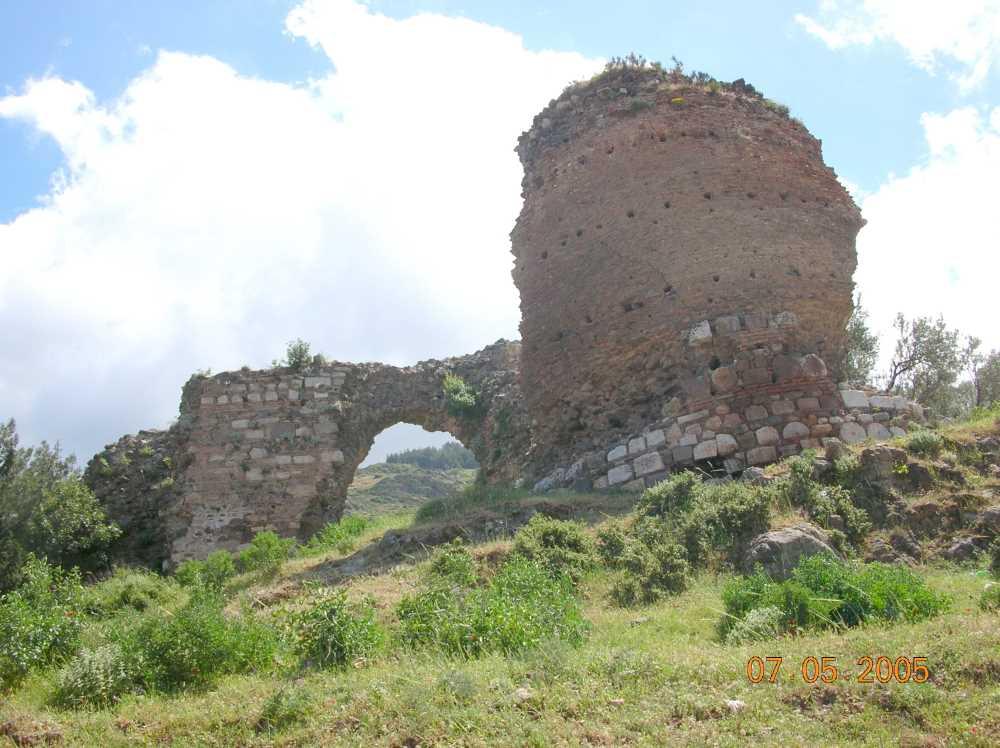
Manisa Castle was built using the characteristic Byzantine technique of brick-tied rubble stone masonry. The castle consists of two main sections: the Outer Castle and the Inner Castle. The Outer Castle walls, approximately 4.5 kilometers long, are supported by 13 towers and are believed to have originally had seven gates; only the remains of two of these gates have survived to the present day. The Inner Castle, known as Sandıkkale due to its pentagonal plan, is fortified by seven towers. Access to the Inner Castle was through a narrow gate on the southern side; historically, it contained residences, storehouses, cisterns, and a mosque, but only the remains of the cisterns have survived to the present.
Evliya Çelebi, during his visit to Manisa in 1671, provided detailed information about the castle. In his travelogue, he mentioned that the Inner Castle contained thirty houses, storehouses, two cisterns, and a mosque. Only the remains of the cisterns have survived to the present. Additionally, in the account of the Polish traveler Simeon, dated to the early 17th century, reference is made to an Armenian church on Spil Mountain. Kâtip Çelebi recorded in 1654 that the outer walls of the castle were in ruins.
Although the surviving remains of Manisa Castle are limited, certain structures such as the cisterns and fragments of the walls are still observable. The castle, through the various repairs and uses it underwent throughout its history, provides significant insights into the military, administrative, and social structure of the region.
"Manisa Kalesi | Şehzadeler’in Bekçisi." YouTube video, Manisa İl Kültür Turizm Müdürlüğü. Accessed June 21, 2025. https://www.youtube.com/watch?v=YW9zX_UIN3Y&t=15s.
Ministry of Culture and Tourism. "Manisa Kaleleri." *T.C. Manisa Valiliği İl Kültür veTurizm Müdürlüğü, Accessed June 21, 2025. https://manisa.ktb.gov.tr/TR-152006/kaleler.html.
Ministry of Culture and Tourism. "Manisa Kalesi." *Kültür Portalı*, Accessed June 21, 2025. https://www.kulturportali.gov.tr/turkiye/manisa/gezilecekyer/manisa-kalesi.

Location | Spil Mountain Manisa | ||||||||
|---|---|---|---|---|---|---|---|---|---|
Period(s) | Hellenistic Ottoman Saruhanids Byzantine | ||||||||
Structure(s) | Inner Castle (Sandıkkale) Outer Castle | ||||||||
Technique | Rubble stone with brick inclusions | ||||||||
Feature(s) | 13 towers cistern remains 7 gates | ||||||||
Historical Background
Architectural Features and Construction Techniques
The Castle in Travelogues
Current Condition