
This article was automatically translated from the original Turkish version.
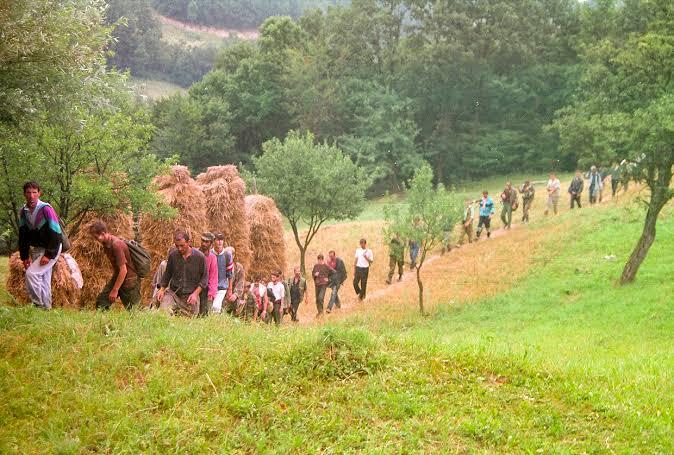
Marš Mira is a traditional commemorative event held annually between July 8 and 10 in memory of those who lost their lives in the Srebrenica Genocide in Bosnia and Herzegovina. The march follows the route used by Bosniaks fleeing the attack by Bosnian Serb forces toward the town of Tuzla, which had been declared a “safe area,” a path known as the “path of death.” Participants walk the route in reverse, arriving three days later in Potočari, where mass coffin processions took place. The march begins in the village of Nezuk and ends at the Potočari Memorial Cemetery. During the three-day event, participants cover an average of 35 kilometers per day.

A Scene from the Marš Mira March (Anadolu Agency)
The march gives monumental form to a “critical gaze” embodied by mothers and wives searching for their lost men, expressed as a return to “our empty forests.” Marš Mira monumentalizes and recalls a question that still awaits an answer for many, as the route passes through riverbeds and fields where bodies may still be buried. This march can be understood as a manifestation of the “forensic landscape”—a space carrying the question of the disappeared. One of its most distinctive features is the temporary markers placed along the route. Unlike permanent unofficial monuments erected by local communities, these markers are installed only for the duration of the march.
Footage of the Marš Mira March (Anadolu Agency)
The Marš Mira route traverses a vast region containing mass graves linked to the genocide. This landscape includes former primary, secondary, and tertiary mass grave sites, as well as areas where new discoveries may still be made. Although a few unofficial monuments have been erected by locals along the route, the majority of markers are temporary and stand only during the duration of the Peace March. These black signs are equipped with arrows indicating the direction of nearby mass grave sites. As participants approach Srebrenica, they notice an increasing number and density of these sites. The markers also draw attention to the specific types of terrain chosen for mass burials—such as private land, riverbeds, cemeteries, and dense forested areas. The signs feature black-and-white photographs by Tarik Samarah depicting excavation sites. The text on the signs includes detailed information such as the classification of the grave (e.g., secondary grave), the date of excavation, and the number of bodies recovered. These markers invite participants to witness the destruction and concealment campaign carried out by the VRS and the efforts of forensic investigators to locate human remains secretly scattered across the Drina Valley. The march aims to enable participants to experience the landscape as an open and contested terrain and to monumentalize the experience of searching for lost men within the landscape. Although the march concludes narratively upon reaching Potočari, it emphasizes that the forensic landscape remains a “condition of the present” until all the missing are found and buried.

Visual Representation of Marš Mira March Stops (TRT News)
Following the breakup of Yugoslavia, Bosnia and Herzegovina declared its independence in 1992, triggering a war that lasted four years. During the conflict, Serb forces carried out actions known as “ethnic cleansing,” particularly in eastern Bosnia. In April 1993, the United Nations (UN) declared Srebrenica a “safe area,” and its population swelled to 60,000 as thousands of civilians sought refuge there. Dutch UN peacekeeping forces deployed to defend the area demanded that Bosniaks surrender their weapons, while no similar measures were imposed on the Serbs.
In July 1995, forces under the command of Bosnian Serb Army leader Ratko Mladić intensified their assault on Srebrenica. Despite Dutch UN forces requesting NATO air support, the response was delayed and inadequate due to opposition from French General Bernard Janvier. On July 11, 1995, Srebrenica fell to Mladić’s troops. Approximately 25,000 civilians fleeing the city took shelter in the UN compound in the village of Potočari. However, the Dutch forces handed over the refugees to Serb forces. As a result, more than 8,000 young and adult men were killed between July 11 and 17, 1995. In 2007, the International Court of Justice formally recognized these events as genocide.

Forces Under the Command of Ratko Mladić Entering Srebrenica (Anadolu Agency)
The massacres in Srebrenica gained international attention through the investigations of American journalist David Rohde. In the aftermath, international organizations and governments faced criticism for their roles in the events. The Dutch government, initially denying responsibility, formally accepted full accountability following a 2003 parliamentary inquiry report and subsequently resigned. The United Nations, in a 1999 report, admitted it had failed to protect the people of Srebrenica from the Serb perpetrators.
The International Criminal Tribunal for the former Yugoslavia (ICTY) was the first to classify the Srebrenica massacre as genocide in 2001 and sentenced General Radislav Krstić to 35 years in prison for his role in the crime. The principal architect of the massacre, Ratko Mladić, was arrested on May 26, 2011, and transferred to the International Criminal Tribunal in The Hague. In 2017, he was sentenced to life imprisonment for genocide and crimes against humanity.

A Photograph of Mladić and Karremans Raising Glasses Together (Anadolu Agency)
Anadolu Ajansı. “MARS Mira: Barış İçin Yürünen Ölüm Yolu.” AA, March 10, 2020. https://www.aa.com.tr/tr/ayrimcilikhatti/ayrimcilik/mars-mira-baris-icin-yurunen-olum-yolu/1820821.
Anadolu Ajansı. “Ölüm Yolunda ‘Barış Yürüyüşü’ Başladı.” YouTube, August 16, 2025. https://youtu.be/jdHT65yXwSU.
Cyr, Rachel E. 2014. “The ‘Forensic Landscapes’ of Srebrenica.” Culture/Culture (5): 81–92. Accessed August 16, 2025. https://citeseerx.ist.psu.edu/document?doi=92594a11461371b1813b1593460ce66399913af3
Marš Mira Türkiye. "Tarihçe." Marš Mira Türkiye. https://marsmiraturkiye.org/tarihce.
Özkan, Yusuf. “Ratko Mladić: Eski Bosnalı Sırp generale verilen ömür boyu hapis cezası onandı.” BBC News Türkçe, June 8, 2021. https://www.bbc.com/turkce/haberler-dunya-57404778.

No Discussion Added Yet
Start discussion for "March Mira (Peace March)" article
Memorial Function and Characteristics of the March
Route and Stops of the March
Historical Background
Legal Proceedings and Outcomes