This article was automatically translated from the original Turkish version.
Original Name(s) | Marty Supreme | ||||||||
|---|---|---|---|---|---|---|---|---|---|
Turkish Name | Magnificent Marty | ||||||||
Year of Production | 2025 | ||||||||
Type(s) | Period film Sports Drama | ||||||||
Screenplay(s) | Ronald Bronstein Josh Safdie | ||||||||
Producer(s) | Timothée Chalamet Anthony Katagas Josh Safdie Ronald Bronstein Eli Bush | ||||||||
Distributor | A24 | ||||||||
Lead Actors | Kevin O’Leary (Milton Rockwell) Odessa A’zion (Rachel Mizler) Gwyneth Paltrow (Kay Stone) Timothée Chalamet (Marty Mauser) | ||||||||
Duration | 149 minutes | ||||||||
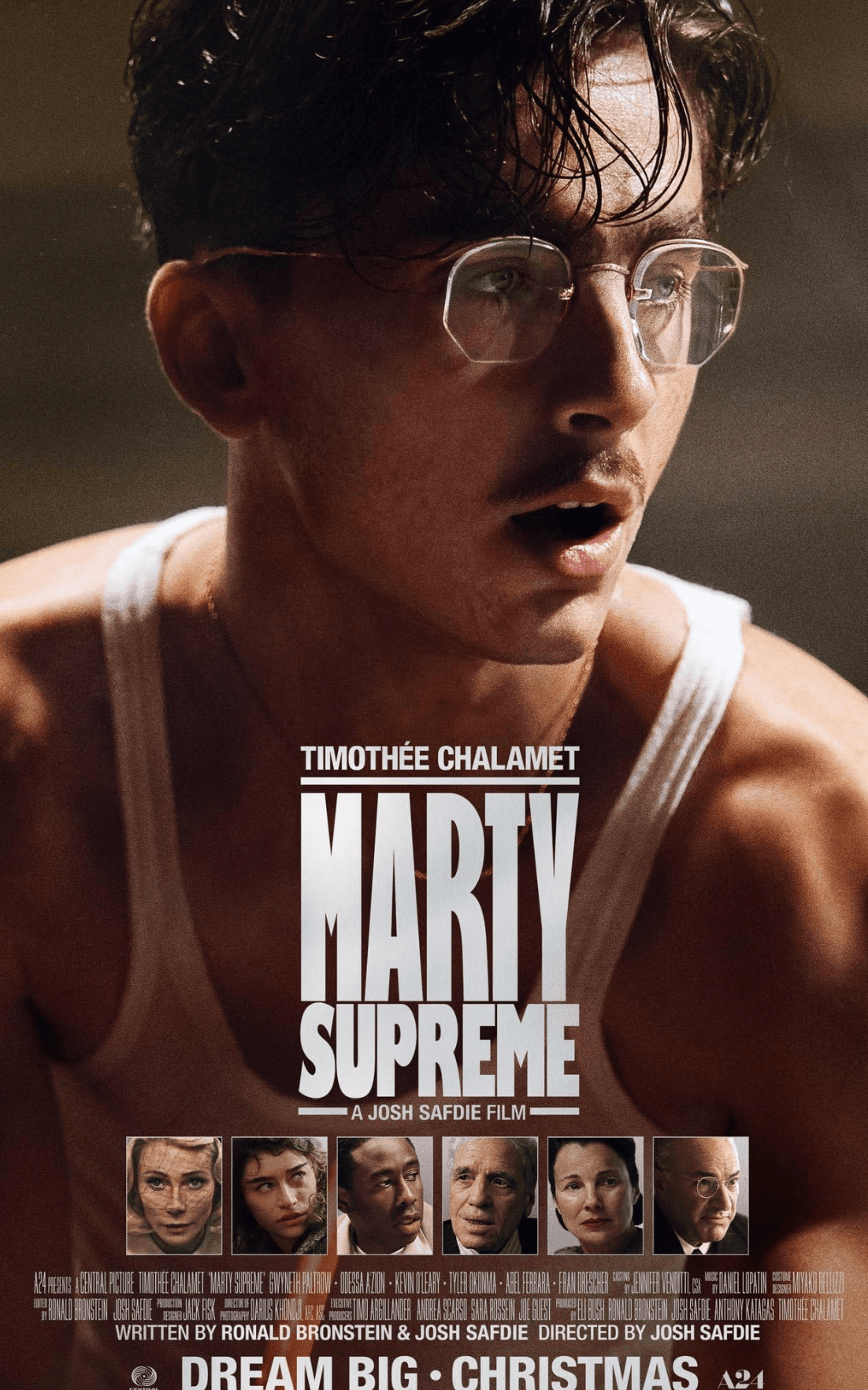
Set against the backdrop of the 1950s, Marty Supreme is a feature-length film that weaves together the era’s narrative through the lenses of sport, social structure, and individual ambition. The film constructs a New York-centered story, exploring the protagonist’s journey from a life constrained by limited means to the arena of international competition. Rather than adhering to the classic sports film narrative of progress and triumph, it deliberately forges a structure centered on the protagonist’s personal motivations and his troubled relationships with those around him. While the narrative makes detailed use of its historical context, it does not bind the story to a linear developmental arc.
Marty Supreme Official Trailer (A24)
Marty Supreme is directed by Josh Safdie and written by Josh Safdie and Ronald Bronstein. The production team includes names from A24 alongside the film’s lead actor. The production is based in the United States, with filming taking place in New York and its surrounding areas. With a runtime of approximately 150 minutes, the film favors a broad temporal scope.
The film unfolds within a time frame centered on 1952. The narrative’s primary settings are working-class neighborhoods of New York, small family-run shops, and indoor sports halls. The period’s decor, costume choices, and daily life practices are meticulously constructed to evoke authenticity. In this production, spaces are not merely background elements but serve as structural forces that define and constrain the protagonist’s social position and mobility. As the narrative progresses, settings change; however, these shifts are not presented as part of an upward trajectory.
At the heart of the film is Marty Mauser, a character who earns his living in a shoe store and seeks to prove himself in the world of table tennis. The story examines the consequences of the steps he takes toward this goal. Rather than focusing on the protagonist’s athletic ability, the narrative advances through the meaning he attaches to that ability. The film does not treat sporting competitions as milestones of success; instead, it uses these scenes to deepen the protagonist’s psychological and social conflicts. The plot follows a fragmented, irregular structure, eschewing traditional dramatic turning points.
The character of Marty Mauser is portrayed as contradictory and inconsistent. The dissonance between his self-confidence and the lack of recognition he receives from his social environment forms one of the narrative’s central tensions. The film avoids idealizing the protagonist; it presents his actions and choices alongside their outcomes. Supporting characters function as figures positioned around Marty, responding to his behavior in varied ways. These characters are presented within a structure that supports the main narrative without becoming central to it.
The lead role is played by Timothée Chalamet. The actor shapes Marty Mauser through physical appearance, body language, and speech patterns. The cast also includes Gwyneth Paltrow, Odessa A’zion, and Kevin O’Leary. The casting combines professional actors with individuals known from other fields, creating a hybrid structure. This approach deliberately challenges the audience’s perception of realism.
The film makes intensive use of handheld camera work and close-ups. The cinematography is designed to reflect the protagonist’s restless, perpetually on-edge psychological state. In most scenes, the camera does not act as a detached observer but as an element that moves in tandem with the character. Lighting is arranged to heighten a sense of confinement and pressure within enclosed and narrow spaces. This visual approach is one of the key elements shaping the film’s pacing.
A dense, layered sound structure is employed. Dialogue, ambient noise, and music are often deliberately layered on top of one another. This choice creates an effect that prevents the viewer from maintaining a comfortable distance from the narrative. The music selections in the film do not strictly correspond to the period in which the story is set. This deliberate anachronism functions as a narrative strategy to destabilize the sense of time.
Marty Supreme incorporates elements of the sports film, period film, and character-driven drama. Yet it does not fully align itself with any one of these genres. Although the theme of sport occupies a central place in the narrative, it does not establish a trajectory of achievement or competition. The period film features are not used to reconstruct history but to reflect the social atmosphere. Rather than fulfilling genre expectations, the film constructs a structure that suspends them.
The film premiered in theaters across the United States at the end of 2025. International screenings took place on varying dates. Information regarding its distribution on digital platforms has been limited. Throughout its exhibition period, the film has drawn critical evaluations and audience responses, with most commentary focusing on its narrative structure and character choices.
IMDb. "Muhteşem Marty (Marty Supreme)." Accessed January 12, 2026. https://www.imdb.com/title/tt32916440/?ref_=mv_close
Rotten Tomatoes. "Marty Supreme." Accessed January 12, 2026. https://www.rottentomatoes.com/m/marty_supreme
The Arts Fuse. “Film Review: ‘Marty Supreme’ — A Thrilling, Empty Trip Through Ego and Excess.” The Arts Fuse, Accessed January 12, 2026. https://artsfuse.org/322148/film-review-marty-supreme-a-thrilling-empty-trip-through-ego-and-excess/
The Guardian. "What’s to like? Why you can hate Timothée Chalamet’s character and still love Marty Supreme." Accessed January 12, 2026. https://www.theguardian.com/film/2026/jan/07/marty-supreme-timothee-chalamet-likability
The Guardian. “Marty Supreme review – Timothée Chalamet a smash in spectacular screwball ping-pong nightmare.” The Guardian, Accessed January 12, 2026. https://www.theguardian.com/film/2025/dec/01/marty-supreme-review-timothee-chalamet-ping-pong-table-tennis
YouTube. "Marty Supreme Official Trailer." A24, Accessed January 12, 2026. https://www.youtube.com/watch?v=s9gSuKaKcqM

Original Name(s) | Marty Supreme | ||||||||
|---|---|---|---|---|---|---|---|---|---|
Turkish Name | Magnificent Marty | ||||||||
Year of Production | 2025 | ||||||||
Type(s) | Period film Sports Drama | ||||||||
Screenplay(s) | Ronald Bronstein Josh Safdie | ||||||||
Producer(s) | Timothée Chalamet Anthony Katagas Josh Safdie Ronald Bronstein Eli Bush | ||||||||
Distributor | A24 | ||||||||
Lead Actors | Kevin O’Leary (Milton Rockwell) Odessa A’zion (Rachel Mizler) Gwyneth Paltrow (Kay Stone) Timothée Chalamet (Marty Mauser) | ||||||||
Duration | 149 minutes | ||||||||
No Discussion Added Yet
Start discussion for "Marty Supreme (Film)" article
Overall Framework
Use of Period and Setting
Narrative Structure and Storytelling Style
Character Construction
Casting and Performance Structure
Visual Language and Camera Usage
Sound Design and Music Usage
Genre Positioning
Release and Exhibition Information