


This article was automatically translated from the original Turkish version.
+2 More
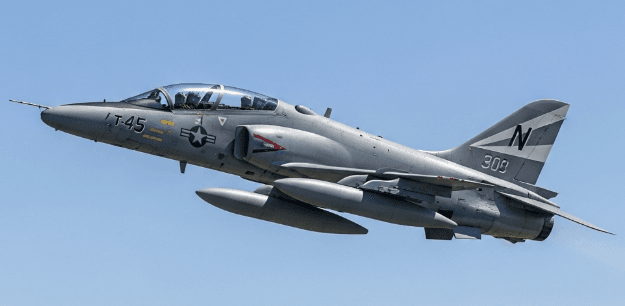
T-45 Goshawk
Producer(s) | McDonnell Douglas (USA) | ||||||||
|---|---|---|---|---|---|---|---|---|---|
First Flight(s) | 29 August 1970 (based on the original DC-10 model) | ||||||||
Entry into Service | 2006 (converted for special missions) | ||||||||
Aircraft Type(s) | Single-engine wide-body multi-purpose aircraft | ||||||||
Models | 10 Tanker (specialized modified mission version) DC-10-30-based T-45 GOSHAWK DC-10-10-based T-45 GOSHAWK | ||||||||
T-45 Goshawk is a single-engine, two-seat jet trainer aircraft developed for the United States Navy and Marine Corps pilot training programs. It was designed through a partnership between British BAE Systems (formerly British Aerospace) and American McDonnell Douglas (later Boeing). The aircraft is a navalized variant of the Hawker Siddeley Hawk Mk.60 trainer. The T-45 is equipped for carrier-based takeoffs and landings and is used in jet fighter pilot training.

T-45 Goshawk (Pixabay)
The purpose of developing the T-45 Goshawk was to replace the United States Navy’s existing T-2C Buckeye and TA-4J Skyhawk training aircraft with a more modern jet training platform. In the early 1980s, the Navy launched the VTAM (V/STOL Training Aircraft Master) program, which evolved into the T-45 Goshawk program.
The aircraft’s first flight occurred on 16 April 1988. It entered service in 1991 and began being used in pilot training programs. Its design includes reinforced landing gear and an arrestor hook to enable operations from aircraft carrier decks (CATOBAR).
The T-45 Goshawk features a two-seat tandem cockpit arrangement, with the instructor and student pilot seated one behind the other. Both cockpits are equipped with avionics systems. The suitability of the T-45 Goshawk cockpit for training purposes is evident in distributed imagery. The aircraft is powered by a single turbofan engine and provides stable subsonic flight performance. Its wing structure is designed to ensure control at low speeds.
T-45C Goshawk ( TheThirdWire)
The T-45 Goshawk is specifically designed for training naval aviators. Its prominent features include:
BAE Systems. "T-45 Goshawk." Accessed May 25, 2025. https://www.baesystems.com/en/product/t-45-goshawk.
Military Factory. "McDonnell Douglas (Boeing) T-45 Goshawk." Accessed May 25, 2025. https://www.militaryfactory.com/aircraft/detail.php?aircraft_id=174#google_vignette.
Naval Technology. "T-45 Goshawk Jet Trainer Aircraft, US." Accessed May 25, 2025. https://www.naval-technology.com/projects/t45-goshawk/.
Pixabay. "Plane, Jet, Aviator, Jet Fighter, Navy." Accessed May 25, 2025. https://pixabay.com/photos/plane-jet-aviator-jet-fighter-navy-67741/.
YouTube. "Navy T-45C Goshawk - "Orange on White" - 2020." Accessed May 25, 2025.

T-45 Goshawk
Producer(s) | McDonnell Douglas (USA) | ||||||||
|---|---|---|---|---|---|---|---|---|---|
First Flight(s) | 29 August 1970 (based on the original DC-10 model) | ||||||||
Entry into Service | 2006 (converted for special missions) | ||||||||
Aircraft Type(s) | Single-engine wide-body multi-purpose aircraft | ||||||||
Models | 10 Tanker (specialized modified mission version) DC-10-30-based T-45 GOSHAWK DC-10-10-based T-45 GOSHAWK | ||||||||
No Discussion Added Yet
Start discussion for "McDonnell Douglas T-45 Goshawk" article
Development Purpose and History
Design Features
Technical Specifications
Key Features and Operational Uses
T-45 Goshawk Naval Aviation Training Features