


This article was automatically translated from the original Turkish version.
Although a mirror appears to be an ordinary object in our daily lives, it carries profound symbolism, encompassing not only practical functions but also cultural, literary, and even spiritual meanings. The word "ayna," derived from the Persian ayne, meaning "indicator," has become part of our language and has served throughout human history as more than just a tool for self-reflection.
The earliest mirrors date back to around 6000 BCE and were made of polished volcanic stone and polished metals such as bronze and silver. The mercury-backed glass technique developed by Venetian artisans in the 19th century laid the foundation for modern mirrors. Today, mirrors produced with aluminum or silver coatings are used across a wide range of fields, from optics to energy technologies.
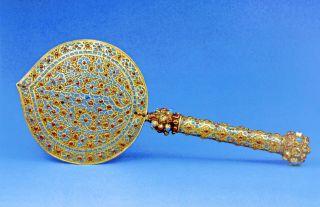
Gold-plated murassa Ottoman mirror from the 16th century (TSM, Inventory no. 1794)
In a hadith, it is stated, "A believer is the mirror of another believer," emphasizing social harmony and self-reflection. In Sufism, the mirror is frequently employed as a metaphor for reflecting truth.
A mirror is not merely a pane of glass that shows our face; it is the silent witness to civilization, science, and humanity’s enduring quest for self-understanding. Perhaps each time we look into it, it reminds us that we must seek more than what it shows us.
Sinemoğlu, Nermin. "Ayna." *Türkiye Diyanet Vakfı İslâm Ansiklopedisi*, Volume 4, pp. 259-260. İstanbul: TDV Yayınları, 1991. Accessed May 10, 2025. https://islamansiklopedisi.org.tr/ayna
Historical Journey: From Stone to Glass
Technological and Practical Functions
Mirror in Culture and Literature
Philosophical and Spiritual Dimension
Final Thoughts
