

This article was automatically translated from the original Turkish version.
+2 More
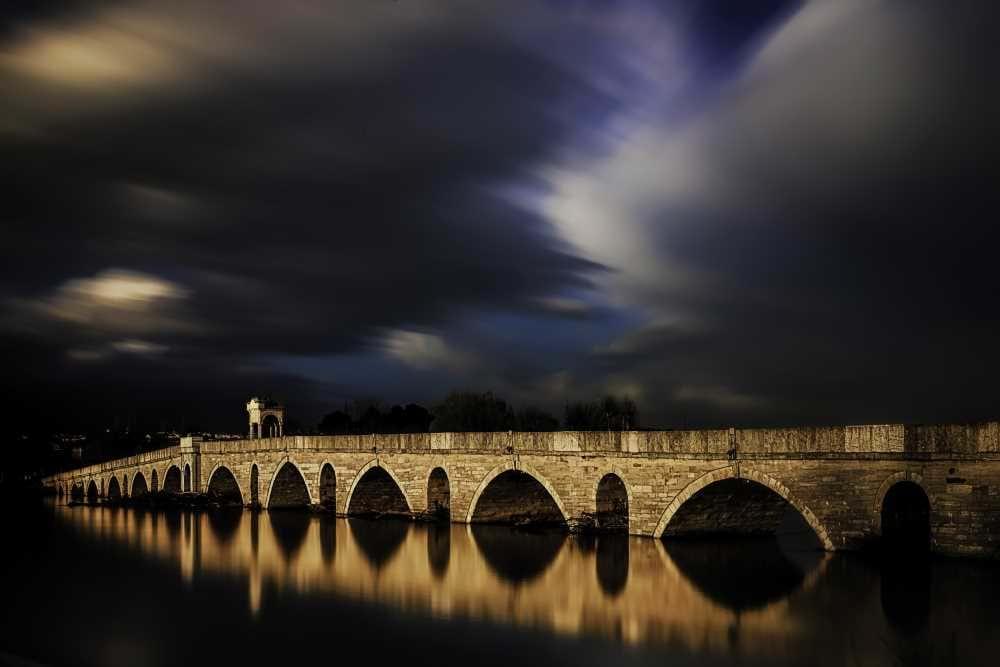
Mecidiye Köprüsü is a stone bridge located over the Meriç River in the central district of Edirne, constructed between 1842 and 1847 during the reign of Sultan Abdülmecid. It is known that a wooden bridge previously stood at this location. The structure, built with cut stone, has 12 arches, is approximately 261 meters long and 7 meters wide. It lies along the transportation route connecting the center of Edirne with Karaağaç and has been known by various names in different periods, including “Meriç,” “Mecidiye,” “Sultan Mecid,” “Yeni,” and “Dış Köprü.”
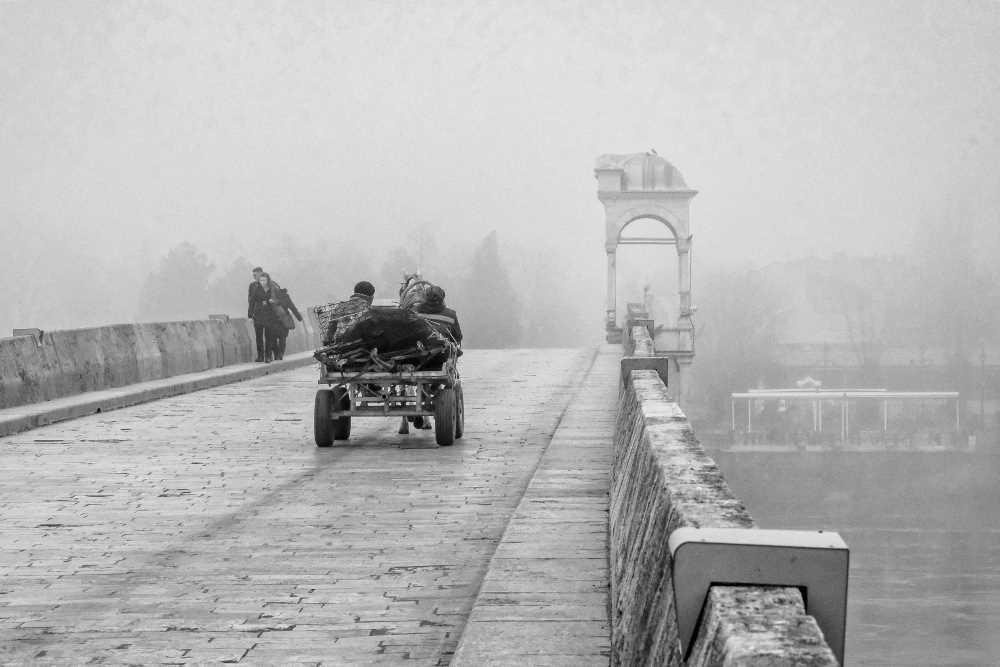
Mecidiye Köprüsü (Kültür Portalı)
It is known that a wooden bridge previously existed at the site of the Mecidiye Köprüsü over the Meriç River. This wooden bridge was destroyed during a flood in 1827. The need for a more durable structure led to a decision during the visit of Sultan II. Mahmud to Edirne in 1833 to construct a stone bridge. Construction began the same year but remained incomplete due to financial constraints and the death of Sultan II. Mahmud.【1】
The completion of the unfinished structure was undertaken during the reign of Sultan II. Mahmud’s son, Sultan Abdülmecid. The bridge was constructed between 1842 and 1847 and opened to traffic. The architect of the bridge is not definitively known. The first inscription related to the bridge dates to the time of Sultan II. Mahmud and is a repair inscription penned by Pertev Paşa. The second inscription belongs to the reconstruction period under Sultan Abdülmecid and was written in talik script by the poet Ziver Bey. It is noted that this inscription was removed during the occupation of Edirne. Today, an inscription on the bridge, faithfully reproduced in 1966 by Hattat Mustafa Uğur, remains.【2】
Mecidiye Köprüsü is a stone bridge spanning the Meriç River, constructed using cut stone. The structure extends in a north-south direction and features a system of regular arch openings over the riverbed. The bridge body is supported by spillway openings and piers, with sections such as a kiosk and a viewing balcony located at its center. The bridge reflects the characteristic features of 19th-century Ottoman bridge architecture through its structural system and the architectural elements and arrangements on its surface.
Mecidiye Köprüsü is constructed of cut stone and rests on a system of 12 arches. There are 11 circular arch-shaped spillway openings. The structure is approximately 261 meters long and 7 meters wide. The widest arch span is reported to be 14 meters. Between the piers, selyaranlar regulate water flow, while heel arrangements are present on the downstream side. The bridge body features a stone cornice and a railing system above it. At the beginning and end points of the railings, pahlı taşlar are used instead of father stones.Art-Sanat, no. 10, (2018): 151-152, Last Access: 12 April 2026, https://dergipark.org.tr/tr/pub/iuarts/article/448991
'>【3】
On the upstream face of the central section of Mecidiye Köprüsü, a marble viewing balcony is one of the bridge’s architectural elements. This section, supported by four marble piers and circular arches, is combined with a kiosk structure featuring a tonoz vaulted roof. The kiosk is positioned along the central axis of the bridge and serves as both a structural and visual focal point.
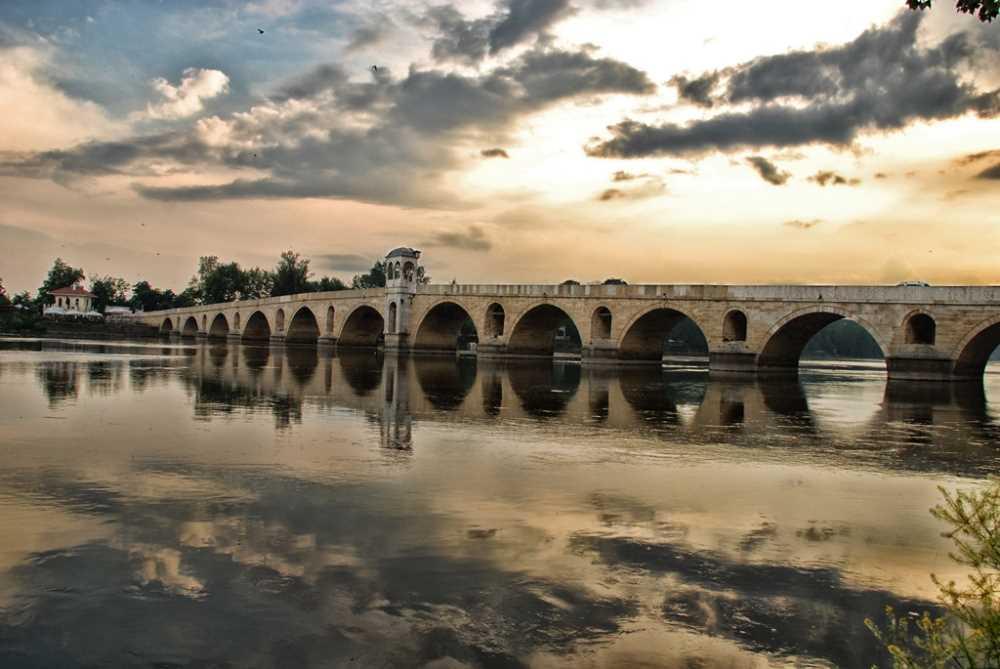
Mecidiye Köprüsü (Kültür Portalı)
Viewing balcony is designed to create a distinct functional area on the bridge facing the Meriç River. It is evaluated together with the inscription kiosk opposite it and forms part of the bridge’s architectural arrangement. The marble material used in this section presents a different application compared to the bridge’s overall stone construction.
Mecidiye Köprüsü is notable not only for its structural features but also for its figurative stone decorations on its surfaces. Various motifs carved in relief technique are found at different locations on the bridge. These decorations cluster around the piers and spillway openings, forming a cohesive whole with the architectural layout. These stone carvings constitute an essential part of the bridge’s decorative program.
The figurative stone decorations on Mecidiye Köprüsü are concentrated particularly around the piers and spillway openings. These include a double dragon motif, a crescent-and-star motif, and bird perches. The decorations are carved in relief on the stone surfaces and positioned at various points on the bridge. The dragon figures are arranged symmetrically on an arch, the crescent-and-star motif is found on a square stone surface, and the bird perches are arranged in stacked tiers. These figures function as decorative elements based on stone craftsmanship within the bridge’s architectural framework.
On the upstream side of Mecidiye Köprüsü, above the first spillway opening on the second pier facing Edirne, a double dragon motif is located. These figures, carved in relief, are arranged symmetrically and facing each other on a keystone 48 cm thick. The dragons, with their coiled bodies, encircle the arch and extend toward both ends, forming a wrapping form around the keystone. Their heads approach each other at the center of the arch. Their mouths are open, tongues partially exposed, and jaws intricately curved. Their bodies are covered with scaled patterns, and differences in head-to-body proportions are evident between the two figures. The dragons are integrated into the bridge’s stone craftsmanship within the arch structure.【4】
On the upper left side of the first spillway opening on the second pier facing upstream, a crescent-and-star motif is carved on a square stone surface. In this relief-carved motif, a six-pointed star is placed within a left-facing crescent. This motif, on a stone surface measuring approximately 30x30 cm, is among the bridge’s stone decorative elements. It is positioned within the decorative unity of the bridge alongside other figurative decorations on the piers.【5】
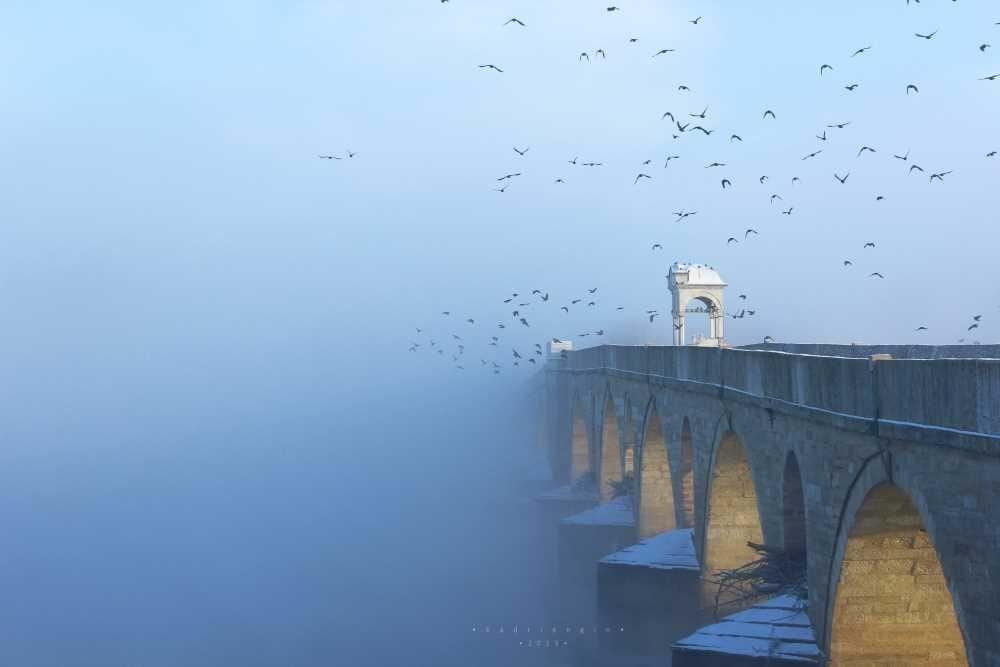
Mecidiye Köprüsü (Kültür Portalı)
On the third pier of Mecidiye Köprüsü, on the left side of the spillway opening, three stacked rows of stone projections are identified as bird perches. These projections are architectural elements projecting outward from the wall surface, with profiled edges and varied designs. The lowest row in this approximately 220 cm long section presents a form divided by a platform in the center and stepped on both sides, exhibiting a small-scale architectural design. These stone projections are said to have been used by birds for perching and resting. They serve both a decorative and functional purpose on the structure.Art-Sanat, no. 10, (2018): 157-158, Last Access: 12 April 2026, https://dergipark.org.tr/tr/pub/iuarts/article/448991
'>【6】
Mecidiye Köprüsü is located on the Meriç River along the transportation route connecting the center of Edirne with Karaağaç. The bridge serves as a vital link between these two settlements. Historically, the Meriç River was an important waterway used for transport, connecting the Balkans to Istanbul via Edirne. Wharves existed along its banks, and ships, boats, and sandals were known to dock at these locations. The bridge’s riverbank connections were shaped by this usage pattern, with stone wharves constructed along the riverbank. Today, the bridge continues to serve as part of the road transport network within the urban fabric of Edirne. These characteristics demonstrate that the bridge has maintained its transportation function both historically and in the present day.
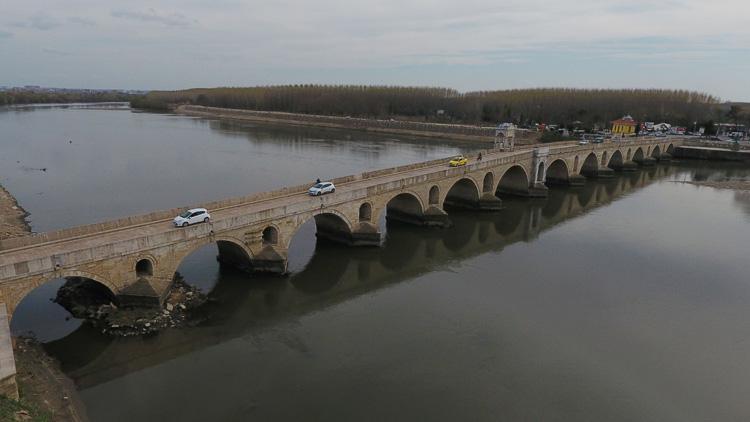
Mecidiye Köprüsü (Anadolu Ajansı)
Mecidiye Köprüsü is among the 19th-century Ottoman stone bridges and constitutes an important component of Edirne’s historical transportation network. The bridge draws attention due to its location over the Meriç River in Edirne, a city through which the Ottoman Empire connected the Balkans and Europe. The figurative stone decorations on the bridge — the double dragon motif, the crescent-and-star motif, and the bird perches — are among the elements reflecting the stone craftsmanship and decorative sensibilities of the era. These decorations, together with the bridge’s architectural identity, define its cultural and artistic characteristics. As one of the examples of the Ottoman tradition of figurative decoration on water structures, Mecidiye Köprüsü holds a place within the architectural heritage of Edirne.
[1]
T.C. Edirne Valiliği, “Edirne Meriç / Mecidiye Köprüsü,” Edirne Valiliği Resmî Web Sitesi, Last Access: 12 April 2026, https://www.edirne.gov.tr/meric-koprusu
[2]
A.e.,
[4]
A.e., syf. 153
[5]
T.C. Edirne Valiliği, “Edirne Meriç / Mecidiye Köprüsü,” Edirne Valiliği Resmî Web Sitesi, Last Access: 12 April 2026, https://www.edirne.gov.tr/meric-koprusu

History
Architectural Features
Structural Features
Kiosk and Viewing Balcony
Decorative Features
Figurative Stone Decorations
Double Dragon Motif
Crescent-and-Star Motif
Bird Perches
Transportation and Function
Cultural Significance