

This article was automatically translated from the original Turkish version.
+2 More
14 March Medical Day is a special day observed annually in Türkiye on 14 March to honor healthcare workers and the medical community. On this date, healthcare professionals including physicians and medical students gather to commemorate the value and historical significance of their profession.
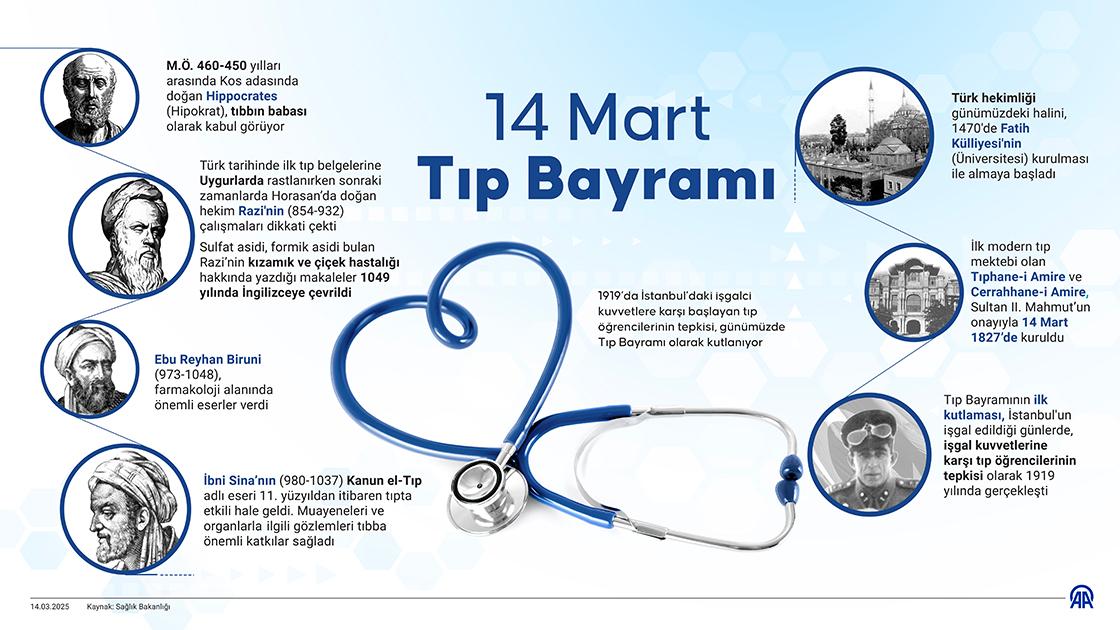
Infographic on Medical Day (Anadolu Agency)
The origins of Medical Day trace back to 14 March 1827, the date recognized as the beginning of modern medical education in the Ottoman Empire; however, this date gained deeper meaning due to the resistance mounted by medical students during the National Struggle.
Thus, 14 March has become a symbol of the Turkish medical community’s dedication to modernization and its patriotic spirit, far beyond merely marking the founding anniversary of a single institution.
Each year, ceremonies, events, and meetings are held to highlight the contributions of the medical profession to society and to honor the sacrifices of healthcare workers.
During the decline of the Ottoman Empire, particularly in the 18th and 19th centuries, there was a growing need for reform in medical education as part of efforts to establish a modern army. In this context, Sultan Mahmud II established the first modern medical school in Istanbul on 14 March 1827 under the names Tıbhane-i Âmire and Cerrahhane-i Âmire. Thus, under the leadership of Chief Physician Mustafa Behçet Efendi, an institution was created to train physicians and surgeons according to contemporary standards. This institution is regarded as one of the earliest steps toward Westernization in healthcare in the Ottoman Empire.
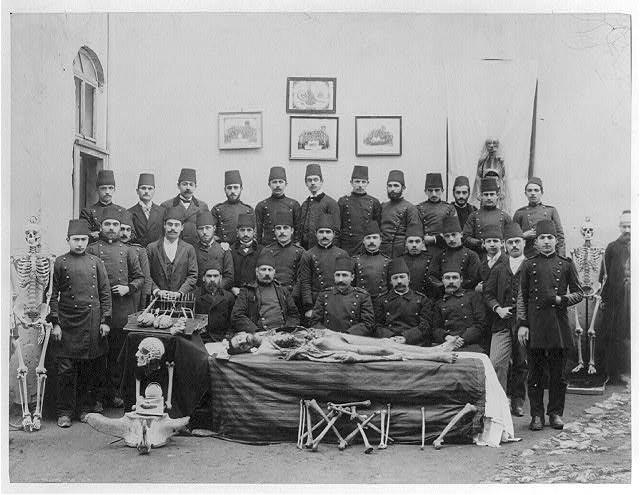
Students of Mekteb-i Tıbbiye-i Şahane (Library of Congress)
In 1836, Tıbhane and Cerrahhane were merged and relocated to Gülhane under the name Mekteb-i Tıbbiye. Subsequently, it was restructured according to Western models and began instruction on 17 February 1839 in its new building in Galatasaray under the name Mekteb-i Tıbbiye-i Adliye-i Şahane.
Along with this reform, the language of instruction became French. Under the leadership of European experts such as Dr. Bernard, botanical gardens, anatomy and pathology museums, and physics and chemistry laboratories were established, and a printing press was set up for publishing medical textbooks. These developments enabled Ottoman medicine to adopt a modern structure.
Following World War I and the signing of the Armistice of Mudros, the Ottoman State effectively ceased to exist and Istanbul was occupied by the Allied Powers. During this occupation, British forces began forcibly using the building of Mekteb-i Tıbbiye-i Şahane as a headquarters on 3 February 1919. This situation provoked strong reactions among medical students, some of whom traveled to Anatolia to join the National Struggle, while those remaining in Istanbul began organizing a secret resistance.
The Story of Medical Day (Anadolu Agency)
Knowing they could not hold direct meetings, they planned secret gatherings under the pretext of a celebration. At this point, third-year student Hikmet (Boran) proposed that the anniversary of the school’s founding on 14 March would be an appropriate occasion.
On the morning of 14 March 1919, despite efforts by the occupying forces to prevent it, the students hoisted a large Turkish flag between two towers of the school, staging one of Istanbul’s first open national protests.
This protest is recorded in history as the first open act of resistance by medical students against the occupation. Following the event, some students were arrested, but they defended themselves by claiming they were merely celebrating the founding anniversary of their school.
Documentary on Medical Day (NTV Documentary)
Hikmet of the Medical Students later participated as a delegate in the Sivas Congress, where he strongly opposed the mandate idea and became a historical figure, earning praise from Mustafa Kemal Paşa. This event is regarded as one of the most significant developments that gave 14 March profound meaning for the Turkish medical community.
After the founding of the Republic of Türkiye, 14 March was not regularly celebrated for a long period, but it was revived in 1935 through the initiative of students at Istanbul University Faculty of Medicine.
During these commemorations, the students declared 14 March 1827, the date they recognized as the beginning of modern medical education in Türkiye, as Medical Day. This tradition initiated by the students expanded in subsequent years and was adopted nationwide, becoming the common holiday of all physicians. Thus, 14 March acquired the status of a holiday celebrated not only by medical students but by all healthcare workers.
On Medical Day (Ministry of Health of the Republic of Türkiye)
Today, 14 March Medical Day is observed throughout Türkiye by the healthcare community as both a day of remembrance and a day of professional solidarity. On this date, medical faculties, hospitals, and health institutions host official ceremonies, conferences, symposia, and panels.
In the evenings, social events and traditional gatherings such as the “14 March Medical Ball” strengthen camaraderie among professionals. During the celebrations, the values the medical profession contributes to society are emphasized, while the challenges and achievements of healthcare workers are brought to public attention. Thus, 14 March Medical Day continues to be observed as a dynamic and meaningful day that carries the legacy of the past into the future.
Anadolu Ajansı. "14 Mart Tıp Bayramı." Infographic. Accessed March 14, 2026. https://www.aa.com.tr/tr/info/infografik/45101.
Anadolu Ajansı. "Sağlık Bakanlığı 14 Mart Tıp Bayramı'nın Hikayesinin Canlandırıldığı Video Hazırladı." Video Galeri. Accessed March 14, 2026. https://www.aa.com.tr/tr/vg/video-galeri/saglik-bakanligi-14-mart-tip-bayraminin-hikayesinin-canlandirildigi-video-hazirladi/116
Arda, Berna. "Galatasaray Tıbbiyesi." Ankara Üniversitesi Tıp Fakültesi Mecmuası 42, no. 4 (1989): 671–80. Accessed March 14, 2026. https://dergipark.org.tr/en/download/article-file/4977507.
Kastamonu Education and Research Hospital. "14 Mart Tıp Bayramı Tarihçesi." Accessed March 14, 2026. https://kastamonueah.saglik.gov.tr/TR-136929/14-mart-tip-bayrami-tarihcesi.html
Library of Congress. "[A Group Photograph of the Students and the Teachers of the Mekteb-i Tıbbiye-yi Mülkiye (Civil Medical School)]." Prints and Photographs Division. Accessed March 14, 2026. https://www.loc.gov/pictures/item/2002716673/.
NPİSTANBUL Hospital and Üsküdar Dental Hospital. "14 March Medical Holiday Be Blessed." Accessed March 14, 2026. https://www.youtube.com/watch?v=VPUZzP0VHLI.
T.C. Ministry of Health. "Bazen Küçük Bir An İçin Ömür Bile Verilir - 14 Mart Tıp Bayramı." YouTube. Accessed March 14, 2026. https://www.youtube.com/watch?v=FBcdqkbNsUYlist=RDFBcdqkbNsUYstart_radio=1
Türkiye Klinikleri TV. "14 Mart Tıp Bayramı Kutlu Olsun!" YouTube. Accessed March 14, 2026. https://www.youtube.com/watch?v=fFidvScS_ZQ.
Uğurlu, Mehmet Cemil. "14 Mart Tıp Bayramı'nın Düşündürdükleri." Ankara Üniversitesi Tıp Fakültesi Mecmuası 50, no. 1 (1997): 1–25. Accessed March 14, 2026. https://dergipark.org.tr/tr/download/article-file/39243.
Çağlar, Musa Kazım. "14 Mart Tıp Bayramı ve Tıbbiyeli Hikmet." Academia.edu. Accessed March 14, 2026. https://www.academia.edu/50976953/14_MART_TIP_BAYRAMI_VE_TIBB%C4%B0YEL%C4%B0_H%C4%B0KMET
Şehsuvaroğlu, Bedi N. Türk İstanbul'da Tıp Öğretimizin 500. Yıldönümü. İstanbul: Fen Fakültesi Matbaası, 1971. Accessed March 14, 2026. https://www.oktayaras.com/turk-istanbulda-tip-ogretiminin-500-yildonumu/tr/41428

History
Resistance to Occupation and Hikmet of the Medical Students
Medical Day in the Republican Era
Celebrations in the Modern Era