


This article was automatically translated from the original Turkish version.
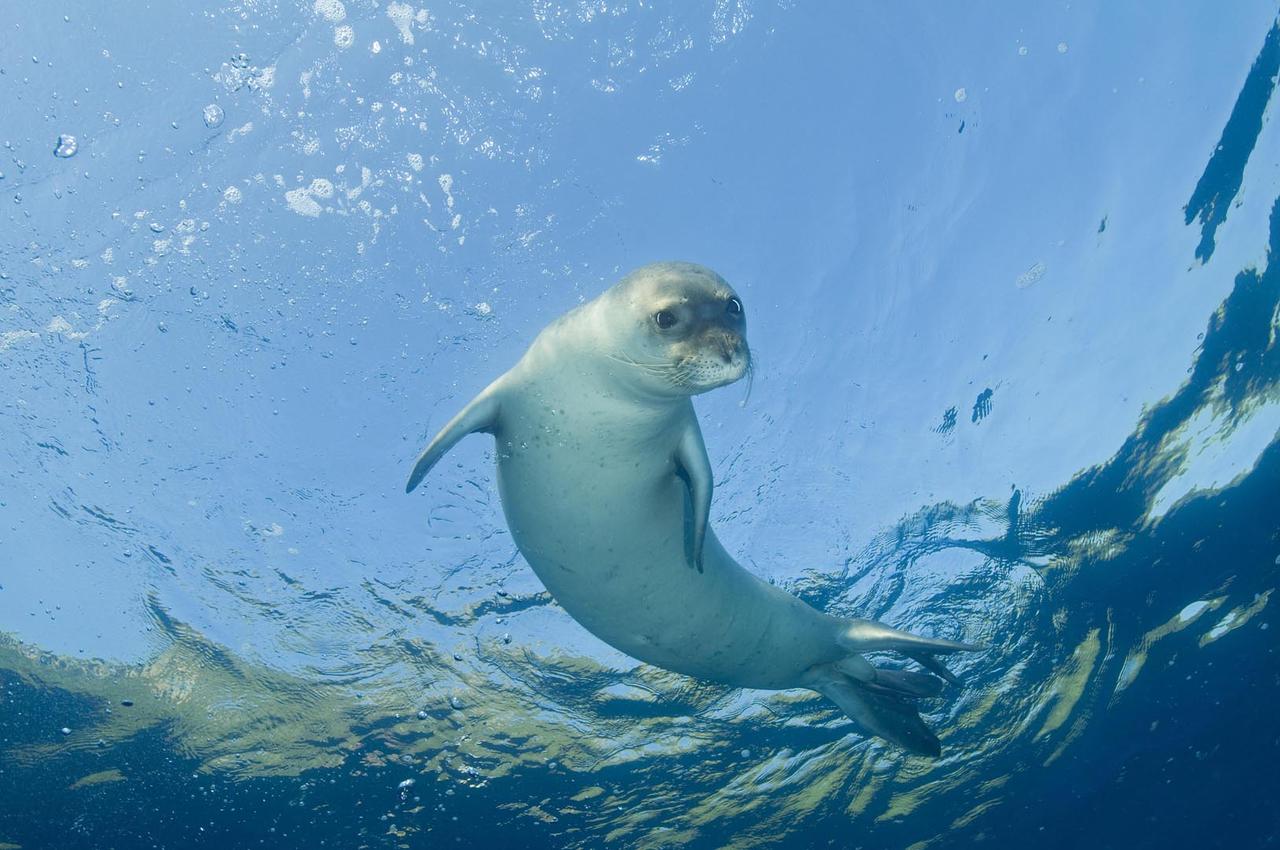
Mediterranean Monk Seal
Realm | Animals | ||||||||
|---|---|---|---|---|---|---|---|---|---|
Branch | Chordates | ||||||||
Class | Mammals | ||||||||
Team(s) | Carnivores | ||||||||
Family | Phocids | ||||||||
Genus | Monachus | ||||||||
Specie(s) | M. monachus | ||||||||
The Mediterranean monk seal (Monachus monachus) is a marine mammal belonging to the genus Monachus within the superfamily Pinnipedia and is one of the 33 species of flippered seals on Earth. In members of this family, the front flippers are smaller while the hind flippers are larger. The hind flippers cannot be curled under the belly when on land. Therefore, despite being excellent swimmers, they move more slowly on land. The Mediterranean monk seal is generally a large marine mammal, with adults reaching lengths of 2 to 3 metres and newborns measuring between 80 and 90 cm.
Adult seals weigh between 200 and 300 kg, while newborn pups average around 20 kg. Their most distinctive features are their large head structure, black eyes, and prominent whiskers. Pups are born covered in black fur, but around two months of age, they molt their black coat and develop a shiny grey coat of short hairs approximately 5 mm in length, giving them a velvety appearance.
The Mediterranean monk seal was historically found along the coasts of the Mediterranean, Aegean and Black Seas, as far north as 34ºN latitude along the northwestern African coastline. However, due to overhunting, habitat loss and degradation of the marine ecosystem, the species’ distribution has shrunk and its population has declined rapidly. The Aegean coasts and islands represent the areas with the highest concentration of this species, with shorelines being their primary habitat. They typically prefer quiet, isolated, undisturbed areas inaccessible to humans. In particular, caves with underwater entrances are the most favored locations for shelter and reproduction.
As a carnivore, the Mediterranean monk seal exhibits a characteristic trait among pinnipeds. The majority of its diet consists of fish, octopus and lobster caught underwater. When capturing prey, it sometimes brings it to the surface. To kill and tear apart its prey, it rapidly shakes its head from side to side, consuming any pieces remaining in its mouth while chasing and catching larger fragments. It repeats this motion until the prey is fully consumed.
As mammals, Mediterranean monk seals possess lungs like humans and breathe air. They dive underwater after taking in air at the surface, and do not breathe underwater. Mediterranean monk seals typically make dives lasting 5 to 10 minutes before returning to the surface to breathe.
The Mediterranean monk seal is recognized as a shallow-water diver compared to other pinnipeds. Its deepest recorded dives do not exceed 100 metres. It is also known to steal fish from coastal fishermen’s nets. This behaviour has led to intentional killing of seals by coastal fishermen.
The Mediterranean monk seal is a large marine mammal with a body length of 2 to 3 metres and a weight ranging from 200 to 300 kilograms. The body of adults is covered with short, stiff hairs not exceeding 0.5 cm in length. When seen at the surface, its most distinctive features are its large head, long whiskers and black eyes like beads. There is no significant difference in size or weight between adult males and females, but distinct sexual dimorphisms exist. When lying on land, their bulky and rounded body shape is striking. On either side of the body are the front flippers (anterior limbs), and at the rear are two hind flippers (posterior limbs) arranged in a pair.
1. Male: Dark brown to black in colour with a prominent white patch on the belly.
2. Female: Light brown or grey in tone, with the underside of the body ranging from lighter than the back to nearly white. Additionally, there are scars on the upper body region caused by males during mating.
3. Pup: At birth, it measures approximately 80–90 cm in length and weighs about 20 kg. Its entire body, except for a distinct white patch on the belly, is covered with shiny black hairs 1–1.5 cm long. Pups are born with whiskers, like their mother and father. Around two months of age, they begin to molt, and within one or two months, the long black hairs are replaced by shorter, shiny grey ones.
The Mediterranean monk seal is not an active migratory species and spends most of its time within a limited range. Females are more mobile outside the pupping and breeding season. Juvenile seals have also been observed migrating to distant areas during their growth phase. On land, where they are clumsier than in water, Mediterranean monk seals prefer to bask or rest in locations closest to the sea in case of threat.
It is believed that female Mediterranean monk seals travel long distances to reach males and then leave the male’s territory after mating. Mating occurs in the sea. Females reach sexual maturity at 4–5 years of age. After a gestation period of 10–11 months, a female may give birth to a pup annually or every second year. Consequently, the Mediterranean monk seal has a low reproductive rate and produces few offspring. The mother nurses her pup on land with her milk for approximately four months. The Mediterranean monk seal absolutely requires land—particularly coastal caves—for giving birth and raising its young.
In our country, observations indicate that Mediterranean monk seal reproduction occurs between the months of August and November. It is estimated that an average of 12–13 months pass between births. Survival rates of pups are very low, with only about half surviving their first two months. Their lifespan in natural environments is known to be around 20 years.
The Mediterranean monk seal is a shy and less social animal compared to other pinniped species. Individuals living along our coasts generally move alone and are rarely seen together. Researchers have occasionally observed groups of 2 to 4 seals in Turkey, and although rare, numbers as high as 7–8 have been recorded. There is limited information regarding their behaviour, as is the case with many of their characteristics. It is speculated that Mediterranean monk seals sometimes gather in groups and then disperse again. Adult males generally establish a territory and remain within it throughout their lives. Females are more mobile than males, but during the pupping season, they do not leave the breeding cave or its vicinity. Juvenile seals may migrate to distant areas during their growth phase.
Until the beginning of the 20th century, Mediterranean monk seals freely inhabited coastal areas throughout the Mediterranean and along the eastern Atlantic coasts from the Portugal to the West coasts of Africa, with populations numbering in the thousands. However, due to overhunting, habitat loss and degradation of the marine ecosystem, the species’ global distribution has contracted and its population has declined rapidly.
The Mediterranean monk seal currently lives in today in Greece, Türkiye, Morocco, Mauritania and the Madeira Islands, with an estimated total population of 450 to 550 individual. The Mediterranean monk seals along the coasts of Mauritania live in colonies, exhibiting social group behaviour. However, due to human pressure, the overall population has been forced to adopt solitary living patterns rather than congregating. The Mediterranean monk seal now survives in two isolated populations:
1. Atlantic Population (Mauritania coasts, Madeira Islands and Morocco)
2. Mediterranean Population (Greece, Türkiye and Western Mediterranean)
The largest population of the species is in the Aegean Sea. Therefore, the survival of the Mediterranean monk seal in the Mediterranean and its continued presence in the ecosystem largely depends on Türkiye and Greece.
Through various scientific studies in Türkiye, individual identification has confirmed the presence of 31–44 Mediterranean monk seals, and it is estimated that fewer than 100 seals inhabit our coasts. Considering the global population estimate of 450–550, this number represents a significant portion. The distribution of the Mediterranean monk seal does not follow a continuous coastal pattern but shows concentration in specific areas. In Türkiye, monk seals inhabit:
1. In the Marmara region; Marmara Islands, Mola Islands and the northern shores of the Biga Peninsula,
2. In the Aegean; along the Aegean coasts of the Gelibolu Peninsula between Behramkale and the new Foça and Datça,
3. In the Mediterranean; between Datça and Arch, between Alanya and Taşucu, and along the shores between Hatay Samandağ and the Syrian border.
The Mediterranean monk seal ranks among the most endangered species globally. It is listed by the International Union for Conservation of Nature (IUCN) in the highest threat category: Critically Endangered (CR). Today, the Mediterranean monk seal survives only in the vicinity of Türkiye, Greece, Morocco, Mauritania and the Madeira Islands (Atlas Ocean—Northwest Africa waters).
Akdeniz Koruma Derneği. "Akdeniz Foku." Accessed February 12, 2025. Accessed Adresi.
Irkkan, Bülent. "Solan Renkler: Akdeniz Fokları Tükeniyor." *Fotoğrafya.com.* Accessed February 12, 2025. Accessed Adresi.
Sualtı Araştırmaları Derneği. "Akdeniz Foku: Dünya Dağılımı ve Nüfusu." Akdeniz Foku Araştırma Gurubu. Accessed February 12, 2025. Accessed Adresi.
Turkish Marine Research Foundation. "Akdeniz Foku ve Korunması." Accessed February 12, 2025. Accessed Adresi.
Özkan, Murat. "Dünya Mirası Akdeniz Foku." Türk Tarım ve Orman Dergisi, 2023. Accessed February 12, 2025. Accessed Adresi.

Mediterranean Monk Seal
Realm | Animals | ||||||||
|---|---|---|---|---|---|---|---|---|---|
Branch | Chordates | ||||||||
Class | Mammals | ||||||||
Team(s) | Carnivores | ||||||||
Family | Phocids | ||||||||
Genus | Monachus | ||||||||
Specie(s) | M. monachus | ||||||||
No Discussion Added Yet
Start discussion for "Mediterranean Monk Seal" article
Diet
Physical Appearance
Reproduction
Social Behaviour
Distribution and Population
Current Status of Mediterranean Monk Seals