


This article was automatically translated from the original Turkish version.
+1 More
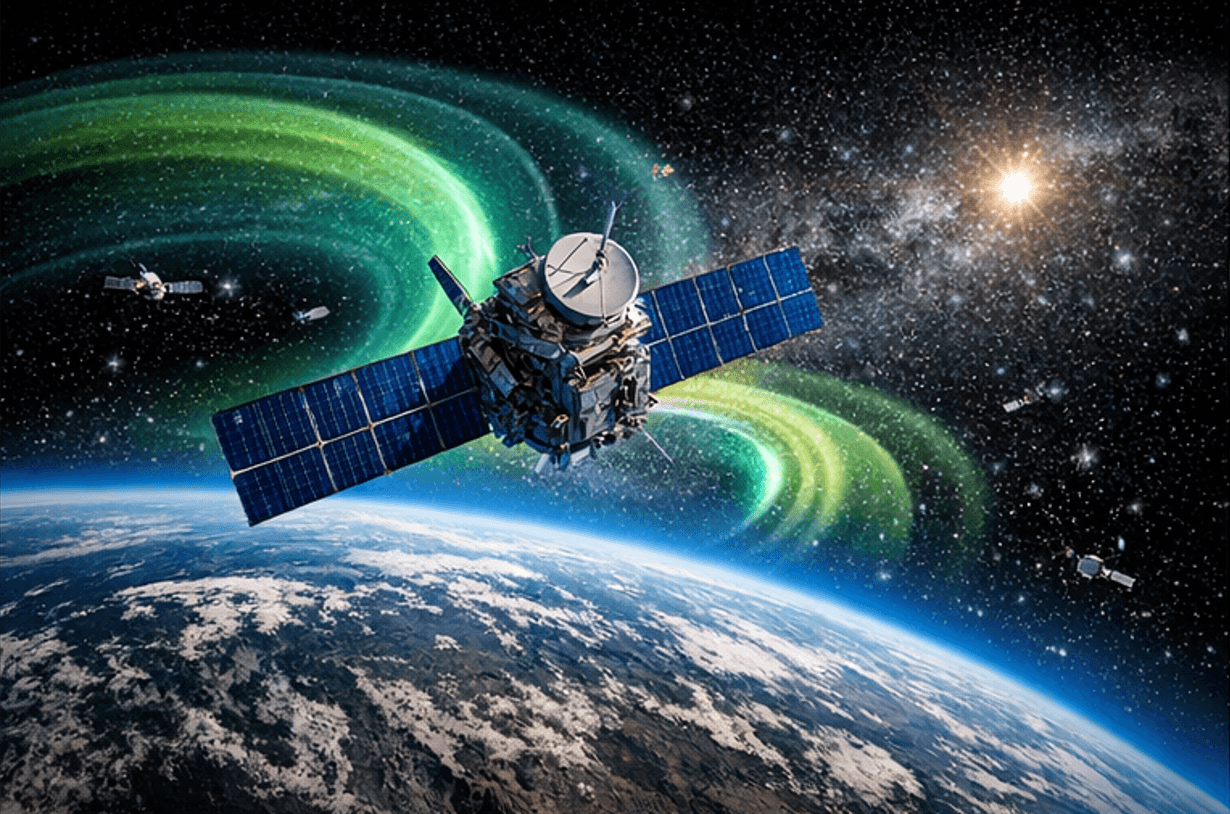
MEO (Yapay Zekâ ile Oluşturulmuştur)
Medium Earth Orbit (MEO) is the orbital region that spans the altitude range between Low Earth Orbit (LEO) and Geostationary Earth Orbit (GEO). MEO occupies altitudes between LEO and GEO and is often analyzed in relation to the Van Allen radiation belts according to many definitions.
Medium Earth Orbit refers to a band of altitudes rather than a single fixed altitude. In some definitions the upper limit of LEO is set at approximately 2000 km and MEO extends from above this boundary up to Geostationary Earth Orbit. According to an operational definition an orbit is classified as MEO if its perigee altitude is greater than 2000 km and its apogee altitude is less than 35786 km (approximately the 2000–35786 km band).
Orbital velocity and period depend on altitude. For example in circular orbits at the common MEO altitude of approximately 20200 km used in global positioning systems the orbital period is about 12 hours and the orbital velocity is approximately 3.9 km/s. Such positioning constellations employ multiple orbital planes with specific inclination angles.
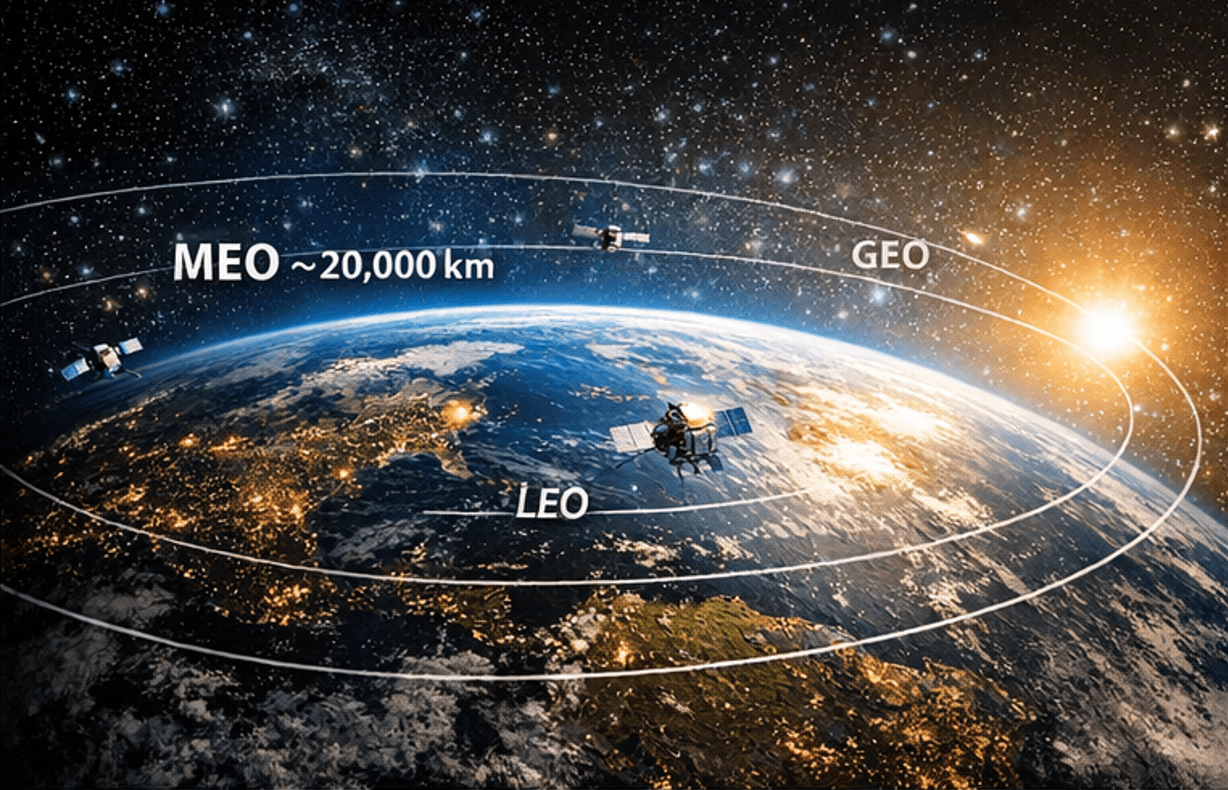
Medium Earth Orbit - MEO (Generated by Artificial Intelligence)
The coverage footprint of MEO is larger than that of LEO therefore fewer satellites are required to achieve global or hemispheric coverage compared to LEO systems. Unlike Geostationary Earth Orbit satellites which appear fixed in the sky MEO satellites move relative to the ground therefore ground stations and user terminals must perform tracking and handover processes. In some communication architectures MEO is considered as an orbital option offering lower latency than GEO.
In some classifications the upper boundary of LEO (approximately 2000 km) is associated with regions where Van Allen belt effects become significant. MEO encompasses altitudes above this boundary and radiation effects are considered in mission design under headings such as electronics design shielding and redundancy.
The MEO region is an actively used orbital regime alongside GNSS constellations. This region can be evaluated not only to include circular MEOs but also portions of highly elliptical transfer orbits. Studies on the MEO debris population consider optical scanning and tracking approaches in scenarios where highly elliptical and inclined orbits partially overlap with MEO.
In MEO atmospheric drag is weaker than in LEO so natural orbital decay is limited and end-of-life disposal plans are implemented. In some applications satellites are raised to separate disposal orbits above their operational altitude; in other cases they are left passive in their operational orbits. Since long-term orbital dynamics such as Sun-Moon-Earth gravitational perturbations and resonances can affect the evolution of disposal orbits the selection of disposal orbits and separation distances must be evaluated in conjunction with these dynamics.

MEO (Yapay Zekâ ile Oluşturulmuştur)
No Discussion Added Yet
Start discussion for "Medium Earth Orbit (MEO)" article
Orbital Altitude Velocity and Period
Communication with Ground Stations and Coverage
Applications
Space Environment and Radiation Conditions
Comparison of MEO with LEO and GEO
Advantages of MEO over LEO:
Disadvantages of MEO over LEO:
Advantages of MEO over GEO:
Disadvantages of MEO over GEO:
Space Debris Density and Observation Studies
End-of-Life and Disposal Approaches