


This article was automatically translated from the original Turkish version.
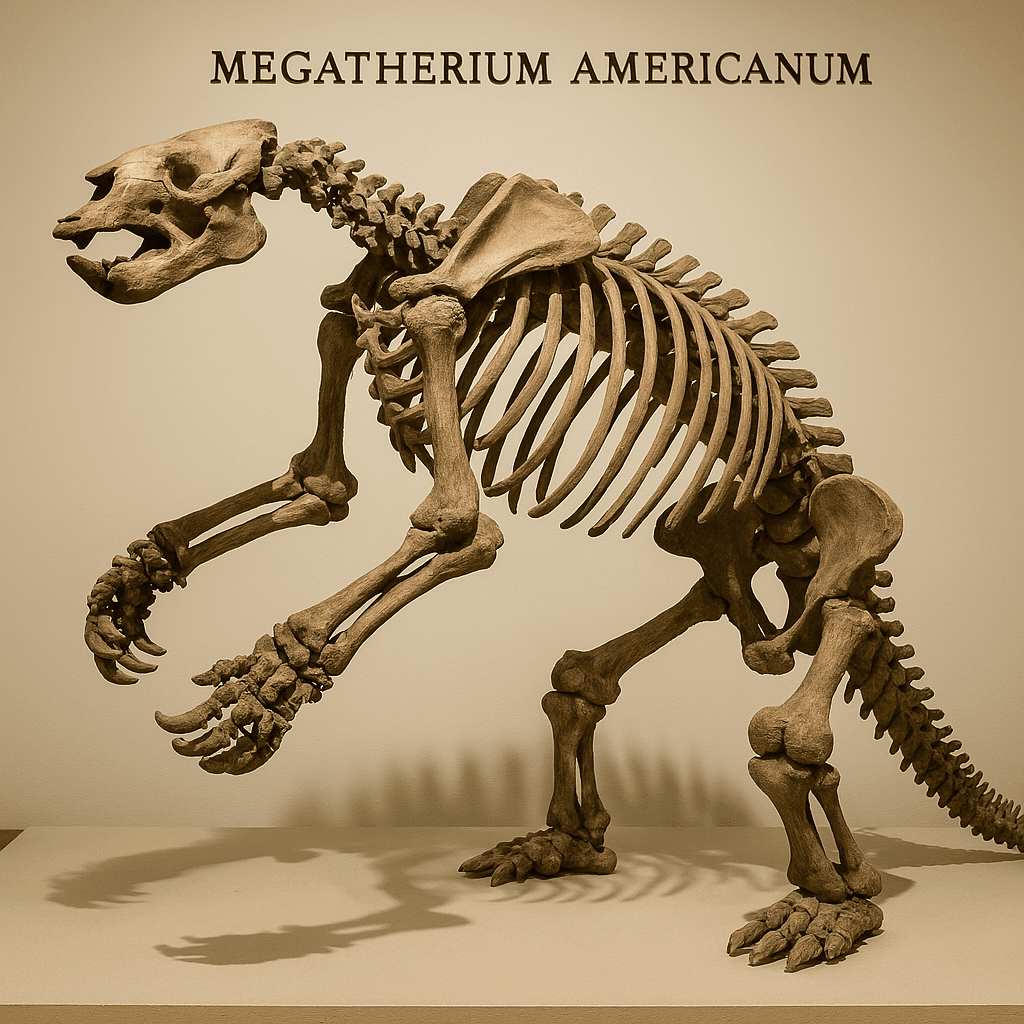
Megatherium is a genus of extinct animals belonging to the family Megatheriidae that lived during the Pleistocene epoch. The species was first discovered in 1788 in the Luján region of Argentina and described by Cuvier. The most well-known species of this genus is Megatherium americanum, which is regarded as one of the largest land mammals of prehistoric times, reaching weights of approximately four tons and lengths of up to six meters. The genus name derives from the Greek for “great beast.”
Megatherium is classified as a herbivore that fed on vegetation; however, morphofunctional analyses have revealed a degree of selectivity in its diet. Based on its powerful jaw muscles and high-crowned, incisive lobes, it is thought to have fed on relatively soft but fibrous leaves. Its thick and robust limb bones evolved to allow the animal to stand on its hind legs to reach leaves or perform defensive movements.

Estimated appearance of Megatherium americanum (Photo: SpinopsNobu Tamura's Paleoart Portfolio)
The skull of Megatherium americanum is broad and robust, with clearly defined surfaces for the attachment of chewing muscles. The wear patterns on the masticatory apparatus indicate strong development of the temporalis and masseter muscles. The lower jaw is massive, with a prominently thickened symphysis. The teeth are highly crowned (hypsodont) and bilophodont in structure. The cutting edges of the teeth are sharply triangular, indicating a functional adaptation oriented toward slicing rather than grinding.
Megatherium, with its enormous size and sturdy skeletal structure, is one of the most striking mammals of the Pleistocene terrestrial fauna. At approximately six meters in length and weighing up to four tons, it was vastly larger than any living land herbivore. Its body was heavy, with thick and short limb bones; this morphology enabled the animal to adopt a stable and powerful stance. The forelimbs were five-toed, with large claws on the inner digits. These claws were likely used both for defense and for stripping bark, branches, or vegetation. The hind limbs were robust with broad, flat soles; the pelvic structure evolved to support an upright posture.
When examined, the cranial morphology of Megatherium americanum reveals a broad and sturdy skull. The dental formula consists of five molariform teeth; these teeth are square-shaped, highly crowned (hypsodont), and bilophodont. According to analyses by Bargo (2001), this structure allowed for strong biting forces directed particularly in the vertical plane. The cutting edges of the teeth were primarily adapted for slicing rather than grinding, suggesting that the animal fed on relatively soft but durable leaves, branches, and grasses rather than extremely fibrous and hard vegetation. The extensive attachment surfaces for the jaw muscles indicate that Megatherium possessed a powerful chewing system. Furthermore, its vertebral column and hip bones were shaped to support its massive body weight and to enable rearing up on its hind legs when necessary. These adaptations enhanced both access to food and defensive capabilities.
Megatherium was a terrestrial herbivore that inhabited open areas and sparse woodlands during the Pleistocene. Ecologically, it is considered one of the dominant large mammals in the Pampean region of southern South America throughout the late Pleistocene. Fossil evidence and morphological studies indicate that this giant sloth primarily moved alone and foraged with slow but powerful movements. Its thick bone structure and massive body mass suggest a low-metabolism, low-mobility lifestyle.
Behaviorally, although Megatherium was a herbivore in the broad sense, morphofunctional analyses reveal that it did not primarily consume grasses but instead fed on leafy plants, branches, and woody parts of vegetation—plant materials that were tough but not excessively fibrous.
In terms of habitat, it likely preferred areas near water sources and rich in vegetation. The concentration of fossil finds suggests that it inhabited moist environments and semi-open savanna ecosystems. Despite its large size and powerful claws offering some protection against predators, it remained vulnerable to human hunting, which was one of the key factors leading to its extinction at the beginning of the Holocene.
The genus Megatherium is exclusively known from the fossil record of South America, particularly represented in Pleistocene deposits of countries such as Argentina, Uruguay, Bolivia, and Paraguay. The most well-known species, Megatherium americanum, is extensively documented by abundant fossil remains from the Pampas region of Argentina, especially around La Plata.
Geologically, Megatherium fossils are predominantly found in sedimentary layers known as the Pampean Formation. This formation corresponds to grassland and alluvial plains. It is believed that the species moved slowly across vast grasslands and also frequented areas near water bodies. The diversity of its habitats demonstrates a high degree of environmental adaptability despite its enormous size.
The genus Megatherium, particularly the species M. americanum, became extinct during the early Holocene, approximately 10,000 years ago. This extinction event is directly linked to the global environmental and biotic changes occurring during the Pleistocene-Holocene transition. During this period, the climate of southern South America became warmer and drier, and significant shifts occurred in vegetation patterns, leading to a reduction in food resources for large herbivores such as Megatherium.
However, climatic changes alone do not provide a sufficient explanation. Recent archaeozoological and paleontological research indicates that human impact, particularly the activities of early hunter-gatherer groups, played a decisive role in the extinction of Megatherium. Humans arrived in South America around 12,000 years ago and exerted significant pressure on large mammals. It is believed that slow-moving and defenseless species such as Megatherium were unable to withstand this hunting pressure.
Reduction in feeding grounds, low reproductive rates, extensive habitat requirements, and hunting pressure were the primary factors accelerating the decline of Megatherium. These factors, shared by many other Late Pleistocene megafaunal species, led to the disappearance of this giant land sloth from the Earth.
Bargo, M. Susana. “The Ground Sloth Megatherium americanum: Skull Shape, Bite Forces, and Diet.” *Acta Palaeontologica Polonica* 46, no. 2 (2001): 173–192. Accessed adresi.
De Iuliis, Gerardo. “A Systematic Review of the Megatheriinae (Mammalia: Xenarthra: Megatheriidae).” University of Toronto, 1996. Accessed adresi.
Owen, Richard. “XXXI. “On the Megatherium (Megatherium americanum, Blumenbach).” Philosophical Transactions of the Royal Society of London 141 (1851): 479–512. https://doi.org/10.1098/rstl.1851.0035

Characteristics
Behavior and Ecology
Distribution and Habitat
Extinction