

This article was automatically translated from the original Turkish version.
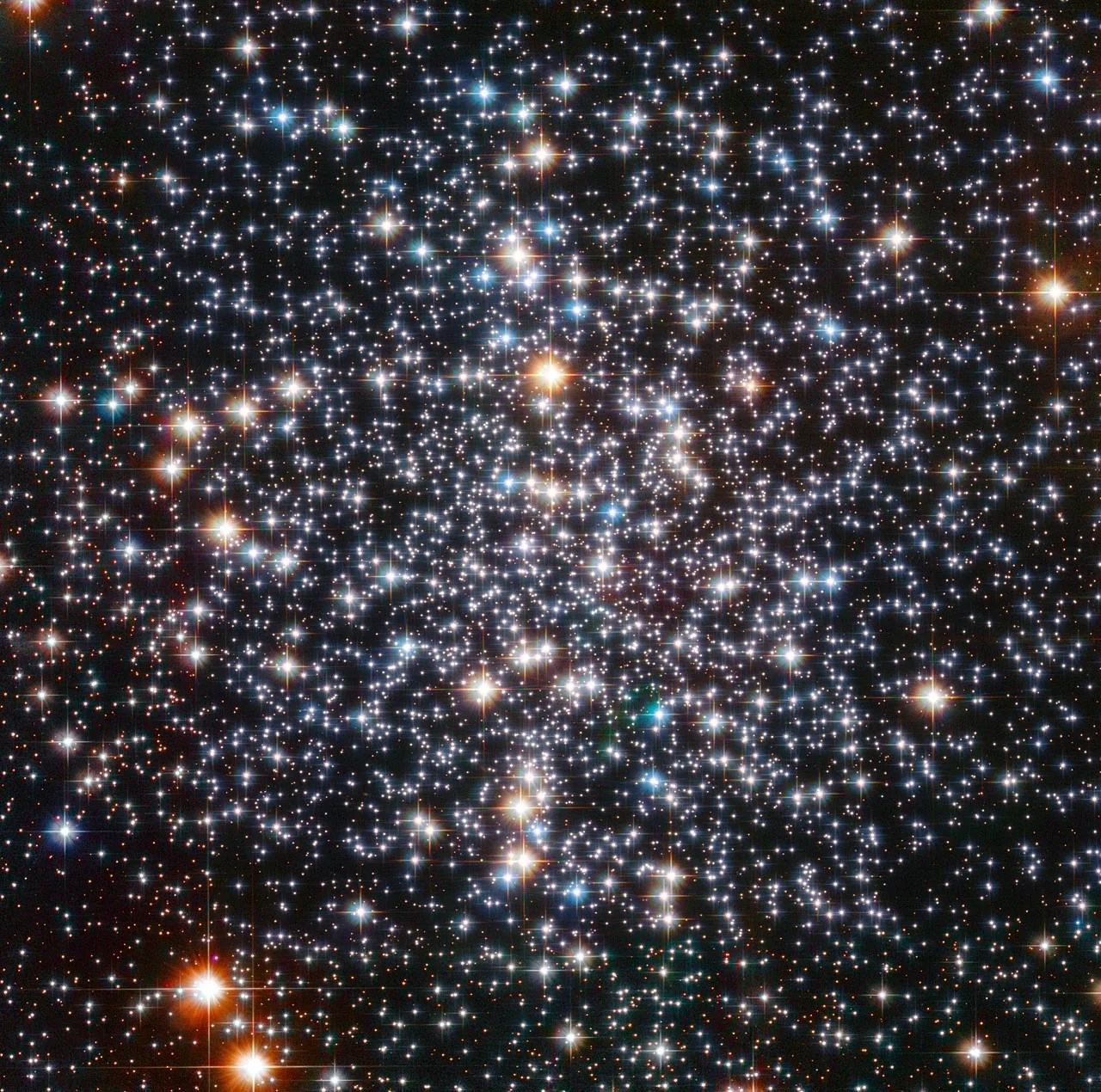
Messier 4 (M4) is a globular star cluster located in the constellation Scorpius at a distance of approximately 6,000 light years from Earth. It is considered one of the closest globular clusters to Earth and contains between 100,000 and 500,000 stars. M4 is recognized as the first globular cluster in which individual stars were resolved, and it can be observed in the night sky just 1.3 degrees west of the bright star Antares.【1】
M4 was discovered between 1745 and 1746 by Swiss astronomer Jean-Philippe Loys de Chéseaux. The cluster was observed from the Cape of Good Hope by Nicolas-Louis de Lacaille between 1751 and 1752 and listed as entry I.9 in his catalog. Charles Messier observed M4 on 8 May 1764 and added it to his catalog, noting that it appeared as a nebulous patch of faint stars through a small telescope. Later, William Herschel resolved all Messier globular clusters using large telescopes.
M4 is located in the constellation Scorpius, 1.3 degrees west of Antares and in the direction of Sigma Scorpii. With an apparent magnitude of +5.6, it is visible to the naked eye under very dark skies.【2】 The cluster has an angular diameter of approximately 36 arcminutes and features a prominent bar-like structure composed of stars of magnitude 11 near its center. Unlike dense globular clusters, M4 has an open structure, allowing individual stars to be resolved even with small telescopes. A fainter globular cluster, NGC 6144, lies nearby.
M4 has a diameter of approximately 75 light years and is classified as loosely concentrated (low concentration, Class IX) among globular clusters in the Milky Way galaxy. Its half-light radius is 12.9 light years (3.95 parsecs) and its total mass is estimated at 90,400 solar masses. The cluster has a concentration class of IX and a central core with a diameter of 3.6 light years.【3】 Its spectral type is classified as F8 with a color index BV=1.03. M4 is receding from us at a velocity of 70.4 kilometers per second.

M4 Star Map (NASA)
M4 contains approximately 40,000 white dwarfs, which are the exposed cores of dead stars whose outer layers have been expelled into space. White dwarfs become fainter as they age, and the faintest ones are comparable in brightness to a 2.5-watt nightlight when compared to the Moon’s separated regions. The cluster also contains approximately 43 variable stars, a millisecond pulsar, and stars unusually rich in lithium.
The orbit of M4, derived from astrometric data, ranges from 2.0 to 21.25 kilolight years from the Galactic Center and has an orbital period of approximately 75 million years. Based on the velocity distribution of its stars and analysis of its color-magnitude diagram, the cluster’s age is estimated at 11.5 to 13 billion years.
Hubble Space Telescope and VLT (Very Large Telescope) observations have enabled detailed study of the white dwarfs in the cluster. These studies have improved the accuracy of white dwarf cooling rates and age estimates. Additionally, a planet has been detected orbiting the pulsar PSR B1620-26 in M4; this planet has a mass 2.5 times that of Jupiter and is approximately 13 billion years old.
The colorful images of M4 are created by combining exposures taken in blue, green, and red wavelengths of light. This allows stars to be seen in colors ranging from blue (approximately 10,000 °C) to red (approximately 4,000 °C), corresponding to their temperatures.【4】 The cluster’s faint stars have been detected thanks to the VLT’s large mirror surface.
[1]
Messier Charles, “M4.” Messier Objects, Access date 8 March 2026, http://www.messier.seds.org/m/m004.html
[2]
Messier Charles, “M4.” Messier Objects, Access date 8 March 2026, http://www.messier.seds.org/m/m004.html
[3]
Messier Charles, “M4.” Messier Objects, Access date 8 March 2026, http://www.messier.seds.org/m/m004.html
[4]
European Southern Observatory (ESO), “Messier 4: A Globular Star Cluster in Scorpius,” European Southern Observatory, Access date 8 March 2026, https://www.eso.org/public/images/eso9820c/

History
Position and Observational Characteristics
Physical Characteristics
Stellar Population and White Dwarfs
Orbit and Age
Observational Research
Visual Representation