


This article was automatically translated from the original Turkish version.
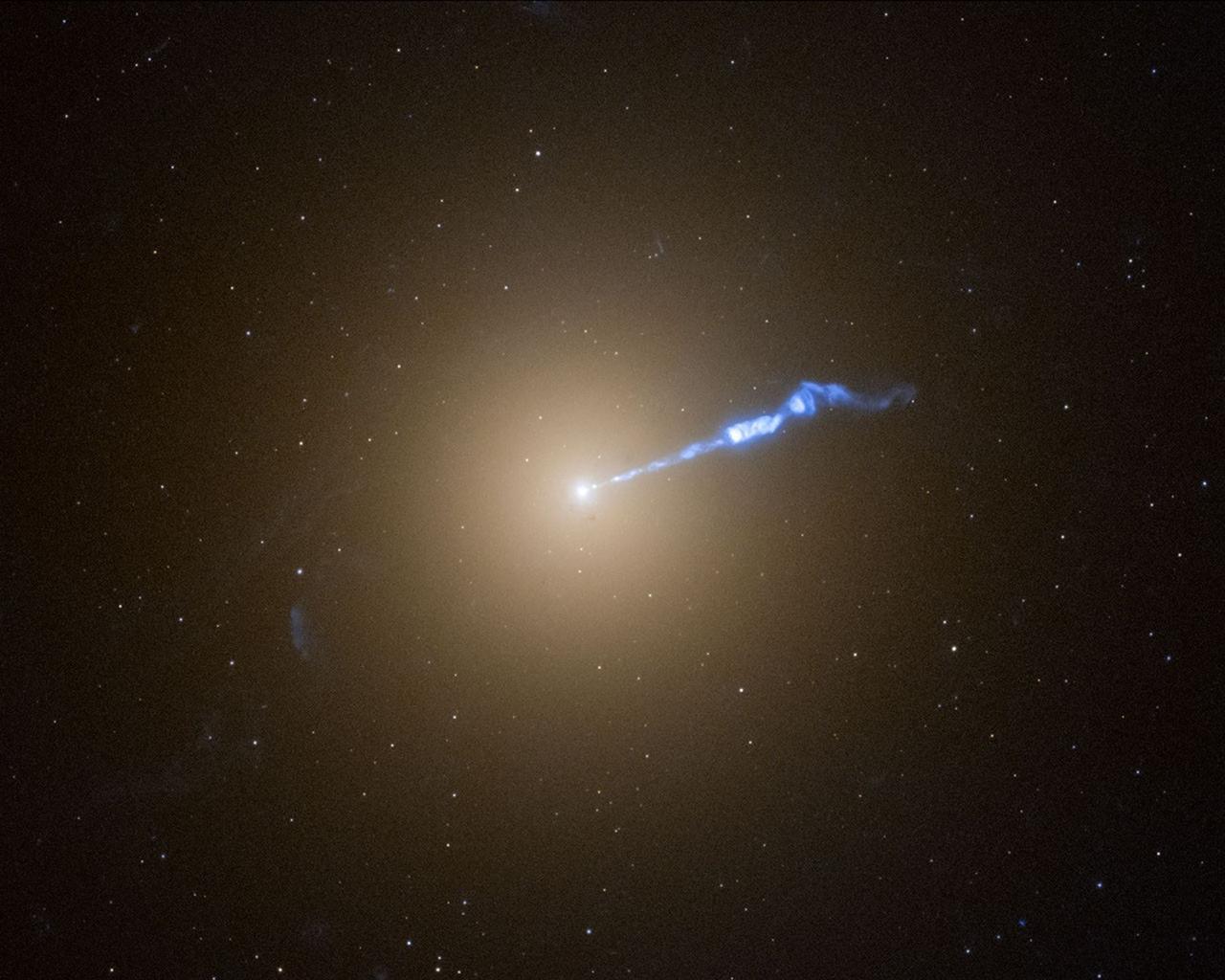
Messier 87
Type(s) | Elliptical Galaxy (E0–E1 Type) | ||||||||
|---|---|---|---|---|---|---|---|---|---|
Constellation | Virgo | ||||||||
Messier Catalog Number | M87 | ||||||||
NGC Number | NGC 4486 | ||||||||
Discovery(ies) | Charles Messier 1781 | ||||||||
Surface Brightness | +9.6 Magnitude (Apparent Brightness) | ||||||||
Distance(s) | Approximately 53.5 Million Light Years | ||||||||
Estimated Diameter | ~120,000 Light Years | ||||||||
Total Mass | Approximately 2.7 Trillion Solar Masses | ||||||||
Number of Stars | Approximately One Trillion Stars | ||||||||
Messier 87 (M87) is a massive elliptical galaxy located in the constellation Virgo. It was discovered in 1781 by French astronomer Charles Messier and listed as object number 87 in the Messier catalog. This galaxy lies approximately 53.5 million light-years from Earth and is one of the largest and brightest members of the Virgo Cluster. It holds particular importance in astrophysical research due to the supermassive black hole at its center and the relativistic jet emanating from it.

Image of M87 generated by Artificial Intelligence.
Messier 87 belongs to the class of classic elliptical galaxies and lacks a prominent disk structure. Containing hundreds of billions of stars, M87 has an estimated diameter of 120,000 light-years.
The stars within M87 are predominantly old and have low metallicity, giving the galaxy an overall yellowish-white hue. It lacks spiral arms or regions of intense star formation, resulting in a low rate of star formation.
The number of globular clusters associated with M87 is extraordinary. While the Milky Way Galaxy has approximately 150 globular clusters, M87 hosts between 12,000 and 15,000. These clusters play a crucial role in understanding the distribution of dark matter, which constitutes a large fraction of the galaxy’s total mass.
The total mass of M87 is estimated at about 2.7 trillion solar masses. Observations indicate that a significant portion of this mass does not originate from visible matter but from dark matter. The presence of dark matter is supported by the fact that stars in the outer regions of the galaxy rotate at higher velocities than expected.
The most striking feature of M87 is the supermassive black hole at its center. In 2019, the Event Horizon Telescope (EHT) collaboration achieved the first direct imaging of this black hole, capturing the first-ever observation of a black hole’s “shadow.” This milestone marked a turning point in the direct testing of general relativity.
The mechanism behind jet formation is likely related to the black hole’s rotation and the surrounding magnetic fields. Such jets are a characteristic feature of active galactic nuclei (AGN) and play a key role in transporting high-energy particles beyond the galaxy.
M87 is the largest galaxy at the center of the Virgo Cluster, which contains approximately 2,000 galaxies. Due to its mass and gravitational influence, it is believed to be pulling in and disrupting smaller galaxies. Interactions with the intracluster medium are studied through observations of hot gas distributions detected in X-rays.
This galaxy is also a dominant radio source located at the cluster center and remains a key observational target in radio astronomy.
Messier 87 plays a critical role in understanding the evolution of massive structures on cosmological scales. It is a fundamental subject of study in the following areas:
Moreover, M87 has contributed to the observational confirmation of general relativity through EHT observations that directly test the curvature of spacetime around a black hole.
Messier 87 is a galaxy of high astrophysical value, serving as a research subject across a broad spectrum from black hole physics to galaxy evolution.

M87 (NASA)
It continues to serve as an important observational target for understanding the large-scale structure of the universe, both through its supermassive black hole and its interactions with the intergalactic medium.
NASA. *Ground-Based Image of M87*. Hubble Supporting Observation. Last modified April 11, 2019. Accessed May 10, 2025. https://science.nasa.gov/asset/hubble/ground-based-image-of-m87/
NASA. *Hubble ACS Image of Elliptical Galaxy M87*. Advanced Camera for Surveys Image. Last modified April 10, 2019. Accessed May 10, 2025. https://science.nasa.gov/asset/hubble/hubble-acs-image-of-elliptical-galaxy-m87/
NASA. *Hubble Image and 3D Model of M87*. Hubble Space Telescope Visualization. Last modified April 11, 2019. Accessed May 10, 2025. https://science.nasa.gov/asset/hubble/hubble-image-and-3d-model-of-m87/
NASA. *Hubble Observes Flare in Jet Knot of M87 (Narration Only)*. Hubble Space Telescope Media. Last modified March 24, 2021. Accessed May 10, 2025. https://science.nasa.gov/asset/hubble/m87-jet-knot-flaring-narration-only/
NASA. *Messier 87 (M87)*. Hubble Space Telescope Image. Last modified April 10, 2019. Accessed May 10, 2025. https://science.nasa.gov/asset/hubble/m87-4/
NASA/CXC. M87: Telescopes Combine to Unravel Galaxy’s Jet. Chandra X-ray Observatory Feature. Last modified April 12, 2021. Accessed May 10, 2025. https://chandra.harvard.edu/photo/2021/m87/

Messier 87
Type(s) | Elliptical Galaxy (E0–E1 Type) | ||||||||
|---|---|---|---|---|---|---|---|---|---|
Constellation | Virgo | ||||||||
Messier Catalog Number | M87 | ||||||||
NGC Number | NGC 4486 | ||||||||
Discovery(ies) | Charles Messier 1781 | ||||||||
Surface Brightness | +9.6 Magnitude (Apparent Brightness) | ||||||||
Distance(s) | Approximately 53.5 Million Light Years | ||||||||
Estimated Diameter | ~120,000 Light Years | ||||||||
Total Mass | Approximately 2.7 Trillion Solar Masses | ||||||||
Number of Stars | Approximately One Trillion Stars | ||||||||
Physical Properties
Structure and Size
Global Cluster Population
Mass and Dark Matter
Supermassive Black Hole and Jet Formation
Interaction with the Virgo Cluster and Surroundings
Scientific Importance