


This article was automatically translated from the original Turkish version.
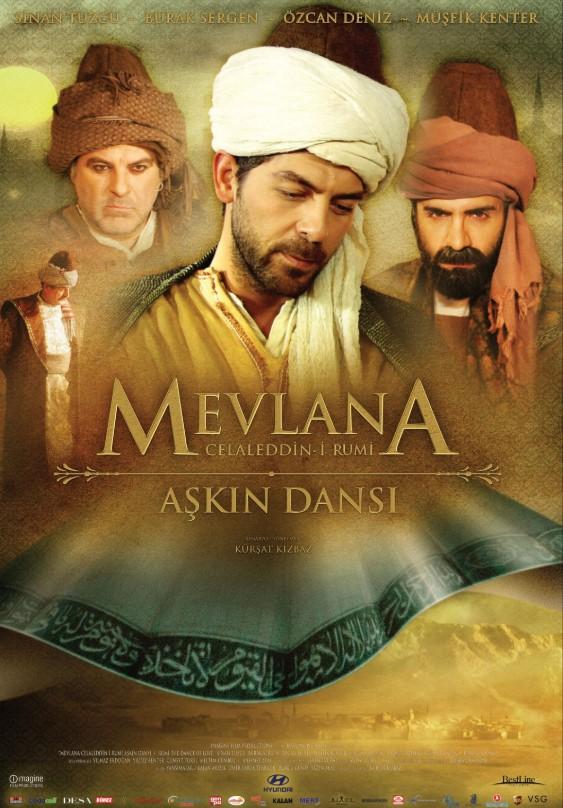
Mevlana Jalaluddin Rumi: The Dance of Love (Film)
Director(s) | Kürşat Kızbaz | ||||||||
|---|---|---|---|---|---|---|---|---|---|
Screenplay(s) | Kürşat Kızbaz | ||||||||
Lead Actors | Bülent İnal, Kutsi, Burcu Kıratlı | ||||||||
Genre | Biography / Religious / Drama | ||||||||
Production Year | 2023 | ||||||||
Duration | 115 minutes | ||||||||
IMDb Rating | 6.3/10 | ||||||||
Mevlânâ Celâleddîn-i Rûmî: The Dance of Love is a 2023 cinematic film that dramatizes the life and intellectual legacy of Mevlânâ Celâleddîn-i Rûmî, who lived in the 13th century, through poetic and Sufi elements. Directed by Kürşat Kızbaz, the production centers on Mevlânâ’s childhood, his migration to Anatolia, his encounter with Shams-i Tabrizi, and his journey toward Sufi maturity. Blending historical events with fictional narrative, the film presents Mevlânâ’s concepts of love, tolerance, and divine affection to the audience through visual storytelling. The production stands as a significant example of the cinematic representation of Mevlevi culture.
The film explores Mevlânâ’s migration from Balkh to Anatolia with his family and the transformation he undergoes during this period. After beginning his life in Konya, Mevlânâ encounters Shams-i Tabrizi, whose arrival triggers a profound spiritual transformation following his scholarly youth. Shams’s arrival leaves deep marks on Mevlânâ’s life; the relationship, marked by inner questioning, social resistance, and spiritual seeking, forms the film’s central axis. The film’s conceptual world and its treatment of the concept of love, which laid the foundation for Mevlânâ’s works such as the Masnavi and the Dîvân-i Kebîr, are conveyed through symbolic imagery. The film concludes with the emergence of the sema ritual, the symbolic embodiment of Mevlânâ’s call to “turn with love.”
Mevlânâ Celâleddîn-i Rûmî: The Dance of Love (youtube)
The film was shot in historical and natural locations including Konya, Istanbul, and Cappadocia. Historical sources were consulted to accurately recreate period-appropriate architecture, costumes, and the Sufi atmosphere. Director Kürşat Kızbaz, who previously participated in documentaries and productions centered on Mevlânâ, aimed in this film to strike a balance between historical authenticity and cinematic interpretation by emphasizing dramatic storytelling. The film’s music, composed with inspiration from classical Turkish musical modes, highlights the ritual aesthetics of the sema scenes through these melodies.
The film examines Mevlânâ’s effort to interpret the concept of “love” not merely as a human emotion but as a divine experience. His relationship with Shams-i Tabrizi serves as the starting point of this quest.
Mevlânâ’s spiritual evolution, as he seeks to bridge the gap between Sharia and Haqiqa, along with the social conflicts he encounters in this process, is constructed as a symbol of personal transformation.
The political, social, and religious atmosphere of 13th-century Anatolia is portrayed alongside the Mongol invasions, madrasa environments, and the daily lives of the people.
Beyazperde. "Mevlana: Aşkın Dansı – Film." Accessed May 2, 2025.
IMDb. "Mevlana Celaleddin-i Rumi: Aşkın Dansı (2023)." Accessed May 2, 2025.
Youtube. "Mevlana: Aşkın Dansı – Film." Accessed May 2, 2025.

Mevlana Jalaluddin Rumi: The Dance of Love (Film)
Director(s) | Kürşat Kızbaz | ||||||||
|---|---|---|---|---|---|---|---|---|---|
Screenplay(s) | Kürşat Kızbaz | ||||||||
Lead Actors | Bülent İnal, Kutsi, Burcu Kıratlı | ||||||||
Genre | Biography / Religious / Drama | ||||||||
Production Year | 2023 | ||||||||
Duration | 115 minutes | ||||||||
IMDb Rating | 6.3/10 | ||||||||
No Discussion Added Yet
Start discussion for "Mevlana Celaleddin-i Rumi: The Dance of Love (Film)" article
Plot
Cast
Production and Filming Process
Thematic Structure
Divine Love and Spirituality
Sufi Transformation
Cultural and Historical Texture
Awards and Nominations