


This article was automatically translated from the original Turkish version.
+1 More
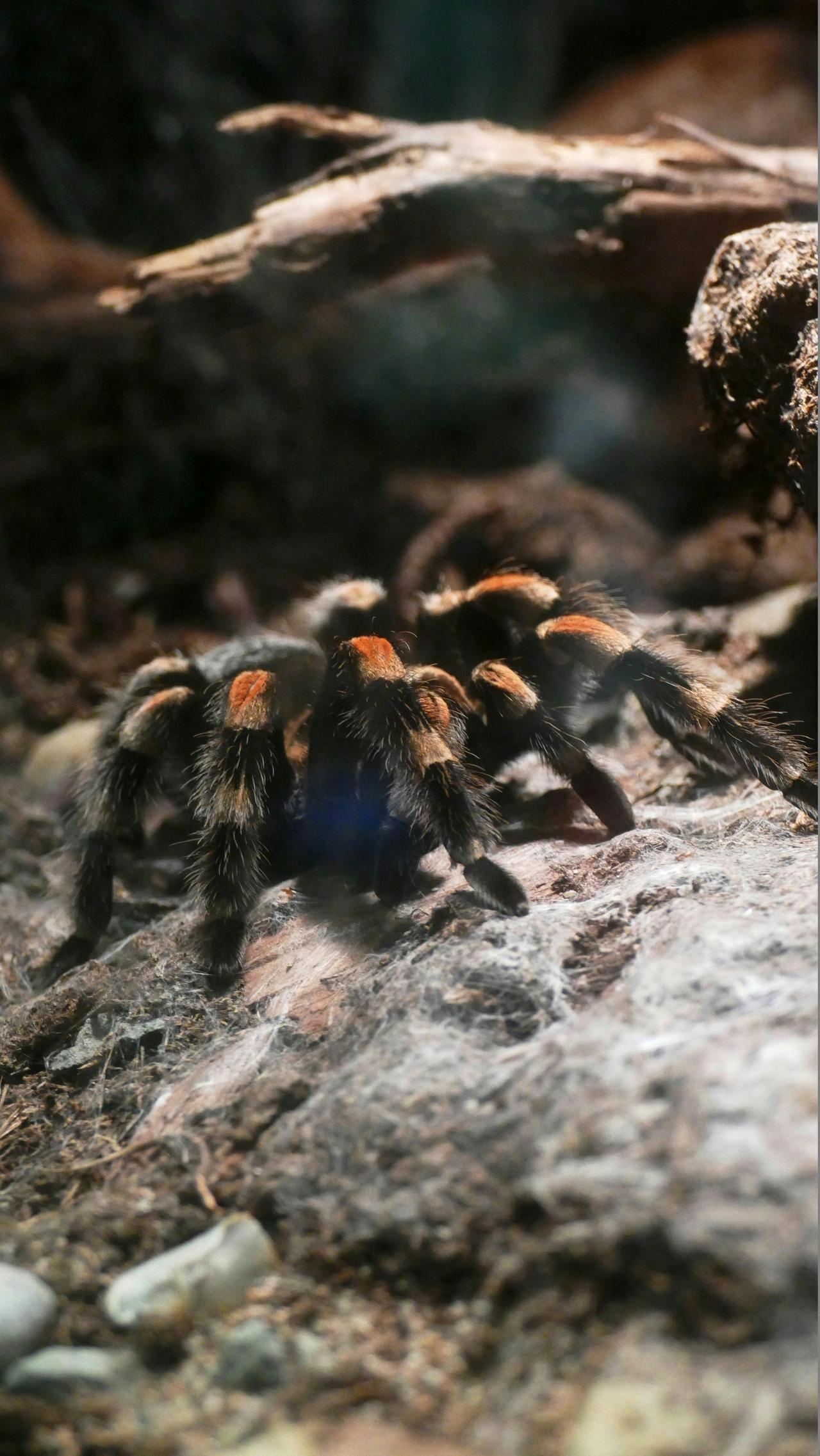
Mexican Red-Kneed Tarantula (Brachypelma smithi)
Realm | Animalia (Animals) | ||||||||
|---|---|---|---|---|---|---|---|---|---|
Branch | Arthropoda (Arthropods) | ||||||||
Class | Arachnida (Arachnids) | ||||||||
Team(s) | Araneae (Spiders) | ||||||||
Family | Theraphosidae (Tarantulas) | ||||||||
Genus | Brachypelma | ||||||||
Specie(s) | Brachypelma smithi (Mexican Redknee Tarantula) | ||||||||
Conservation Status (IUCN) | CITES Appendix II (trade under regulation) | ||||||||
Natural Habitat | Semi-arid regions of Mexico near the Pacific coast | ||||||||
The Mexican Redknee Tarantula (Brachypelma smithi) is a species of tarantula native to México, known for its striking coloration and generally docile nature. This spider, which lives close to the ground, is among the most recognized and commonly kept as a pet tarantulas worldwide. In its natural habitat of humid and semi-arid regions, it primarily resides in burrows it digs itself. This species is protected under CITES and is frequently encountered in scientific research, documentaries, and exotic pet collections.

Brachypelma smithi (Pixabay)
Brachypelma smithi is one of the larger and more robust spider species. The leg span of adult individuals typically reaches 12–15 cm. The body consists of two main regions: the prosoma (cephalothorax) and the opisthosoma (abdomen). These two regions are connected by a narrow structure called the pedicel. The chitinous exoskeleton provides both structural support and protection against external environmental factors.
Coloration is a defining feature of this species. Prominent orange and red bands appear on the leg joints against a black background. These colors serve both to deter predators and to facilitate recognition among individuals.
Each of the eight legs consists of seven segments: coxa, trochanter, femur, patella, tibia, metatarsus, and tarsus. These structures enable the spider to capture prey and move with precision across uneven surfaces. At the tips of the legs, fine-haired tarsal combs are present and play a role in detecting environmental vibrations.
On the front of the body are two chelicerae (venomous jaw structures). These are used both to kill prey and to initiate digestion. The venom injected through the chelicerae liquefies the internal tissues of the prey, allowing the tarantula to suck up the resulting fluid. The chelicerae of females are generally thicker and more robust than those of males.
The abdomen (opisthosoma) is relatively softer and covered with microscopic hairs as well as urticating hairs used for defense. When threatened, the spider rubs these hairs off with its legs and releases them into the air, potentially causing irritation to the eyes, nose, or skin of predators. Respiration occurs through book lungs located on the sides of the abdomen.
The visual system consists of eight simple eyes. However, these eyes are not adapted for detailed vision but rather for detecting motion. The tarantula’s primary sensory organs are the sensory hairs on its legs and the pedipalps, which resemble small pincers. In males, the pedipalps are used to transfer sperm during mating.
This detailed morphological structure is fundamental to understanding the biological adaptations and survival strategies of Brachypelma smithi in its natural environment.

Brachypelma smithi – Ventral View of the Mexican Redknee Tarantula (Pixabay)
This species is found exclusively in western México, particularly in the semi-arid and scrubland regions of the states of Guerrero and Oaxaca. This geography lies at the edge of the tropical climate zone and is characterized by dry, hot conditions and loose soil for most of the year. This soil composition is ideal for the deep burrows the tarantula constructs underground. Burrows typically range from 20 to 40 cm in depth and are lined internally with silk secreted by the spider.
These burrows provide protection from daytime heat and facilitate the capture of prey that approaches the entrance. Brachypelma smithi is generally solitary and rarely ventures far from its burrow. Maintaining adequate humidity and filtering sunlight are vital for its life cycle. Natural habitats are shrinking due to human settlements and agricultural activities.
Tarantulas are generally nocturnal. Brachypelma smithi is a typical night hunter. It captures prey—primarily insects such as ants, cockroaches, grasshoppers, small lizards, and occasionally small mammals—by ambushing them near the entrance of its burrow. Once captured, it injects venom through its chelicerae to liquefy the internal organs, which it then consumes. The mating season typically occurs during spring and summer. When a male tarantula locates a female’s burrow, he approaches cautiously, using specific leg taps and silk signals to communicate with her.
After a successful mating, the male usually flees quickly, as he is at risk of being preyed upon by the female. Several months after mating, the female produces an egg sac containing 300–500 eggs. This sac is kept within the burrow and guarded for 6–8 weeks. After hatching, the spiderlings disperse within a few weeks. Growth is slow; it takes 4–7 years for them to reach full maturity. Females can live up to 20 years, while males typically die shortly after mating.
Brachypelma smithi is a typical carnivore whose feeding strategy relies heavily on passive ambush. It feeds on ants, cockroaches, grasshoppers, small lizards, and occasionally small mammals. Before attacking, it positions itself by detecting vibrations in the environment. When prey movement is sensed, it launches a rapid strike, seizing the prey with its chelicerae and injecting venom. The venom quickly immobilizes the prey by affecting its nervous system. The spider then uses its external digestion system to liquefy the prey’s internal tissues and suck up the resulting fluid. An adult Brachypelma smithi feeds once or twice a week. It is highly resistant to prolonged fasting and can survive for weeks without food by slowing its metabolism during seasonal droughts.
The defense strategy of Brachypelma smithi is based on deterrence rather than aggression. First, it uses its legs to rub off urticating hairs from its abdomen and flicks them into the air. These hairs cause severe irritation when they come into contact with sensitive areas such as the eyes, nose, or skin of potential predators. This defense is particularly effective against mammals and birds. If the threat persists, the spider may retreat or resort to biting.
Its venom is generally not lethal to humans but can cause allergic reactions, localized swelling, and pain. Although widely traded as a pet, irresponsible care and illegal collection pose threats to animal welfare and natural populations. Due to its generally docile nature, Brachypelma smithi is commonly kept as a pet. However, improper care conditions—including stress, insufficient humidity, and inappropriate temperatures—can shorten its lifespan and trigger aggressive behavior. Therefore, thorough research and ethical sourcing are essential before acquisition.

Brachypelma smithi (Pixabay)
Although Brachypelma smithi is not currently classified as endangered, it is protected due to habitat destruction and the pet trade. It is listed under Appendix II of CITES (the Convention on International Trade in Endangered Species of Wild Fauna and Flora), meaning its international trade is regulated. In recent years, increased illegal collection and uncontrolled harvesting have led to declines in natural populations.
This situation, particularly the extraction of juvenile specimens from the wild, threatens the species’ reproductive cycle. Additionally, climate change and drought are reducing the availability of natural habitats. Some local and international initiatives aim to monitor the species in the wild, establish captive breeding programs, and promote conservation education. The Mexican government and various environmental organizations are working to protect released individuals and regulate commercial activities to ensure the species’ long-term survival.
Although tarantulas are often feared, Brachypelma smithi has contributed to changing this perception. It is frequently used in educational programs for children to reduce arachnophobia and raise awareness about ecosystem balance.
Scientifically, research has been conducted on the pharmacological properties and toxin structure of its venom. These studies have provided models for understanding nerve cell transmission, pain receptors, and muscle contraction mechanisms. Additionally, spider silk, due to its high tensile strength and elasticity, has gained prominence in biomaterials research.
Culturally, tarantulas are not feared but respected by indigenous communities in México as part of nature. In some mythologies, they symbolize patience, underground wisdom, and tranquility.
Aixklusiv. "Kaplama Oluşturma Tarantula Makro JPG." Pixabay. Accessed May 11, 2025. https://pixabay.com/tr/photos/kaplama-olu%C5%9Fturma-tarantula-makro-3344820/.
Animal Diversity Web. "Brachypelma smithi: INFORMATION." Accessed May 12, 2025. https://animaldiversity.org/accounts/Brachypelma_smithi/.
CITES. "Redknee." Accessed May 12, 2025. https://cites.org/eng/gallery/species/invertibrate/redknee.html.
Cornell University. “Tarantulas: Terrible or Terrific!” Accessed May 12, 2025. https://blogs.cornell.edu/spiders/tarantulas-terrible-or-terrific/.
Lange, Marcus. “Kahverengi ve Siyah Örümcek JPG.” Pexels. Accessed May 11, 2025. https://www.pexels.com/tr-tr/fotograf/kahverengi-ve-siyah-orumcek-3234842/.
Maryland Zoo. "Mexican Redknee Tarantula." Accessed May 12, 2025. https://www.marylandzoo.org/animal/mexican-redknee-tarantula/.
Pixabay. “Tarantula – Brachypelma JPG.” Accessed May 11, 2025. https://pixabay.com/tr/photos/tarantula-brachypelma-62868/.
Tarantupedia. "Brachypelma smithi." Accessed May 12, 2025. https://www.tarantupedia.com/theraphosinae/brachypelma/brachypelma-smithi.
The provided content is an HTML snippet containing a transparent image tag with no visible text or citation data. It does not contain any Turkish text to translate, nor does it include any bibliographic elements (such as author, title, access date, URL, etc.) that require translation under the specified rules.Therefore, no translation is needed or possible from the given input.**Output:**(no translation required — no citatable content present)

Mexican Red-Kneed Tarantula (Brachypelma smithi)
Realm | Animalia (Animals) | ||||||||
|---|---|---|---|---|---|---|---|---|---|
Branch | Arthropoda (Arthropods) | ||||||||
Class | Arachnida (Arachnids) | ||||||||
Team(s) | Araneae (Spiders) | ||||||||
Family | Theraphosidae (Tarantulas) | ||||||||
Genus | Brachypelma | ||||||||
Specie(s) | Brachypelma smithi (Mexican Redknee Tarantula) | ||||||||
Conservation Status (IUCN) | CITES Appendix II (trade under regulation) | ||||||||
Natural Habitat | Semi-arid regions of Mexico near the Pacific coast | ||||||||
No Discussion Added Yet
Start discussion for "Mexican Red-Kneed Tarantula (Brachypelma smithi)" article
Morphological Characteristics
Distribution and Habitat
Behavior and Life Cycle
Feeding Habits and Hunting Strategies
Defense Mechanisms and Human Interactions
Conservation Status and Threatened Populations
Scientific Significance and Cultural Implications