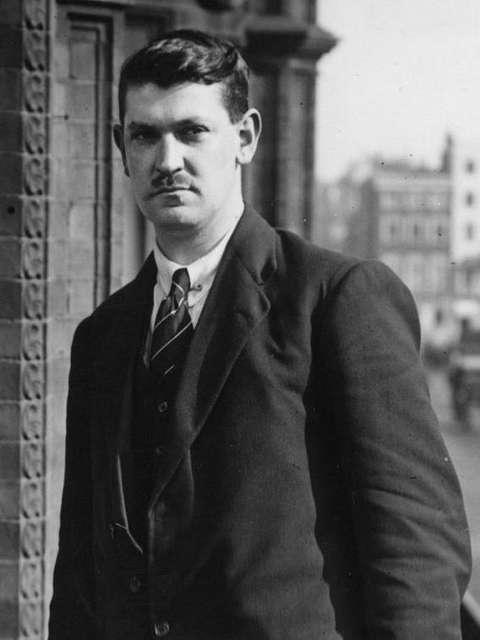
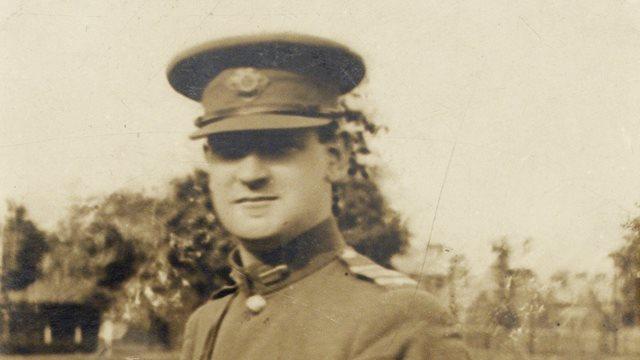

Michael Collins (1890–1922) was one of the most prominent revolutionary leaders in Ireland’s struggle for independence at the beginning of the 20th century. As the founder of the Irish Republican Army’s (IRA) intelligence network and one of the signatories of the Anglo-Irish Treaty, he played a decisive role in both the course of the war and the birth of the new Irish state. His early death has generated a wide range of legends and debates surrounding his legacy.
Documentary on Michael Collins (Vimeo)
Michael Collins was born on 16 October 1890 at Woodfield, a family farm in the village of Sam’s Cross, County Cork, in western Ireland. He was the youngest of eight children. His father, also named Michael Collins, was a farmer who had participated in the Fenian movement; his mother, Mary Anne O’Brien, was fifty years younger than her husband and devoted herself to raising their children. On his deathbed, his father expressed his belief that his son would accomplish great things for Ireland.
He received his early education at national schools in Lisavaird and Clonakilty. His teachers, Denis Lyons and local blacksmith James Santry, instilled in him a strong sense of nationalism at an early age. Those around him described him as an ambitious, stubborn and intelligent child.
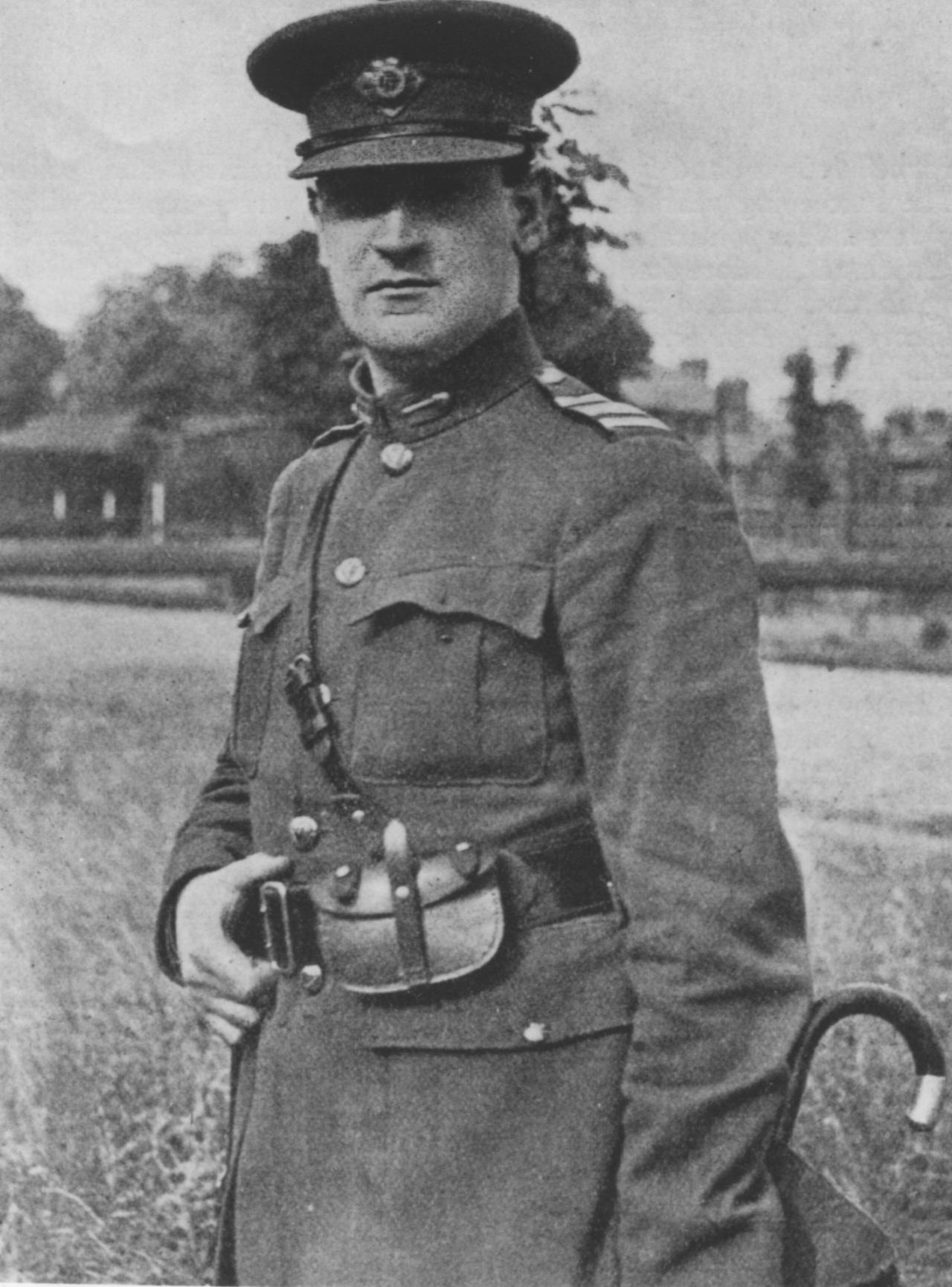
Michael Collins (Flickr)
In 1906, Collins won a competitive examination that secured him a position with the British Post Office and moved to London, where he began work at the Post Office Savings Bank. He later worked for a stockbroker and at the Board of Trade; in 1915 he was appointed senior clerk at the Guaranty Trust Company.
During his years in London, he joined the Gaelic Athletic Association (GAA) and the Gaelic League. In 1909 he entered the secret Irish Republican Brotherhood (IRB). The organizational experience and bureaucratic knowledge he gained there proved vital in later building his intelligence network.
Returning to Ireland at the end of 1915, Collins began working with the Plunkett family and served as an aide-de-camp (ADC) to Joseph Mary Plunkett during the 1916 Easter Rising. He was stationed at the General Post Office in Dublin. Despite sustaining a wound, he participated in the fighting, helping to dismantle barricades and managing supplies and communications.
After the failure of the uprising, he was arrested and sent to the Frongoch internment camp in Wales. There, in an environment known as the “university of revolution,” he participated in strategic discussions and quickly emerged as a leading figure.
Joining Sinn Féin in 1917, Collins rapidly rose within the party and gained recognition for a forceful speech at the funeral of Thomas Ashe in the same year. In 1918 he was elected as a member of parliament for Cork South in the Irish parliamentary elections. During this period he played an active role in organizing the IRA and became its Director of Intelligence.
Collins established an extensive spy network stretching as far as the Dublin Metropolitan Police and Dublin Castle. He created a special assassination unit known as “The Squad,” which carried out targeted killings against British intelligence operatives. The unit’s most famous operation occurred on 21 November 1920, known as “Bloody Sunday,” when twelve British intelligence officers were killed.
As Minister for Finance in the newly established Dáil Éireann in 1919, Collins raised hundreds of thousands of pounds through a fundraising campaign called the “National Loan,” laying the financial foundation for the new republic. He also managed arms procurement and prisoner escape operations; in 1919 he organized Éamon de Valera’s escape from Lincoln Prison in England.
Following the truce declared in July 1921, Collins participated as a delegate in negotiations in London. Although initially reluctant, he became one of the signatories of the Anglo-Irish Treaty on 6 December 1921. The treaty established the Irish Free State comprising twenty-six counties, while leaving six northern counties within the United Kingdom. Collins described this as “a stepping stone to freedom.”
After the treaty, Collins became Chairman of the Provisional Government in January 1922. However, the treaty caused a deep split within Sinn Féin. Although Collins signed a “pact” with Éamon de Valera in an attempt to appease republican opposition, no lasting compromise was achieved.
In June 1922, after anti-treaty forces occupied the Four Courts in Dublin, Collins ordered the building to be besieged using artillery borrowed from the British. This event marked the beginning of the Irish Civil War.
Collins quickly became Commander-in-Chief of the National Army. Through military campaigns, he reclaimed Munster and western regions. However, it is also known that during the war he sought ways to negotiate peace with his opponents.
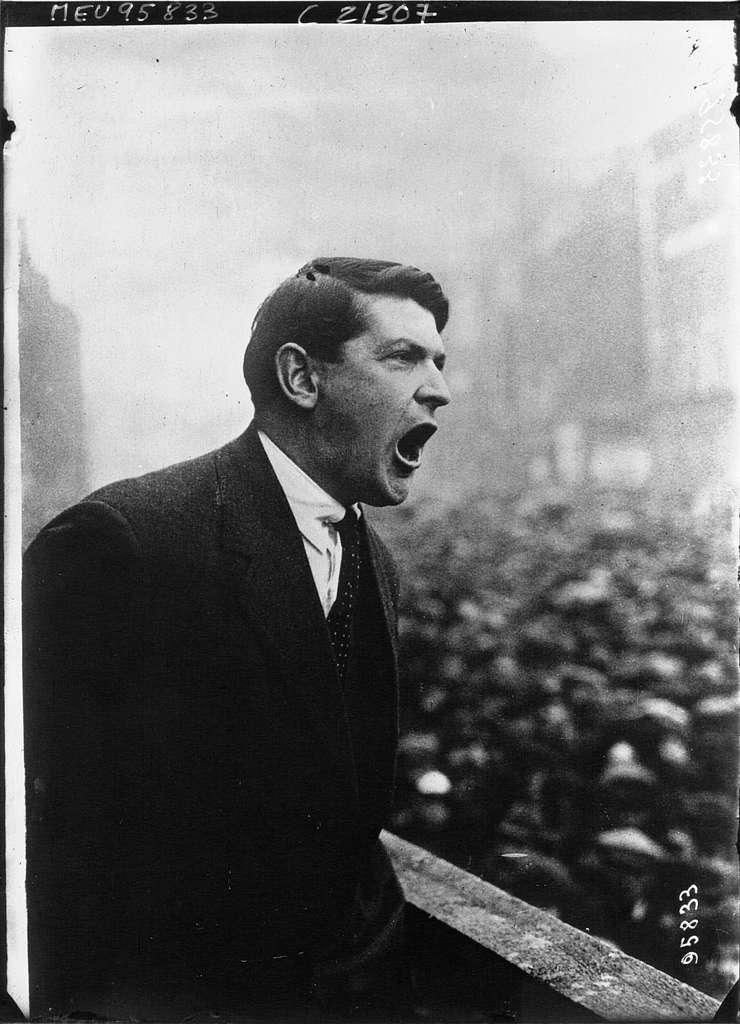
Michael Collins Addressing the Public in Skibbereen on Saint Patrick’s Day 1922 (GetArchive)
On 22 August 1922, Collins was ambushed at Béal na mBláth near Cork. After his convoy came under attack, he stopped to join the firefight and was killed by a bullet to the head. He was 31 years old.
His funeral in Dublin was attended by hundreds of thousands of people. For many years after his death, there was debate over who fired the fatal shot; while some believed it was the result of a conspiracy, most historians accept that he was killed by Denis “Sonny” O’Neill, an anti-treaty fighter.
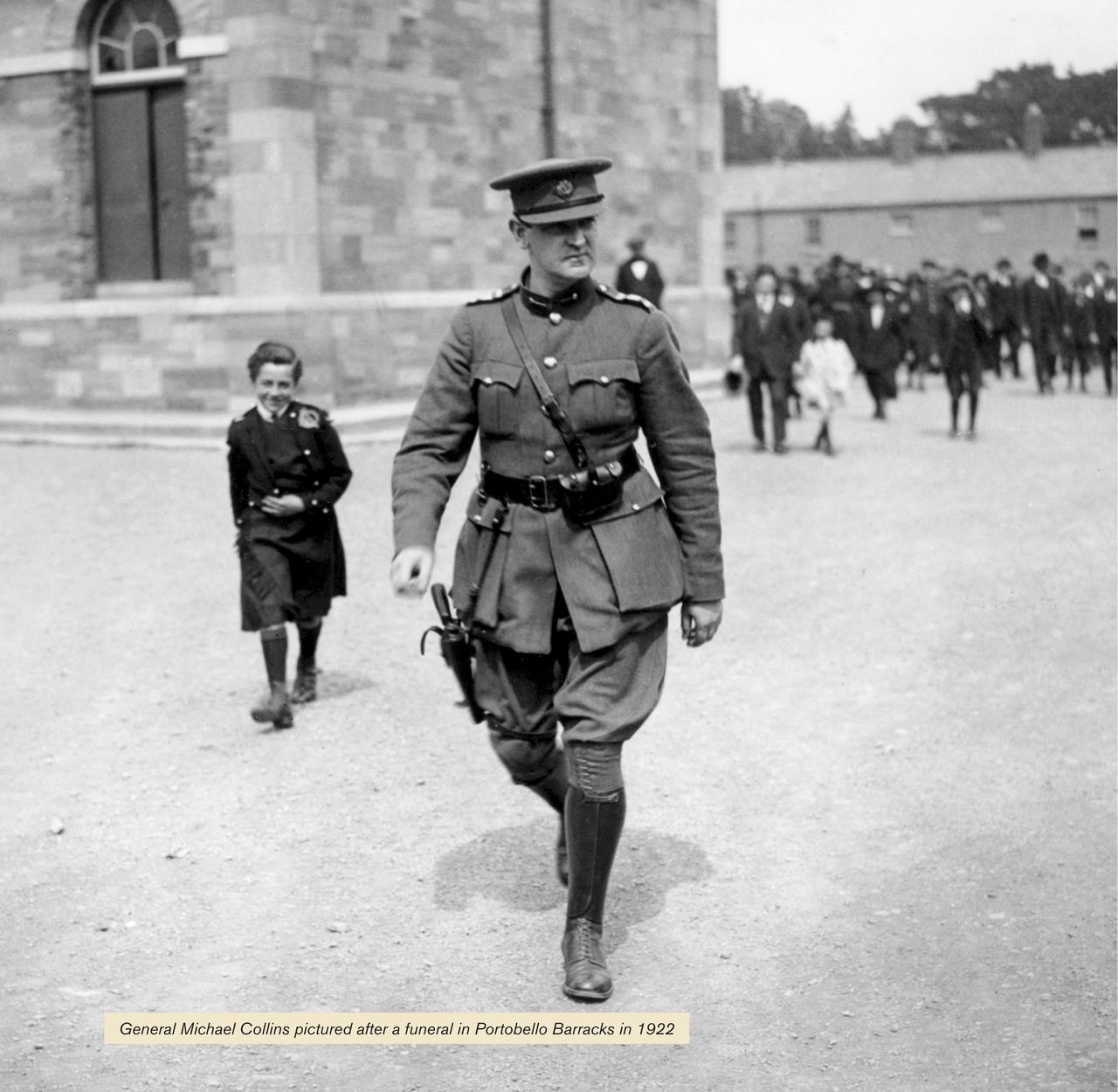
General Collins Leaving Cathal Brugha Barracks Before His Death (Flickr)
Collins’s death intensified the Irish Civil War. His charisma, pragmatic leadership and legendary escapes during the war transformed him into a heroic figure known as “The Big Fellow.”
Collins’s life remains a subject of debate in Ireland to this day. The Fine Gael party embraces him as a founding leader, while Sinn Féin and the anti-treaty tradition have long viewed him as a traitor. His legend reached international audiences through Neil Jordan’s 1996 film Michael Collins.
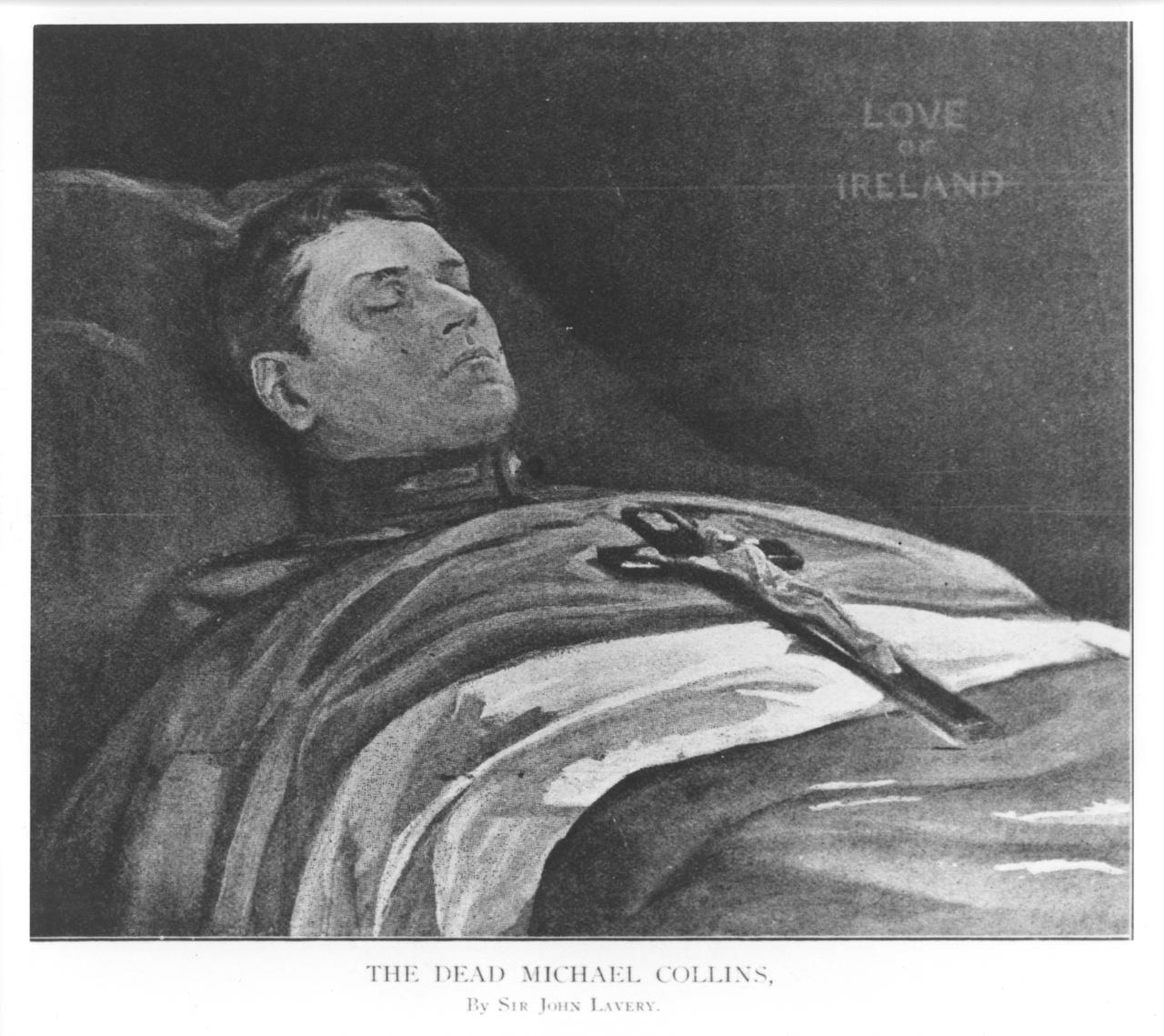
Sir John Lavery’s Painting Depicting General Collins’s Body on Display During the State Funeral (Flickr)
Collins, Michael. *Dictionary of Irish Biography.* Accessed August 16, 2025. https://www.dib.ie/biography/collins-michael-a1860
Michael Collins House. "Michael Collins Easter Rising." Accessed August 16, 2025. https://www.michaelcollinshouse.ie/videos-and-podcasts-about-micheal-collins/articles-research/michael-collins-easter-rising/
Michael Collins House. "Michael Collins in the British Media, Part 2." Accessed August 16, 2025. https://www.michaelcollinshouse.ie/videos-and-podcasts-about-micheal-collins/articles-research/michael-collins-in-the-british-media-part-2/
Michael Collins House. "Michael Collins in the British Media." Accessed August 16, 2025. https://www.michaelcollinshouse.ie/videos-and-podcasts-about-micheal-collins/articles-research/michael-collins-in-the-british-media/
Rodden, John. “Michael Collins at 100: Exaltation or Execration?” *Estudios Irlandeses: Journal of Irish Studies* 19 (March 17, 2024). Accessed August 16, 2025. https://www.estudiosirlandeses.org/2024/03/michael-collins-at-100-exaltation-or-execration/
“Discovering Ireland: Michael Collins.” *Discovering Ireland.* Accessed August 16, 2025. https://www.discoveringireland.com/michael-collins/
“General Michael Collins.” *The Irish War.* Accessed August 16, 2025. https://www.theirishwar.com/general-michael-collins/
“Lost Leaders: Michael Collins.” National Museum of Ireland. Accessed August 16, 2025. https://www.museum.ie/en-IE/Collections-Research/Art-and-Industry-Collections/Exploring-the-Irish-Wars,-1919-1923/Bitter-Divisions/Lost-Leaders-Michael-Collins
“Michael Collins (Photograph 1).” *Flickr, DF Magazine.* Accessed August 16, 2025. https://www.flickr.com/photos/dfmagazine/7588866272/in/photostream/
“Michael Collins (Photograph 2).” *Flickr, DF Magazine.* Accessed August 16, 2025. https://www.flickr.com/photos/dfmagazine/7588867624/in/photostream/
“Michael Collins (Photograph 3).” *Flickr, DF Magazine.* Accessed August 16, 2025. https://www.flickr.com/photos/dfmagazine/7588864984/in/photostream/
“Michael Collins, 1921.” GetArchive. Accessed August 16, 2025. https://itoldya420.getarchive.net/amp/media/michael-collins-1921-70a9c4
“Michael Collins, 1922.” GetArchive. Accessed August 16, 2025. https://itoldya420.getarchive.net/amp/media/michael-collins-1922-138b34
“Michael Collins.” Vimeo. Accessed August 16, 2025. https://vimeo.com/410993709?fl=pl&fe=vl&pgroup=plv

Childhood and Early Years
Years in London
The 1916 Easter Rising
Political Rise and the IRA Intelligence Network
The War of Independence and the Anglo-Irish Treaty
The Provisional Government and the Civil War
Death
Legacy and Legend