


This article was automatically translated from the original Turkish version.
+2 More
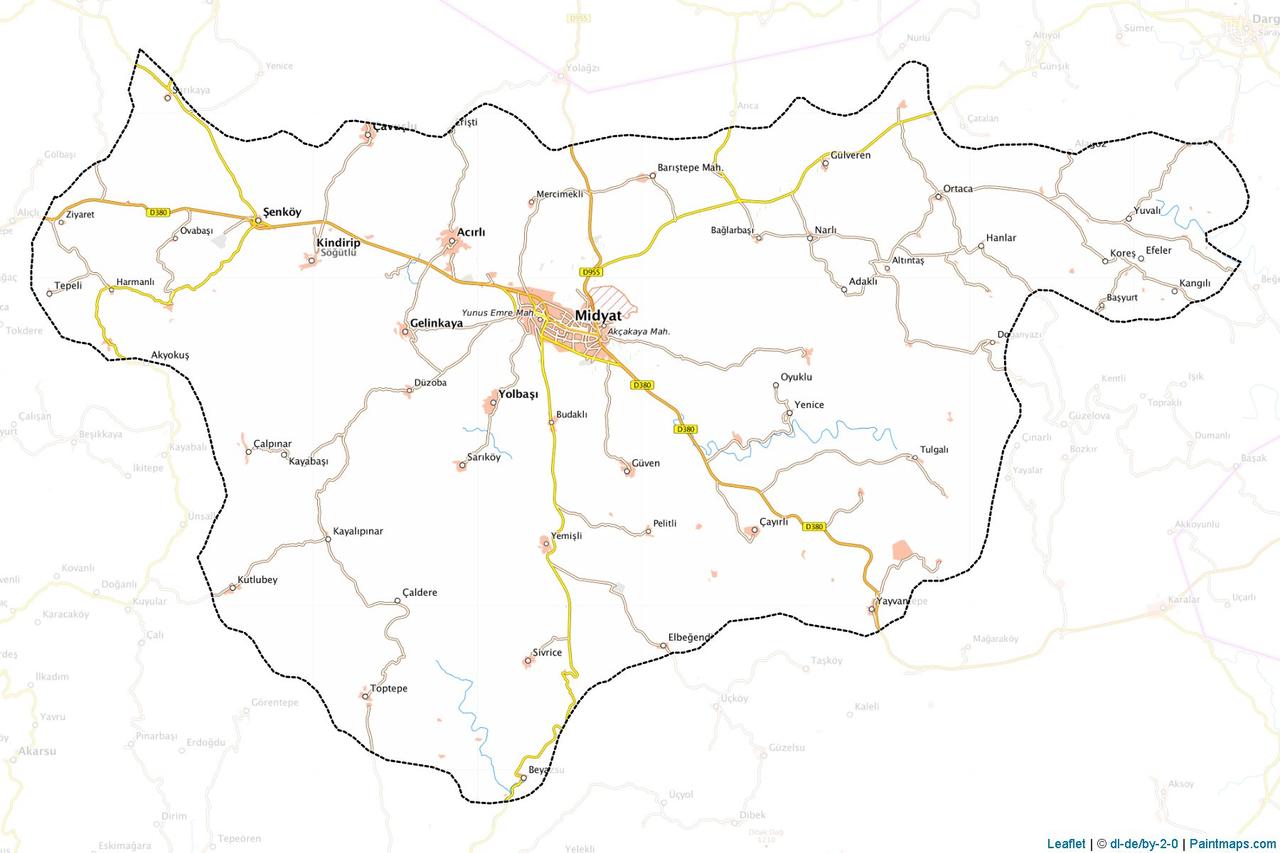
Midyat (District)
Midyat (District)
Location | Mardin Türkiye Southeastern Anatolia Region | ||||||||
|---|---|---|---|---|---|---|---|---|---|
Area(s) | More than 10 000 km² | ||||||||
Neighboring Districts | East to Dargeçit, west to Ömerli, northwest to Savur, north to Gercüş (Batman), south to Nusaybin, southeast to İdil (Şırnak) | ||||||||
Distance(s) | Approximately 1.5 hours from Mardin | ||||||||
Origin of the Name | "Ayna" (a mixture of Persian, Arabic and Syriac), "Matiate" (City of Caves in Assyrian inscriptions from the 9th century BCE) | ||||||||
Midyat is a district of Mardin Province in southeastern Türkiye. Known for its historical heritage cultural richness and unique architecture Midyat resembles an open-air museum. The district covers an area of more than 10 000 km² and is located approximately one and a half hours from Mardin.
The history of Midyat dates back to ancient times and bears traces of multiple civilizations. There are various theories regarding the origin of its name. According to some sources Midyat derives from a word formed from a mixture of Persian Arabic and Syriac meaning “mirror”. Another tradition holds that it evolved from the word “Matiate” meaning “City of Caves”. This is supported by Assyrian inscriptions which indicate that the name “Matiate” appeared in the 9th century BCE and that the Assyrian king Ashurbanipal II declared in 879 BCE “I took Matiate and its villages under my command”. The earliest settlement in Midyat being located in caves is corroborated by Roman-era remains found at the Elath (Sheikh Eles) site.
According to the 1973 Mardin Provincial Yearbook the Eti Turks who migrated from central Anatolia settled in Mesopotamia during the 2000s BCE and established Midyat as a cave city. These caves were used as interconnected dwellings linked by tunnels. Later the Komuk Turks settled in the region and engaged in prolonged conflicts with the Assyrians. Between 500 and 100 BCE the region was ruled by the Macedonians Persians and Romans. Midyat became permanently inhabited during the Seleucid period around 180 BCE.
Christianity dominated the region until the 5th century CE. Beginning in the 6th century the spread of Islam led to waves of incursions. In the 7th century the armies of Khalid ibn al-Walid conquered the area and during the Abbasid period significant construction activities took place. Most of Midyat’s villages were founded during the reign of Harun al-Rashid and the Mahalmi community emerged during this era. In the 11th century the region came under the control of Artuqids and Midyat experienced a golden age. Captured by the Ottomans in 1535 Midyat gained district status in 1810 and was developed in 1915 by Cevat Pasha.
Midyat is located in the Abdin region part of Upper Mesopotamia. It borders Dargeçit to the east Ömerli to the west Savur to the northwest Gercüş which belongs to Mardin to the north Nusaybin to the south and İdil which belongs to Şırnak to the southeast. Region has a hilly topography and covers an area exceeding 10 000 km². Beneath Midyat lies a network of interconnected caves that have been used as shelters throughout history.
Midyat has a transitional climate combining Mediterranean and continental characteristics. Summers are very hot and dry while winters are rainy and cold. The region’s vegetation is steppe-like and features fertile arable soils. In Midyat oak walnut pistachio like trees as well as acur watermelon and the world’s finest grapes are cultivated.
Midyat has a social structure where diverse culture and religions have coexisted. Throughout history Syriacs Turks Arabs and other peoples have lived together in this region. The Mahalmis a community known locally speak Mahalmice a mixed language of Turkish Syriac and Arabic. As the Syriacs gradually left the region the cultural center shifted to Estel yet Midyat’s cultural diversity has persisted.
Midyat’s economy is based on agriculture animal husbandry and handicrafts. Fertile soils produce grape pistachios melons and other crops. In addition metalworking and filigree craftsmanship are among the district’s key economic activities. Several master filigree artisans in Midyat’s bazaar continue this tradition. Tourism has also increasingly become an important part of the local economy in recent years.
Midyat evokes a medieval town with its caravanserais arched passages Syriac churches and mosques. Notable sites to visit include Midyat House Estel Cultural House Municipality Museum Pavilion Square Gümüşçüler Bazaar Gelüşke Han Purple Gabriel (Deyrulumur) Monastery and Beyazsu Recreation Area. The Mor Gabriel Monastery built in 397 CE was placed under protection during the time of Hz. Omar. Accommodation options in Midyat include Kasr-ı Nehroz Shmayaa Hotel and other boutique hotels as well as Demirdağ Hotel and Matiat Hotel. Local delicacies such as kitele ırok sembusek stuffed lamb ribs and lebeniyye attract tourists.
Throughout history Midyat has been home to various ethnic and religious groups. Syriacs Turks and Arabs are the foundational elements of the region’s population. However the migration of the Syriacs altered the demographic makeup and the urban center shifted to Estel. The Mahalmis continue to exist as a distinct community of the region. Today the district exhibits a vibrant demographic profile shaped by both local residents and tourism.
Midyat is one of Türkiye’s significant historical and tourist centers with its rich heritage cultural fabric and natural beauty. Renowned for its silverwork stonemasonry and regional cuisine the district offers visitors an unparalleled experience.
Mardin Kültür ve Turizm Müdürlüğü. “Midyat.” Accessed April 9, 2025. https://mardin.ktb.gov.tr/TR-56515/midyat.html.
Mardin Valiliği. “Midyat.” Accessed April 9, 2025. http://www.mardin.gov.tr/midyat.
Midyat Belediyesi. "Gezilecek Yerler ve Konaklama Mekanları." Accessed April 9, 2025. https://www.midyat.bel.tr/gezilecek-yerler-ve-konaklama-mekanlari.
Midyat Belediyesi. "Midyat Hakkında." Accessed April 9, 2025. https://www.midyat.bel.tr/midyat-hakkinda.
Midyat Belediyesi. "Yemekler." Accessed April 9, 2025. https://www.midyat.bel.tr/yemekler.
Tanıtma Genel Müdürlüğü. “Midyat.” Accessed April 9, 2025. https://tanitma.ktb.gov.tr/TR-22723/midyat.html.
Midyat (District)
Midyat (District)
Location | Mardin Türkiye Southeastern Anatolia Region | ||||||||
|---|---|---|---|---|---|---|---|---|---|
Area(s) | More than 10 000 km² | ||||||||
Neighboring Districts | East to Dargeçit, west to Ömerli, northwest to Savur, north to Gercüş (Batman), south to Nusaybin, southeast to İdil (Şırnak) | ||||||||
Distance(s) | Approximately 1.5 hours from Mardin | ||||||||
Origin of the Name | "Ayna" (a mixture of Persian, Arabic and Syriac), "Matiate" (City of Caves in Assyrian inscriptions from the 9th century BCE) | ||||||||
History
Geographical Structure
Climate and Vegetation
Social Structure
Economic Structure
Tourism Potential
Demographic Structure