

This article was automatically translated from the original Turkish version.
+1 More
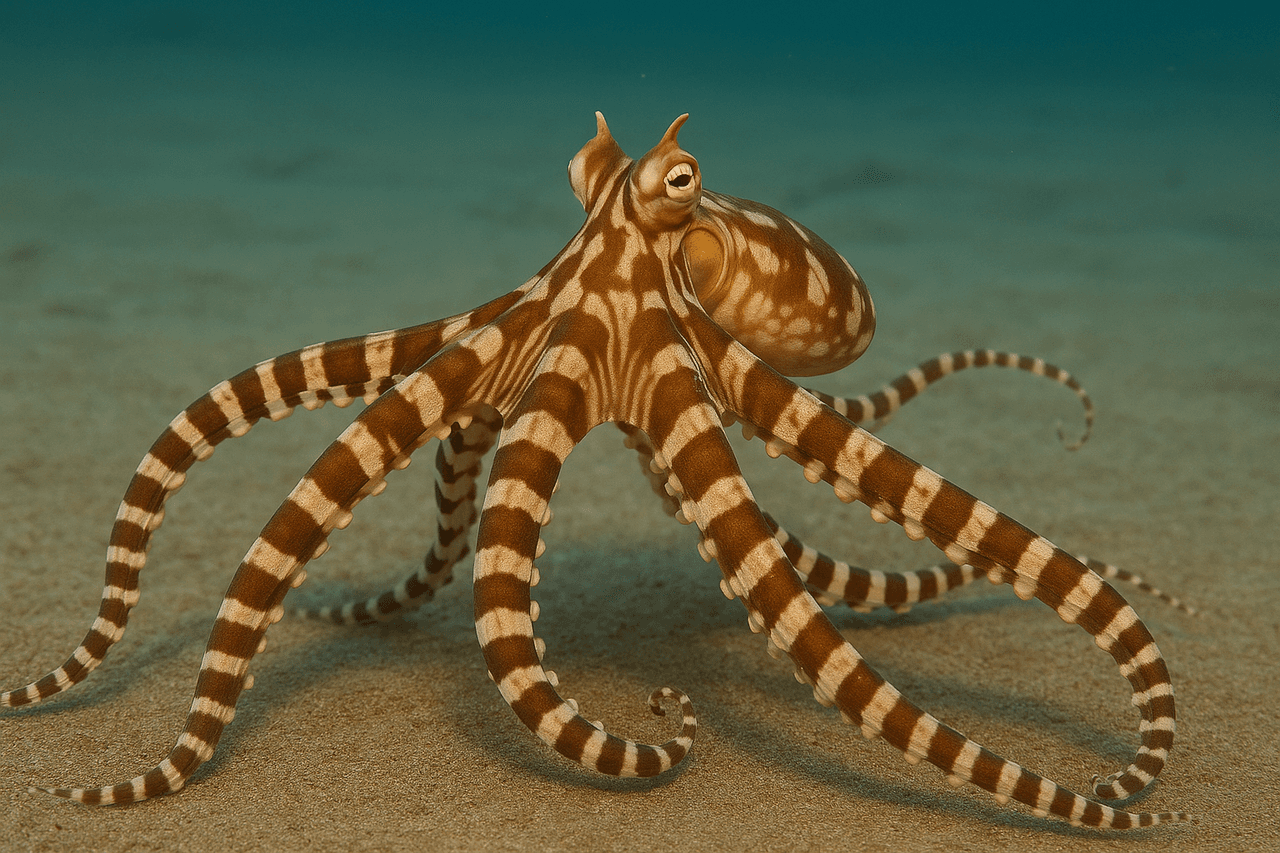
Taklitçi Ahtapot (Thaumoctopus mimicus)
Branch | Mollusca | ||||||||
|---|---|---|---|---|---|---|---|---|---|
Class | Cephalopoda | ||||||||
Family | Octopodidae | ||||||||
Type(s) | T. mimicus | ||||||||
Body Characteristics | Eight arms, double row of suckers, shell-less and soft-bodied | ||||||||
Lifespan | Approximately 9–12 months | ||||||||
Color / Pattern | Brown-white transverse striped patterns | ||||||||
Cells in the Skin | Chromatophores iridophores leukophores | ||||||||
The mimic octopus (Thaumoctopus mimicus) is a species belonging to the phylum Mollusca and the class Cephalopoda. It was introduced to the scientific community in 1998 off the coast of Sulawesi in Indonesia.
The mimic octopus is a medium-sized cephalopod with a soft, shell-less body that can reach an average length of 60 cm. Its body symmetry is radial and it possesses eight arms. Each arm is equipped with a double row of suckers that enable movement, prey capture, and attachment to the substrate. Arm lengths are generally symmetrical; however, individuals can behaviorally extend certain arms to form different shapes.
Its skin is patterned with transverse bands in shades of brown, white, and beige. These patterns arise from the interaction of pigment cells called chromatophores, iridophores, and leucophores in the skin. The skin structure can rapidly change both in color and texture to match environmental conditions. The species is capable not only of color change but also of altering its body shape to imitate various marine animals.
The eyes are located on the front of the head and provide a wide field of vision. Visual perception is highly developed. Movement is achieved through a siphon organ that expels water, following the jet propulsion principle, enabling directional locomotion.
This species is one of the most advanced mimics in nature. It has been documented to imitate at least 15 different marine animals in both appearance and movement. The most frequently mimicked species include flatfish, sea snakes, and lionfish. For example, during snake mimicry, it coils its body to create a threatening posture; during lionfish mimicry, it spreads its arms to display a venomous fin-like appearance. These mimetic behaviors encompass not only form but also behavioral traits. The ability to imitate different organisms depending on the type of threat encountered places this species among the rare examples of “dynamic mimicry.”

Mimic octopus (Generated by Artificial Intelligence.)
The mimic octopus inhabits shallow tropical seas in the Indo-Pacific region. It is found in areas such as Indonesia, Malaysia, Thailand, the Philippines, and the northern coasts of Australia. It prefers muddy and silty seabeds and lives at depths ranging from 0.5 to 37 meters. It is active during the day and prefers to hide at night.
The mimic octopus feeds on benthic organisms such as small fish, crabs, shrimp, and marine worms. It combines camouflage and mimicry behaviors to approach its prey. It can capture hidden animals with its arms, move using jet propulsion to startle prey, and confuse potential targets.
The lifespan is approximately 9 to 12 months. During mating, the male transfers a spermatophore to the female using a specialized arm called the hectocotylus and then dies. The female cleans, aerates, and guards the eggs. After the hatchlings emerge and develop, the female also dies. This short, cyclical life cycle contributes to the species’ rapid adaptation to its environment.
The International Union for Conservation of Nature (IUCN) has assessed the species as Least Concern. Sufficient data on population size and threat levels are currently lacking. However, indirect threats such as habitat loss, coastal development, plastic pollution, and excessive tourism are believed to potentially impact the species. Its mimicry ability and environmental adaptability make it a valuable model organism.
Allcock, A.L. "Thaumoctopus mimicus." The IUCN Red List of Threatened Species. Accessed June 22, 2025. https://dx.doi.org/10.2305/IUCN.UK.2019-2.RLTS.T87585522A87585525.en
MarineBio Conservation Society. “Mimic Octopuses (Thaumoctopus mimicus).” MarineBio. Accessed June 22, 2025. https://www.marinebio.org/species/mimic-octopuses/thaumoctopus-mimicus/
Pexels. “Kişinin Dokunaçları Tutan Ellerinin Fotoğrafı JPG.” Pexels. Accessed June 22, 2025. https://www.pexels.com/tr-tr/fotograf/kisinin-dokunaclari-tutan-ellerinin-fotografi-3219488/

Taklitçi Ahtapot (Thaumoctopus mimicus)
Branch | Mollusca | ||||||||
|---|---|---|---|---|---|---|---|---|---|
Class | Cephalopoda | ||||||||
Family | Octopodidae | ||||||||
Type(s) | T. mimicus | ||||||||
Body Characteristics | Eight arms, double row of suckers, shell-less and soft-bodied | ||||||||
Lifespan | Approximately 9–12 months | ||||||||
Color / Pattern | Brown-white transverse striped patterns | ||||||||
Cells in the Skin | Chromatophores iridophores leukophores | ||||||||
No Discussion Added Yet
Start discussion for "Mimic Octopus (Thaumoctopus mimicus)" article
Morphological Characteristics
Mimicry Ability and Behavior
Distribution and Habitat
Diet
Reproduction and Life Cycle
Conservation Status and Threats