


This article was automatically translated from the original Turkish version.
Definition(s) | A psychological test used to assess personality and psychopathology in clinical diagnosis | ||||||||
|---|---|---|---|---|---|---|---|---|---|
Developer(s) | Starke R. Hathaway and J.C. McKinley (1940s University of Minnesota) | ||||||||
Purpose(s) | To identify psychiatric disorders and conduct personality analysis | ||||||||
Application Area(s) | Clinical psychology and personnel selection forensic evaluation psychiatry | ||||||||
Application Duration | Approximately 1-2 hours | ||||||||
The Minnesota Multiphasic Personality Inventory (MMPI) is one of the psychometric tests developed to assess individuals’ personality traits and psychopathological conditions. Originally developed in 1942 by Stuart Hathaway and Charley McKinley at the University of Minnesota, the MMPI has become a fundamental clinical tool in psychology, psychiatry, and forensic psychology by measuring emotional, cognitive, and behavioral characteristics to evaluate various psychological disorders.
The original version of the MMPI consisted of 567 true/false items and was developed based on a sample primarily composed of white, rural individuals from the Midwestern United States. This original version later faced criticism for ethnic and sociocultural bias. In 1989, the MMPI-2 was published, featuring revised items, a more diverse sample, and a language level adjusted to a sixth-grade reading standard. In 2008, the MMPI-2-RF (Revised Form) was introduced, reducing the number of items to 338 and making the assessment more compact.
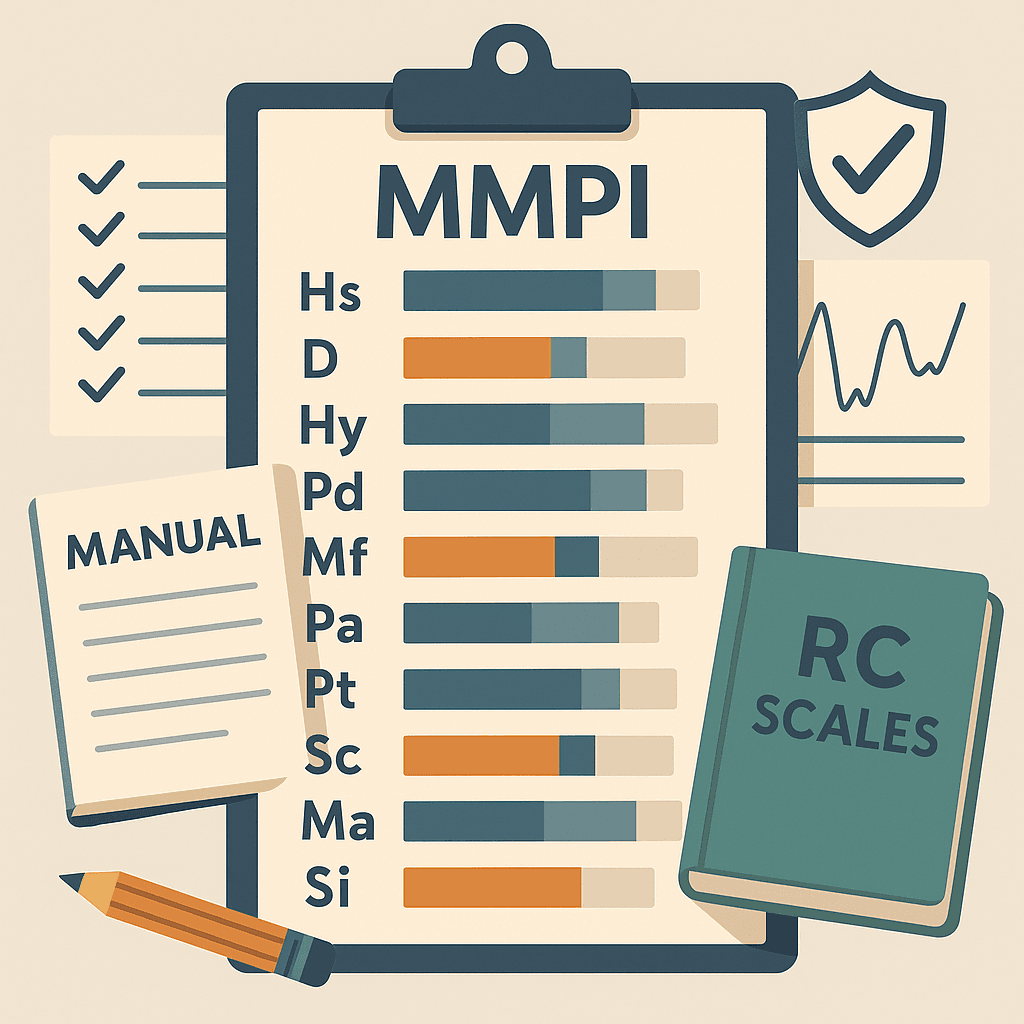
The MMPI includes numerous subscales that evaluate both the individual’s test-taking attitude and psychopathological symptoms. These scales are divided into two main categories: validity scales and clinical scales.
Validity scales assess whether the individual completed the test honestly and meaningfully:
The core clinical scales of the MMPI evaluate psychological symptoms:
Introduced in 2003, the Restructured Clinical (RC) scales were developed to reduce item overlap in the original clinical scales and improve interpretive validity. The RC scales include constructs such as demoralization (RCd), somatic complaints (RC1), low positive emotions (RC2), cynicism (RC3), and antisocial behavior (RC4). These scales aim to provide clearer information about specific psychopathological structures.
The MMPI-2-RF is a more comprehensive form comprising 51 scales. These include:
This structure enables multidimensional assessment of the individual. It is frequently used in specialized fields such as forensic psychology, personnel selection, and custody proceedings.
The MMPI is used in clinical practice to differentiate between various mental disorders and to evaluate personality disorders, depression, anxiety disorders, schizophrenia, and other psychotic conditions. It is also employed to enhance self-insight, guide treatment planning, and support the therapeutic process.
MMPI training programs are designed to provide mental health professionals with both theoretical and practical knowledge regarding test administration, scoring, and interpretation. Training covers the functioning of validity and clinical scales, profile interpretation techniques, and case analysis using real examples.
By the end of the training, participants acquire advanced knowledge of the MMPI’s structure, validity conditions, norms, and interpretation rules. This enables psychological assessment processes to be conducted within a framework of scientific validity and reliability.
Bucaram İl Milli Eğitim Müdürlüğü. “Minnesota Çok Yönlü Kişilik Envanteri (MMPI) Yazısı.” bucaram.meb.k12.tr, 2019. Accessed May 17, 2025. https://bucaram.meb.k12.tr/meb_iys_dosyalar/35/07/887814/dosyalar/2019_04/15163112_MMPI_YAZI.pdf.
Gedik Üniversitesi, Uzemi Günsem. “Kilis Minnesota Çok Yönlü Kişilik Envanteri (MMPI) Eğitimi Nedir?” uzemigunsem.gedik.edu.tr. Accessed May 17, 2025. https://uzemigunsem.gedik.edu.tr/kilis-minnesota-cok-yonlu-kisilik-envanteri-mmpi-egitimi-nedir.
National Center for Biotechnology Information (NCBI). Minnesota Multiphasic Personality Inventory (MMPI). Bethesda, MD: National Institutes of Health, 2020. Accessed May 17, 2025. http://ncbi.nlm.nih.gov/books/NBK557525/.

Definition(s) | A psychological test used to assess personality and psychopathology in clinical diagnosis | ||||||||
|---|---|---|---|---|---|---|---|---|---|
Developer(s) | Starke R. Hathaway and J.C. McKinley (1940s University of Minnesota) | ||||||||
Purpose(s) | To identify psychiatric disorders and conduct personality analysis | ||||||||
Application Area(s) | Clinical psychology and personnel selection forensic evaluation psychiatry | ||||||||
Application Duration | Approximately 1-2 hours | ||||||||
No Discussion Added Yet
Start discussion for "Minnesota Multiphasic Personality Inventory (MMPI)" article
Historical Development and Test Structure
Validity and Clinical Scales
Validity Scales
Clinical Scales
Restructured Clinical Scales (RC)
MMPI-2-RF and Modern Applications
Clinical and Educational Significance of the Test