


This article was automatically translated from the original Turkish version.
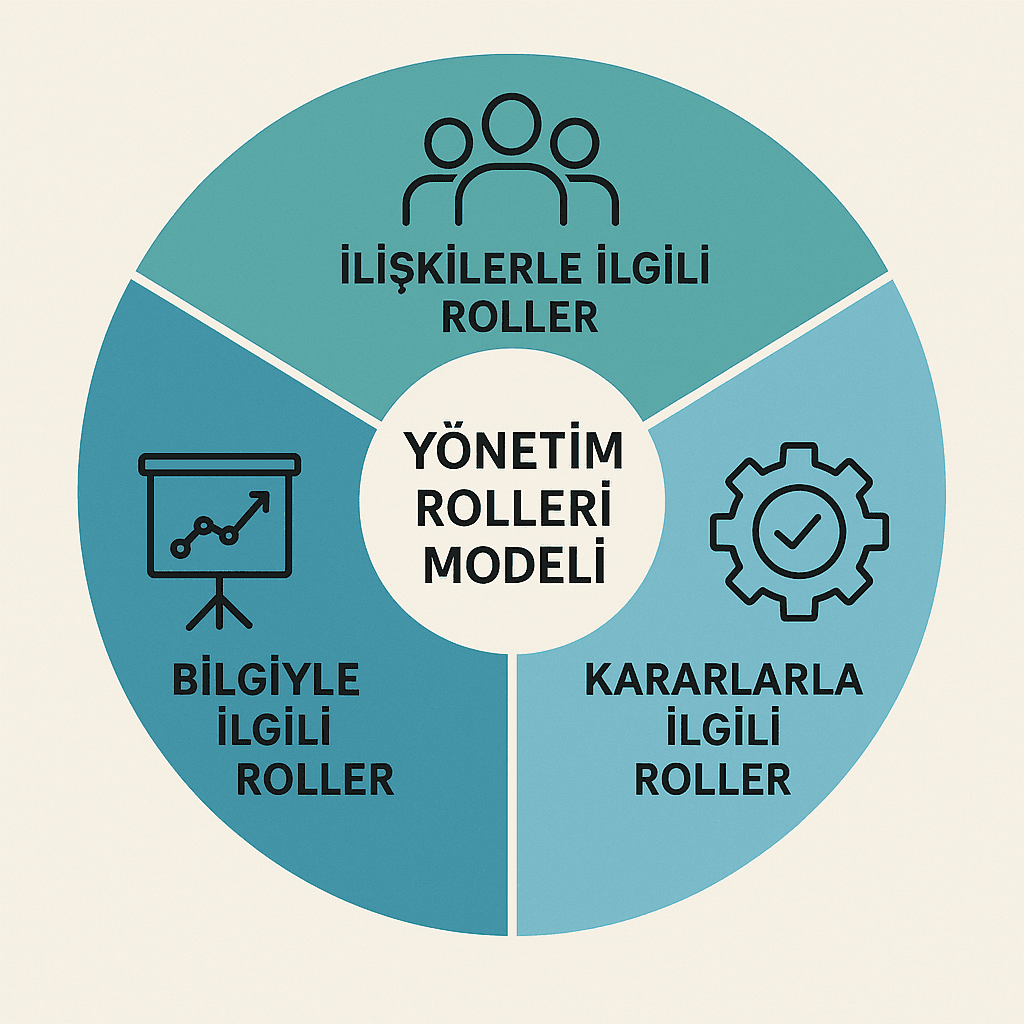
Mintzberg’in Yönetim Rolleri Modeli (Yapay Zeka ile Oluşturulmuştur)
Henry Mintzberg observed managers’ daily practices to develop the concept of “managerial roles.” In his seminal work, The Nature of Managerial Work (1973), Mintzberg categorized managerial activities into three main groups (interpersonal, informational, and decisional roles) and identified a total of ten managerial roles.
This model shifts the focus away from classical functions of management—such as planning, organizing, directing, and controlling—to highlight the multifaceted nature of managers’ roles in daily interactions, information processing, and decision-making processes.
In Mintzberg’s model, the ten managerial roles are classified under three main categories:
These roles involve direct interaction with individuals inside and outside the organization:
These roles encompass the manager’s functions of gathering, processing, and disseminating information:
These roles largely involve taking action, allocating resources, and solving problems:
Mintzberg’s Model of Managerial Roles has been the subject of numerous studies examining managerial behavior across various sectors. The model serves as a reference framework for research analyzing the structure of managers’ daily activities, time allocation, and priority distribution among roles.
In some studies conducted in the healthcare sector, it was found that managers who also hold clinical duties spend a significant portion of their time on medical practices, with managerial roles taking a secondary position. These findings demonstrate that the roles defined by Mintzberg are often intertwined in practice and that managerial responsibilities can compete with professional obligations.
Research in the context of educational institutions reports that faculty managers allocate more time to the “leader” and “liaison” roles compared to other roles, while the “entrepreneur” and “negotiator” roles emerge more limitedly. This suggests that academic institutions have a unique managerial structure shaped by social relationships, representation responsibilities, and institutional traditions.
Empirical studies in the service and tourism sector have analyzed hotel managers’ activities based on the ten roles of Mintzberg’s model. The “leader,” “resource allocator,” and “negotiator” roles were observed most intensively, while the “entrepreneur” and “disturbance handler” roles appeared less frequently. These findings indicate that in service industries, operational continuity and customer satisfaction are prioritized over innovative initiatives.
Qualitative studies in cultural institutions and civil society organizations reveal that senior managers focus on balancing artistic production, public communication, and resource management. These studies highlight that the “spokesperson” and “liaison” roles gain prominence, particularly as communication with external stakeholders and fundraising are central to managerial activities.
Recent studies indicate that the model is being reevaluated in the context of digital transformation and information management. Researchers suggest that in modern management environments, new dimensions such as “data-driven decision maker,” “strategic thinker,” or “technology interface manager” could be added to Mintzberg’s roles. These perspectives emphasize that while the core structure of the model remains valid, it must be interpreted more dynamically to reflect evolving organizational conditions.
Overall, the literature affirms that Mintzberg’s Model of Managerial Roles provides a comprehensive and explanatory framework for both theoretical and applied management research, while also showing that the relative importance of roles can vary according to sectoral, organizational, and cultural contexts.
Although Mintzberg’s Model of Managerial Roles is widely accepted in the literature on management science, it has faced various criticisms and debates over time.
Some researchers argue that the model has a descriptive nature and is insufficient in establishing causal relationships to explain managerial behavior. According to this view, Mintzberg meticulously observed what managers do but did not provide a sufficient theoretical foundation to explain why they behave in these ways.
Another criticism concerns the lack of clear boundaries between roles. From this perspective, a single managerial activity may fall into more than one role category (e.g., both informational and decisional roles). This overlap complicates the model’s measurability and empirical testability.
Some academic studies have noted that Mintzberg’s model is not sensitive to sectoral differences and cannot be uniformly applied across all sectors. In particular, the distribution of roles may vary significantly in areas such as public institutions, academic structures, or healthcare, suggesting that the model’s universal applicability is limited.
Additionally, because the model is based on organizational structures and communication patterns of the 1970s, it has been criticized for inadequately reflecting contemporary phenomena such as digitalization, virtual team management, and remote leadership. Some researchers argue that the model must be adapted to modern digital management environments.
Another point of contention is the model’s limited consideration of cultural and geographical differences. Organizational cultures, leadership styles, and societal values in different countries may directly influence managerial roles; however, the model does not adequately incorporate this diversity.
Finally, some authors argue that the model does not include new role types that have emerged in contemporary management contexts, such as “strategic thinker,” “technology manager,” or “information broker.”
These perspectives emphasize not that Mintzberg’s model needs to be updated, but rather that it should be reinterpreted as a dynamic reference framework.
Overall, evaluations in the literature confirm that Mintzberg’s model continues to offer an important framework for systematically defining managerial behavior; however, it must be used in a more flexible and context-sensitive manner to accommodate the diversity of applications and the changing management environments of today.
Accessed November 26, 2025.
Başarangil, İlke. "A Case Study within Evaluation in Managerial Level of Mintzberg’s Managerial Roles." In II. International Congress of Management Economy and Policy, ICOMEP’16, Proceeding Book, 506-515. Istanbul, 2016. Accessed October 14, 2025
Gökçe, Orhan, and Şahin, Adem. "Yönetimde Rol Kavramı ve Yönetsel Roller." Sosyal Ekonomik Araştırmalar Dergisi 3, no. 6 (2003): 133–156. Accessed October 14, 2025.
Kirişçi-Sarikaya, Aylin, and Sönmez, Tuba. "Managerial Roles of Public Education Center Administrators: An Analysis Within the Scope of Mintzberg Managerial Roles." In *EJER Congress 2023 International Eurasian Educational Research Congress Conference Proceedings*, 449–62. Ankara: Ani Publishing, 2023. Accessed October 14, 2025. https://files.eric.ed.gov/fulltext/ED638429.pdf
Kıran, Funda, and Çetinkaya Bozkurt, Özlem. "Mintzberg’in Yönetici Rolleri Modeli Kapsamında İş İlanlarının Analizi." Uluslararası Yönetim İktisat ve İşletme Dergisi 17, no. 2 (2021): 394–418. Accessed October 14, 2025
Pratici, Lorenzo, Andrea Francesconi, Gianluca Lanza, Antonello Zangrandi, and Simone Fanelli. “The Managerial Role of Healthcare Professionals in Public Hospitals: A Time-Driven Analysis of Their Activities.” *BMC Health Services Research* 23, 468 (2023). Accessed October 14, 2025. https://pmc.ncbi.nlm.nih.gov/articles/PMC10173533/

Mintzberg’in Yönetim Rolleri Modeli (Yapay Zeka ile Oluşturulmuştur)
No Discussion Added Yet
Start discussion for "Mintzberg's Management Roles Model" article
Components of the Model
1. Interpersonal Roles
2. Informational Roles
3. Decisional Roles
Applications and Research in the Literature
Criticisms and Limitations