


This article was automatically translated from the original Turkish version.
Mobile crane is a lifting and handling machine that operates via a hydraulic system, typically featuring a telescopic boom structure, and can move on roads or terrain without being anchored to a fixed foundation. These machines are equipped with their own chassis, enabling them to move independently, become operational in a short time, and safely transport heavy loads in both vertical and horizontal planes.
The primary distinction between mobile cranes and fixed cranes is that mobile cranes are ready for operation without requiring setup. This makes them efficient in terms of time and logistics. They are extensively used in construction sites, energy transmission lines, industrial assembly processes, and disaster response areas. Thanks to outriggers, rotating tower systems, and advanced control modules, they can operate with high precision in confined spaces and challenging environmental conditions.
Modern mobile crane models incorporate not only load lifting and handling functions but also intelligent technologies such as digital load balancing monitoring, remote control, and operator safety systems.
Mobile cranes perform boom extension, lifting, rotation, and load transportation through hydraulic pump systems powered by diesel engines. They are stabilized on the ground using hydraulic outriggers; operation at full capacity is not possible unless these outriggers are fully deployed. Mobile cranes vary in capacity, ranging from compact models capable of lifting 3–20 tons to industrial models capable of lifting up to 1000 tons.
Mobile crane operators must have completed at least primary education and be at least 19 years of age. Operator competence is acquired through theoretical and practical training conducted in accordance with the National Occupational Standard defined by the Vocational Qualifications Authority (MYK) under reference code 11UMS0175-3. Successful candidates receive certificates valid for five years, after which they must undergo re-evaluation.
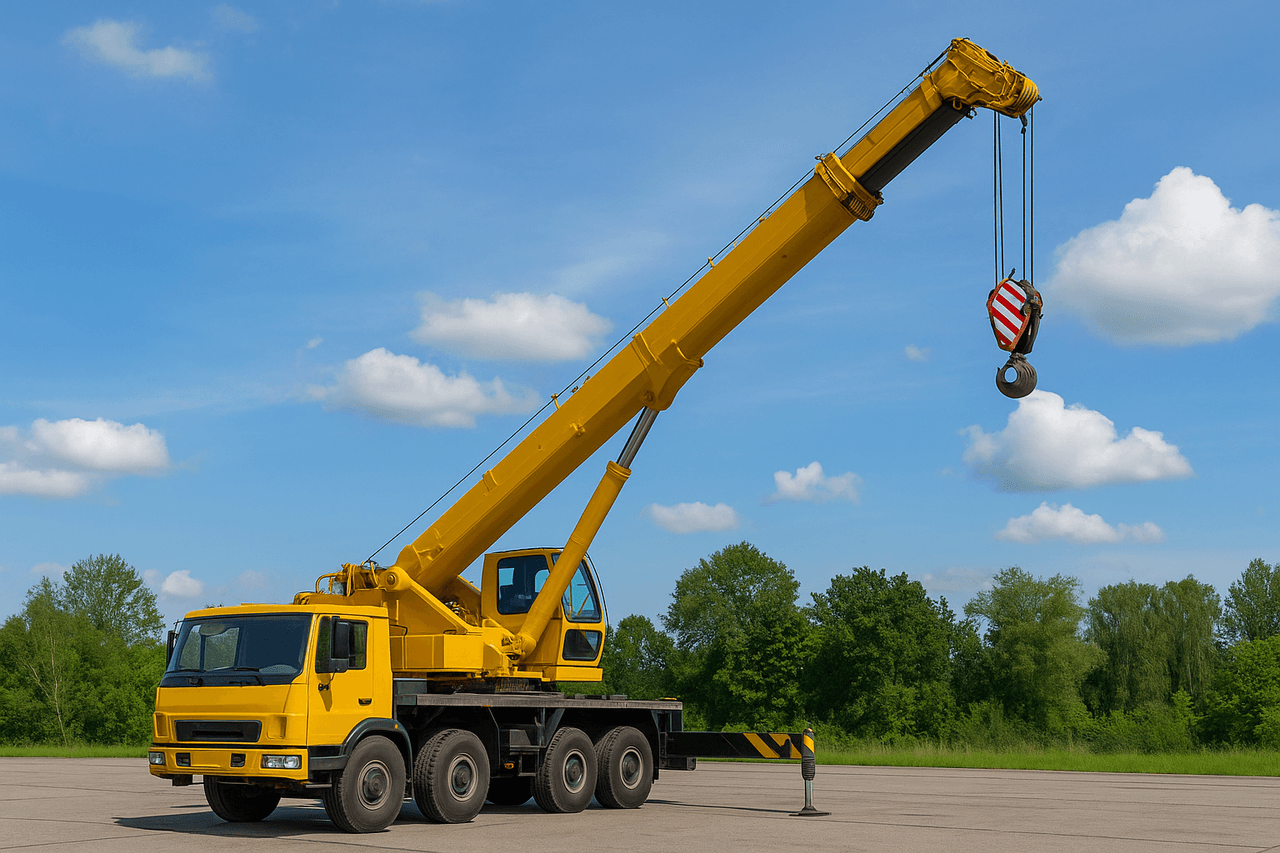
Mobil Crane (Generated by Artificial Intelligence)
According to current regulations, mobile cranes may only be operated by authorized personnel. Fire extinguishing equipment must be available at the worksite, regular periodic inspections must be carried out, and inspections are required after major repairs. These conditions are regulated under the “Regulation on Health and Safety Conditions in the Use of Work Equipment.”
Regulations governing the use of mobile cranes are defined by directives issued by the Ministry of Labour and Social Security. Educational programs implemented by the Ministry of National Education include information on hydraulic systems, occupational health and safety, environmental protection measures, machine classifications, and operational techniques. These programs are structured in accordance with sectoral needs.
Mobil cranes are machines carefully designed with regard to engineering, hydraulic systems, operator competence, and workplace safety, and must be used in compliance with standards established by the Ministry of Labour and Social Security, the Ministry of National Education, and the Vocational Qualifications Authority. These regulations are essential for ensuring operator safety, crane performance, and the prevention of workplace accidents.
Ministry of Family, Labor and Social Services of the Republic of Türkiye. "YAPI İŞLERİNDE YÜKSEKTE ÇALIŞMALARDA İŞ SAĞLIĞI VE GÜVENLİĞİ UYGULAMA REHBERİ." Güvenli İnşaat. Accessed June 22, 2025.
Ministry of Labor and Social Security of the Republic of Türkiye. "İNŞAAT SEKTÖRÜNDE KULLANILAN KULE VİNÇLER İLE YAPILAN ÇALIŞMALARDA KARŞILAŞILAN RİSKLERİN TESPİTİ VE KORUNMA YOLLARI." General Directorate of Occupational Health and Safety. Accessed June 22, 2025.
T.C. Millî Eğitim Bakanlığı. "Mobil Vinç Operatörü Kurs Programı." Talim ve Terbiye Kurulu Başkanlığı. Accessed June 22, 2025.

Technical Structure and Operating Principles
Operator Competence
Occupational Health and Safety
Regulations and Directives
Applications