


This article was automatically translated from the original Turkish version.
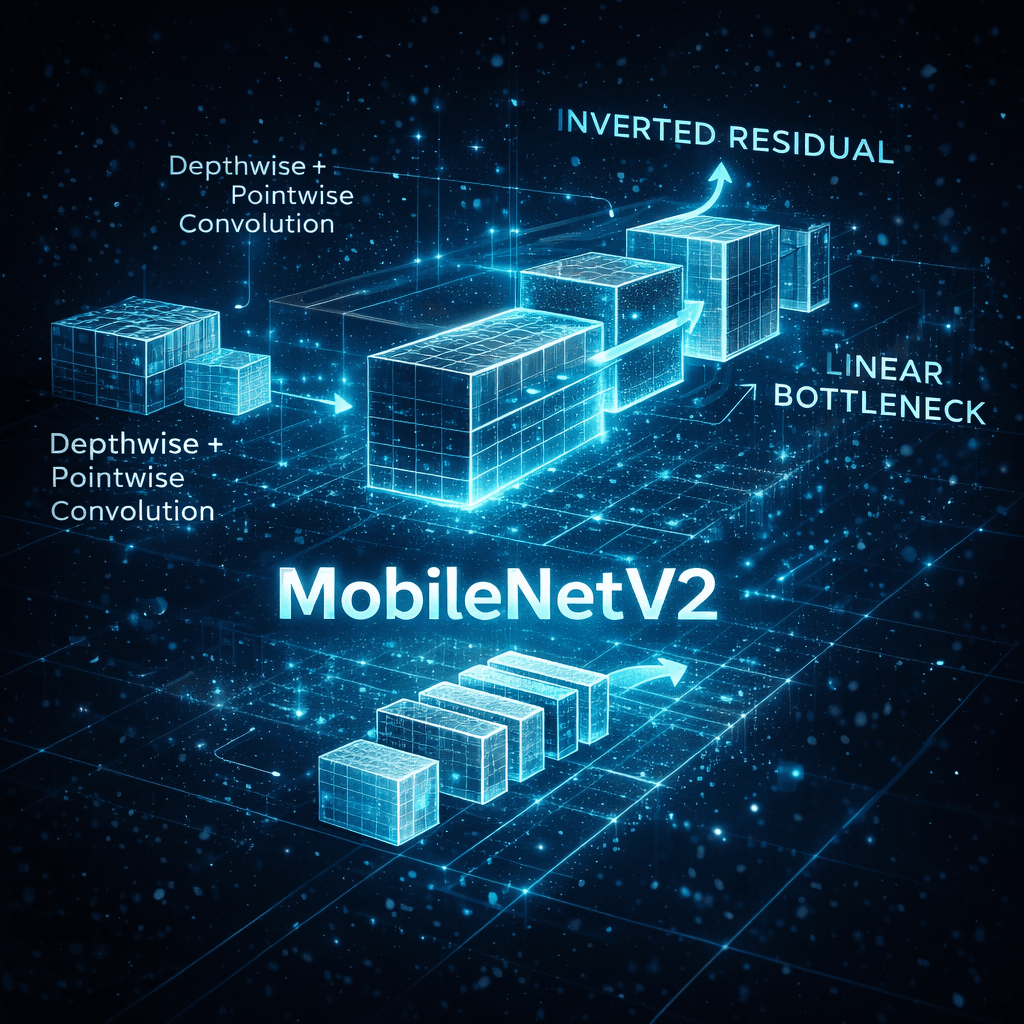
Yapay zeka ile oluşturulmuştur.
MobileNetV2 is a convolutional neural network architecture developed for mobile devices and systems with limited computational capacity. The model is based on a design approach that aims to balance low computational cost with high accuracy, combining depthwise separable convolutions, inverted residual structures, and linear bottleneck components. It is designed to serve as a backbone architecture for various computer vision tasks, including image classification, object detection, and semantic segmentation.
In deep convolutional neural networks, increased accuracy is typically achieved through more parameters and higher computational cost. However, in mobile and embedded systems, constraints such as memory usage, energy consumption, and inference latency are decisive. MobileNetV2 was developed to create an efficient architecture capable of operating under these limitations. The model not only reduces the number of operations but also introduces a novel approach to lowering the representation cost in intermediate layers.
MobileNetV1 initiated a lightweight architecture approach by significantly improving speed and efficiency through the use of depthwise separable convolutions instead of standard convolutions. MobileNetV2 builds on this approach by introducing a new block structure designed to achieve higher accuracy while minimizing information loss.
MobileNetV2 is built upon MobileNetV1 but incorporates significant structural changes. While the depthwise separable convolution approach is retained, residual connections are added to the architecture and structured differently between narrow representations. Additionally, the use of linear activations in narrow layers and the creation of expanded representations in intermediate layers constitute fundamental modifications that reorganize the model’s information flow. This arrangement aims to maintain computational efficiency while preserving representational power.
MobileNetV2’s architecture is built on three core components: depthwise separable convolution, inverted residual structure, and linear bottleneck approach. Depthwise separable convolution reduces computational cost by splitting the standard convolution into two stages. In the first stage, spatial filtering is applied separately to each channel; in the second stage, inter-channel information is combined using 1×1 convolutions. This separation requires significantly fewer operations than standard convolution, especially when the number of channels is high.
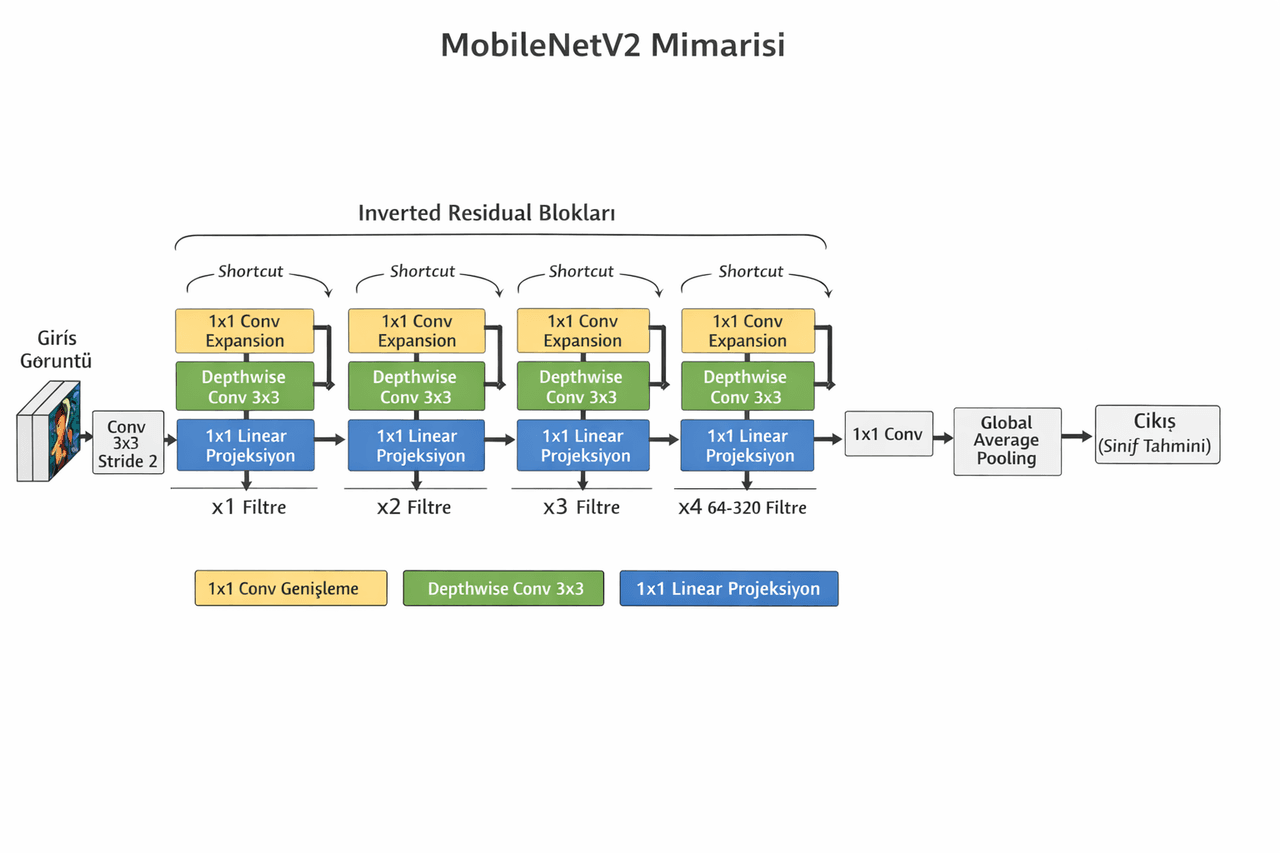
MobileNetV2 architecture (generated by artificial intelligence)
The inverted residual structure is one of MobileNetV2’s distinguishing features. In this structure, the input begins as a low-dimensional representation and is first expanded into a higher-dimensional intermediate space. Spatial filtering is then performed in this expanded space, followed by a linear projection back to a narrow representation. A residual connection is established between the narrow input and narrow output. Unlike classical residual structures, this approach enables deep representation learning while maintaining low computational cost.
The linear bottleneck approach is based on the principle of using linear activations in narrow layers. It assumes that nonlinear transformations in low-dimensional representations may cause information loss; therefore, nonlinearity is applied only in the expanded intermediate layers. This ensures the preservation of information flow.
The fundamental building block of MobileNetV2 is a three-layer block consisting of expansion, depthwise convolution, and linear projection stages. These blocks are organized across the network with specific channel levels and repetition counts. The architecture includes channel levels of 16, 24, 32, 64, 96, 160, and 320, with some blocks repeated multiple times. Stride values are used to perform downsampling at specific layers.
In the final stage of the network, a 1×1 convolution generates a high-dimensional representation, followed by global average pooling to remove spatial dimensions, and finally classification is performed in the output layer. This design enables the network to deepen while controlling resolution reduction in a structured manner.
The model’s data flow begins with the input image passing through the initial convolutional layer. The image is then processed through a series of inverted residual blocks, during which resolution is reduced at certain layers using stride. Feature maps are expanded in intermediate layers to generate more complex representations. In the final layers, a high-dimensional feature representation is created and converted into a one-dimensional vector through global average pooling. In the final stage, a classification layer produces the output. This process enables deep feature extraction with low computational cost.
MobileNetV2 has been trained on large-scale image datasets, with ImageNet being the most commonly used. During training, the cross-entropy loss function is preferred for classification tasks. Model training follows standard deep learning procedures, including data augmentation, learning rate scheduling, and regularization techniques.
The base variant of MobileNetV2 contains approximately 3.4 million parameters and 300 million multiply-add operations. Multiply-adds (MAdds) represent the total number of multiplication and addition operations performed by the model and serve as an indicator of computational cost.
Model performance is typically evaluated using top-1 and top-5 accuracy metrics. Top-1 accuracy measures the proportion of times the model’s highest-probability prediction is correct, while top-5 accuracy measures the proportion of times the correct label appears among the top five predictions. These metrics are widely used to assess classification performance.
MobileNetV2 is used as a backbone architecture adaptable to various computer vision tasks. When combined with the SSDLite structure for object detection, the prediction layers of the classic SSD architecture are replaced with lighter depthwise separable convolutions, thereby reducing computational cost.
In semantic segmentation tasks, MobileNetV2 serves as the feature extractor in the Mobile DeepLabv3 architecture. In this application, the model works with expanded layer structures to generate high-resolution feature maps.

Visual representation of the layered structure of neural networks and the learning process in deep learning systems (generated by artificial intelligence)
MobileNetV2 has become a key reference point among mobile deep learning architectures. Subsequent research has proposed new architectural arrangements based on the inverted residual and linear bottleneck structures introduced in this model. However, some studies have debated potential limitations of these structures in terms of information loss and gradient flow. In this context, alternative block structures have been developed, and various aspects of the original design have been revisited.
MobileNetV2 is used in fundamental computer vision tasks such as image classification, object detection, and semantic segmentation. The model is specifically designed to be suitable for mobile devices, embedded systems, and real-time applications.

Yapay zeka ile oluşturulmuştur.
No Discussion Added Yet
Start discussion for "MobileNetV2 Deep Learning Model" article
Development Purpose and Context
Comparison with MobileNetV1
Core Components of the Architecture
Block Structure and Network Organization
End-to-End Workflow
Training Process and Datasets
Computational Cost and Performance Metrics
Object Detection and Semantic Segmentation
Subsequent Research and Architectural Discussions
Applications