


This article was automatically translated from the original Turkish version.
Around 1900, in Egypt, ten kilograms of Santos coffee sold for 10.50 francs at retail, but when the same beans were placed in genuine Mocha sacks and labeled as “genuine Arab Mocha,” the price could rise to 50 francs.【1】How could the name of a port so dramatically alter the value of coffee?
Today the word “mocha” can refer both to a high-quality coffee and to a coffee beverage often flavored with chocolate. The origin of the name lies in Al-Mukha, the port on Yemen’s Red Sea coast known as Mocha; the French word “moka” also derives from this port’s name.【2】The term “wars” used in the title is a metaphor encompassing the conflicts surrounding coffee production, trade, and its name.
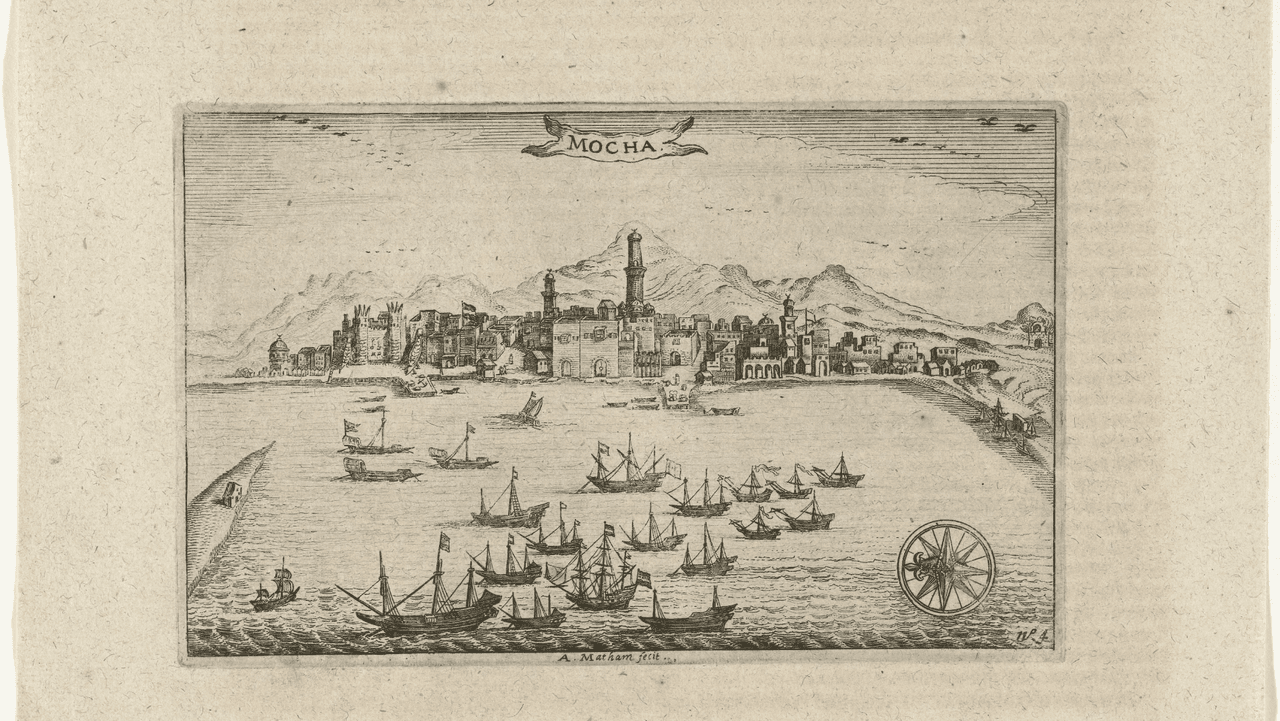
Mocha Limanı Gravürü, 1616 (Adriaen Matham)
While Arabica coffee traces its roots to the Ethiopian highlands, coffee cultivation in Yemen developed in the 15th century.【3】Behind Mocha lay a trade network connecting inland mountainous production areas to the port via Bayt al-Faqih.【4】Mocha’s rise was also aided by its status as the only port in the Arabian region permitted to receive European ships for a long period.【5】
In the first quarter of the 18th century, Yemen’s annual coffee trade volume reached approximately 12,000 to 15,000 tons and remained largely at this level throughout the century; meanwhile, coffee consumption rose rapidly.【6】Moreover, the term “Mocha” in trade was not limited to beans shipped exclusively from this port but also included coffee dispatched from other ports such as Jeddah and Hodeidah.【7】
One of the developments that shifted the balance of competition was the transfer of the coffee plant to other lands. The Dutch East India Company transported coffee plants from the Malabar coast to Batavia in 1696.【8】Two of the three attempts by the French East India Company to transport coffee from Yemen to Réunion Island in 1708, 1715, and 1718 succeeded; the island began exporting coffee in 1726.【9】
The labor systems behind this expansion differed: plantations in Réunion, Saint-Domingue, Cuba, and Brazil relied on enslaved labor, while in Java a system of compulsory cultivation was enforced.【10】In Yemen, production was based on smallholder farms; although large estates existed within the waqf system, the new production centers operated on a much larger scale.【11】Price competition extended as far as Istanbul: cheaper coffee from the West Indies arriving via Marseille began to displace coffee from Red Sea and Gulf of Aden ports.【12】
By 1840, the global share of coffee exports from the Red Sea and Gulf of Aden ports, which once supplied nearly the entire world market, had fallen to approximately 2 to 3 percent.【13】Political balances in Yemen changed from the early 19th century onward as the Qasimi dynasty lost control amid tribal uprisings and the rising power of the Wahhabi movement; later, Ottoman administration came to dominate the region.【14】
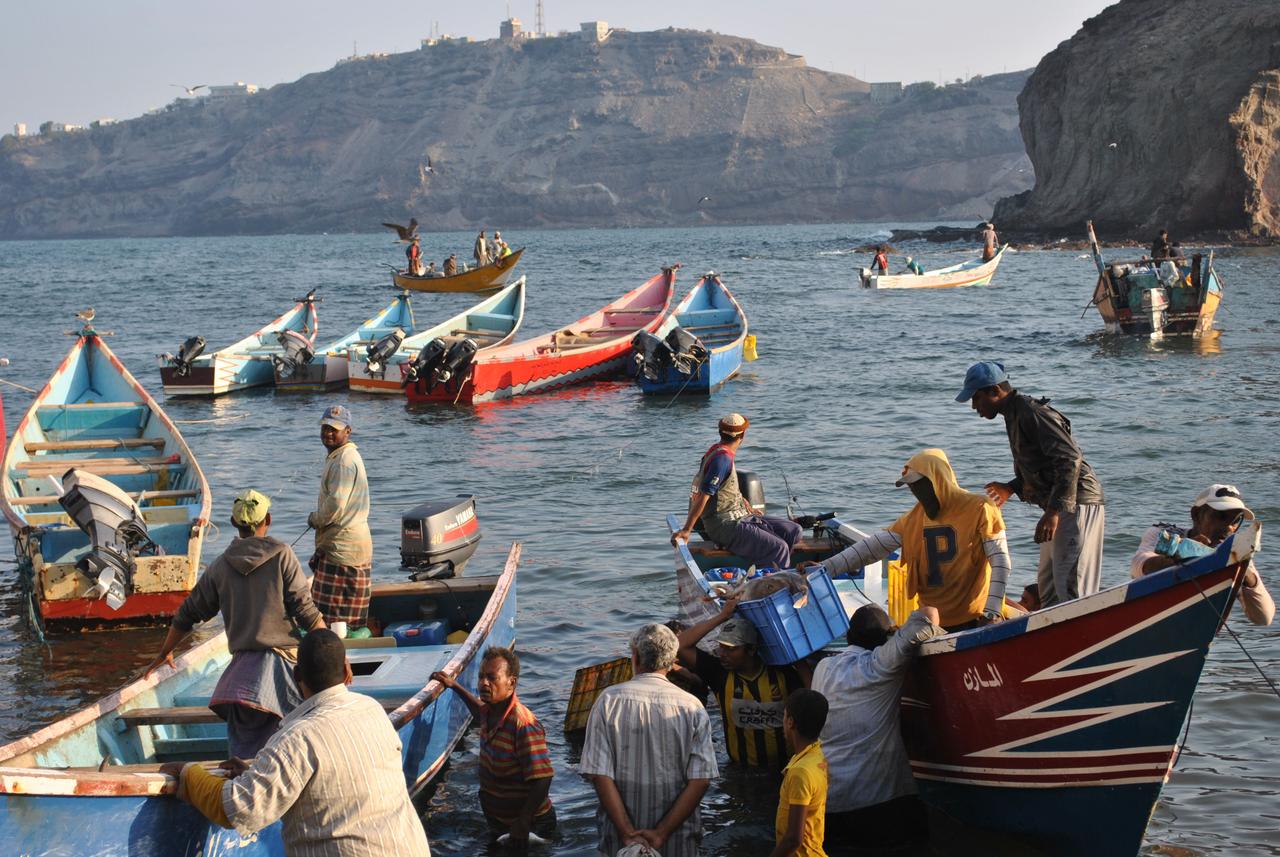
Aden Kıyısı (Pexels)
Military and political developments directly affected the fate of the ports: the British occupied Aden in 1839; the Ottomans withdrew from Mocha Port in the mid-19th century.【15】The main transshipment centers became Aden and Hodeidah; by the mid-1910s, more than half of the coffee exported from Aden originated from the African coast, particularly via Djibouti.【16】
The decline in market share did not diminish the reputation of the name: throughout the 19th century, Mocha remained one of the most highly regarded coffee names in Europe and America.【17】This reputation made it profitable to sell beans grown elsewhere under the name Mocha. Egyptian merchants transported Brazilian coffee purchased in Europe to Arabia via Aden and Jeddah, repackaged it in genuine Mocha sacks, and shipped it to Egypt and Syria.【18】The price difference at the beginning of this text explains why this circuitous journey was possible.
The same name also entered coffee blends: in the late 19th century, blending scarce and expensive Mocha coffee with other beans became one way to make it accessible to a broader consumer base. Although the exact origin date of Mocha Java blends is unknown, a ratio of one-third Mocha to two-thirds Java was among the preferred combinations by the end of the 19th century.【19】However, some blends sold under the name Mocha contained neither Mocha nor Java; Santos coffee, even a mixture of Santos and chicory, was sometimes used.【20】The issue was not only the taste of the blend but also whether consumers could trust what was inside the package.
In the United States, the Pure Food and Drug Act of 1906 introduced regulations against mislabeling food products, including coffee.【21】The 1908 Food Inspection Decision No. 91 restricted the use of the name “Mocha” to coffee grown in Yemen.【22】Yet the long history of trade had already led to Ethiopian coffee being marketed under the same name.【23】Defining the geographical boundaries of a name proved more complex than simply marking a location on a map.
In the 1912 case United States v. The Thomson and Taylor Spice Company of Chicago, Judge Landis ruled that coffee from both Arabia and Ethiopia could be sold as Mocha provided its true origin was clearly stated: labels would read “Arabian Mocha” and “Ethiopian Mocha”.【24】Nevertheless, the understanding that equated Mocha exclusively with Yemeni coffee persisted in trade. In the 1920s in the United States, it became common for blended coffees to be sold by brand name rather than by the origin of the beans.【25】

Mocha (Pexels)
Chocolate also entered the journey of the word: by 1849, “mocha” was being used to mean a mixture of coffee and chocolate.【26】
In Yemen’s recent history, a genuine civil war has raged against coffee producers: as of February 2022, conflicts ongoing since 2015 have made coffee exports difficult and contributed to declining production.【27】Rising costs, changing weather conditions, limited access to inputs, and low prices paid to farmers have further pressured production. Figures shared in February 2022 showed that coffee production had declined from 17,300 tons in 2009 to 15,200 tons, and the area under coffee cultivation had shrunk from 33,500 hectares to 27,000 hectares.【28】
The low income generated by coffee despite its high cost led some farmers to shift toward the more profitable qat plant.【29】The labor invested in growing and delivering the crop did not yield sufficient returns. As a result, continuing coffee cultivation became an increasingly difficult livelihood issue for farmers.
One such producer facing these hardships was Hussein al-Harazi from the village of Al-Hijra in the Manah district of Sanaa, who grew coffee.【30】The price of his coffee had dropped from 2,000 Yemeni rials per kilogram to 1,500 rials.【31】His income did not even cover the costs of planting and transporting the crop to market. When viewed in these terms, it becomes easier to understand why farmers were abandoning coffee production and the economic pressures behind their decisions.
After this long journey, the word “mocha” sounds somewhat different. That brief name on a menu leads us back to a port in Yemen and the people who grew and delivered its coffee. While telling the story of coffee’s global spread, we must also pause at the farmer’s field and ask: does this beloved product provide its grower with a livelihood?
At the end of this long story, rooted in the name of a port, lies the question: can the farmer sustain a living by growing coffee?
Académie française. “Moka.” Dictionnaire de l’Académie française, 9th ed., 2024. Accessed October 5, 2026.
El Bezm, Mahmud. “Kahvenin ana vatanı Yemen’de iç savaş nedeniyle kahve üretimi azalıyor.” Anadolu Ajansı, February 24, 2022. Accessed October 5, 2026.https://www.aa.com.tr/tr/dunya/kahvenin-ana-vatani-yemende-ic-savas-nedeniyle-kahve-uretimi-azaliyor-/2512594
Espinoza, Luis. "Clear Glass with Iced Mocha." Pexels. Accessed October 6, 2026.
Kaffeemuseum Burg. "How Coffee Spread." Museum.de. Accessed October 5, 2026.
Matham, Adriaen. De haven van Mocha, 1616. 1632–1634. Engraving. Rijksmuseum, collection no. RP-P-OB-75.460. Accessed October 6, 2026.
Merriam-Webster. “Mocha.” Merriam-Webster.com Dictionary. Accessed October 5, 2026.
Online Etymology Dictionary. "Mocha." Accessed October 5, 2026.https://www.etymonline.com/word/mocha
Oxford University Press. “Mocha.” Oxford Advanced Learner’s Dictionary. Accessed October 5, 2026.https://www.oxfordlearnersdictionaries.com/definition/english/mocha
Ozdemir, Yuksel. "Yemen'in Aden kıyısında balıkçılar ve teknelerin canlı bir manzarası." Pexels. Accessed October 6, 2026.https://www.pexels.com/tr-tr/fotograf/balik-tutmak-balikcilik-deniz-peyzaj-27513587/
Suzuki, Hideaki. “Mocha Coffee in Four Ways: Beans, Plant, Brand, and Blend.” In *Gyres*, Indian Ocean and Beyond: Discovering the Indian Ocean World, edited by Hideaki Suzuki and Minoru Mio, 25–46. Senri Ethnological Studies 114. Osaka: National Museum of Ethnology, 2025. Accessed October 5, 2026.
[1]
Hideaki Suzuki, “Mocha Coffee in Four Ways: Beans, Plant, Brand, and Blend,” “Gyres”, Indian Ocean and Beyond: Discovering the Indian Ocean World içinde, haz. Hideaki Suzuki ve Minoru Mio, Senri Ethnological Studies 114 (Osaka: National Museum of Ethnology, 2025), 34. https://doi.org/10.15021/0002000335
[2]
Online Etymology Dictionary. “Mocha.” Erişim 5 Ekim 2026. https://www.etymonline.com/word/mocha.
[3]
Suzuki, “Mocha Coffee in Four Ways,” 25, 30–31; Kaffeemuseum Burg. “How Coffee Spread.” Museum.de. Erişim 5 Ekim 2026. https://www.museum.de/audioguide/435/2/EN
[4]
Suzuki, “Mocha Coffee in Four Ways,” 26.
[5]
Kaffeemuseum Burg. “How Coffee Spread.”
[6]
Suzuki, “Mocha Coffee in Four Ways,” 29.
[7]
Suzuki, “Mocha Coffee in Four Ways,” 26.
[8]
Suzuki, “Mocha Coffee in Four Ways,” 31.
[9]
Suzuki, “Mocha Coffee in Four Ways,” 31.
[10]
Suzuki, “Mocha Coffee in Four Ways,” 29.
[11]
Suzuki, “Mocha Coffee in Four Ways,” 29.
[12]
Suzuki, “Mocha Coffee in Four Ways,” 29.
[13]
Suzuki, “Mocha Coffee in Four Ways,” 29.
[14]
Suzuki, “Mocha Coffee in Four Ways,” 29.
[15]
Suzuki, “Mocha Coffee in Four Ways,” 30.
[16]
Suzuki, “Mocha Coffee in Four Ways,” 30.
[17]
Suzuki, “Mocha Coffee in Four Ways,” 33.
[18]
Suzuki, “Mocha Coffee in Four Ways,” 34.
[19]
Suzuki, “Mocha Coffee in Four Ways,” 35.
[20]
Suzuki, “Mocha Coffee in Four Ways,” 35.
[21]
Suzuki, “Mocha Coffee in Four Ways,” 35–36.
[22]
Suzuki, “Mocha Coffee in Four Ways,” 36.
[23]
Suzuki, “Mocha Coffee in Four Ways,” 36.
[24]
Suzuki, “Mocha Coffee in Four Ways,” 36.
[25]
Suzuki, “Mocha Coffee in Four Ways,” 36–37.
[26]
Online Etymology Dictionary. “Mocha.”
[27]
Mahmud El Bezm. “Kahvenin ana vatanı Yemen’de iç savaş nedeniyle kahve üretimi azalıyor.” Anadolu Ajansı, 24 Şubat 2022. Erişim 5 Ekim 2026. https://www.aa.com.tr/tr/dunya/kahvenin-ana-vatani-yemende-ic-savas-nedeniyle-kahve-uretimi-azaliyor-/2512594
[28]
Mahmud El Bezm, “Kahvenin ana vatanı Yemen’de iç savaş nedeniyle kahve üretimi azalıyor.”
[29]
Mahmud El Bezm, “Kahvenin ana vatanı Yemen’de iç savaş nedeniyle kahve üretimi azalıyor.”
[30]
Mahmud El Bezm, “Kahvenin ana vatanı Yemen’de iç savaş nedeniyle kahve üretimi azalıyor.”
[31]
Mahmud El Bezm, “Kahvenin ana vatanı Yemen’de iç savaş nedeniyle kahve üretimi azalıyor.”