

This article was automatically translated from the original Turkish version.
+1 More
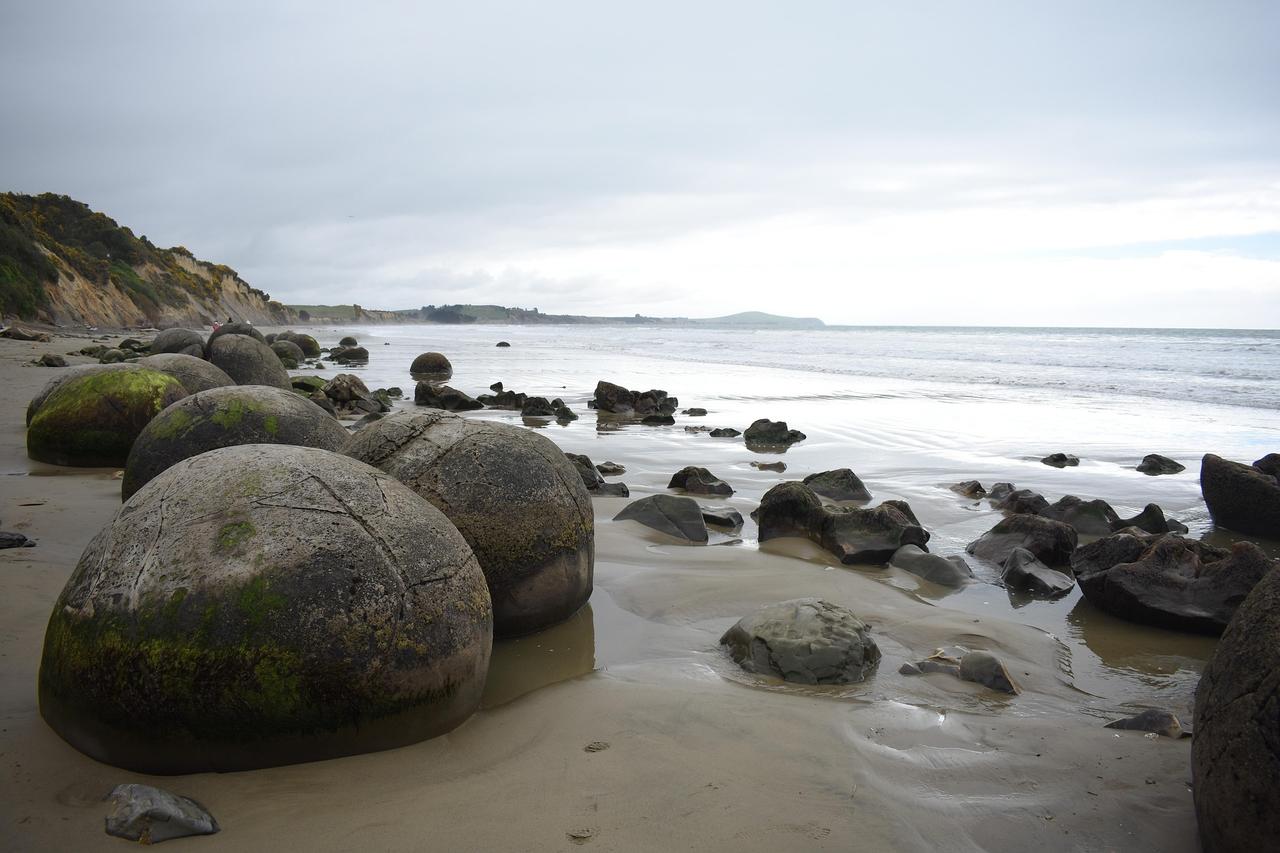
Moeraki Boulders are septarian concretions located along the Moeraki coast on the South Island of New Zealand. These concretions formed within marine mudstones of the Moeraki Formation during the Paleocene epoch under the influence of shallow marine pore waters. Typically ranging from 1 to 2 meters in diameter, the Moeraki Boulders contain internal fractures that developed over time and are commonly filled with yellowish calcite and rarely dolomite. Their structural and mineralogical properties reflect the growth and diagenetic processes of the concretions. The Moeraki Boulders constitute an important natural formation studied in both geological research and regional paleoecological and sedimentological investigations【1】.
The Moeraki Boulders are situated on the South Island of New Zealand approximately 3 km south of the town of Hampden within the Moeraki Formation. The formation consists of Paleocene-age marine mudstones with a gentle dip of 5 to 8° and is positioned within a regional shallow marine shelf lithofacies. Stratigraphically, the formation exhibits various unconformities: at its base, approximately 400 m above (the Marshall Paraconformity), and at its top near the Miocene-Pleistocene boundary. Within this stratigraphic sequence, glauconitic sand layers such as the Otepopo Greensand indicate sedimentation pauses and possible disconformities. The maximum burial depth is estimated at approximately 700 m, and assuming a geothermal gradient of 30°C/km, the maximum burial temperature is about 40°C. Vitrinite reflectance measurements confirm low-temperature organic maturation, with R₀ values ranging from 0.29 to 0.30%, indicating a maximum thermal history of 25–50°C【2】.

Moeraki Boulders (Pixabay)
The Moeraki Boulders formed during early diagenesis within shallow marine pore waters and mudstone matrices. The concretions developed spherically within the mudstone matrix and grew via diffusive mass transfer. Their large size, ranging from 1 to 2 meters in diameter, indicates a prolonged growth period during which pore water chemistry evolved sufficiently to allow mineral precipitation. The hardened cementation on the outer portions of the concretions demonstrates displacement of detrital silt-clay material and infilling of pore spaces. These features indicate that the concretions formed before significant burial and compaction occurred, and that the septarian fractures were filled either concurrently with or immediately following concretion growth【2】.
The Moeraki Boulders are predominantly observed as large, spherical concretions. The concretion bodies developed within the mudstone matrix and exhibit a hardened cementation structure that becomes progressively denser toward the exterior. Cement content increases from the core outward; the core is loosely cemented while the outer portions are more densely cemented and compacted. This structure reflects the transport of pore waters by diffusion and subsequent mineral precipitation during concretion growth. The cement partially replaced detrital silt and clay particles, filling pores and enhancing the structural integrity of the concretions. The outwardly converging conical or funnel-shaped septarian fractures indicate that these features formed during early diagenetic stages and were shaped before significant burial.

Moeraki Boulders (Pexels)
The primary mineral composing the concretions is non-ferroan calcite, with the Ca/Mg ratio increasing from the core toward the outer rim. Fe and Mn contents are generally below 1% and show a homogeneous distribution within the body. The first infilling phase of the septarian fractures consists of brown calcite spar, which has a chemical composition similar to the outer portions of the concretion body. The second infilling phase, yellow calcite spar, is distinctly different from both the body and the early brown calcite; it has low Mg content and elevated Fe and Mn levels, with the Fe/Mn ratio decreasing during crystal growth. Rarely, gray micritic dolomite is found at the center of the fractures; this dolomite exhibits a moderate Fe content, low Mn content, and a Ca > (Fe + Mg + Mn) ratio. This mineral distribution and chemical variation indicate that the concretion body and the septarian fracture infill phases precipitated in distinct chemical environments【3】.
Isotopic analysis of the Moeraki Boulders reveals the precipitation environments of the concretion body and the septarian fracture infill phases. Oxygen isotopes indicate that the concretion body and the early brown calcite infill precipitated from marine pore waters; δ¹⁸O values range from +28.8 to +29.5 ‰ SMOW, corresponding to precipitation temperatures of 20–22 °C. Carbon isotopes show a systematic depletion from core to rim, with δ¹³C values decreasing from −15 to −31 ‰ PDB, reflecting the influence of sulfate reduction and bacterial methane oxidation. The yellow calcite spar infill exhibits distinct isotopic differences: δ¹⁸O values range from +22 to +25 ‰ SMOW and δ¹³C values increase from −18 to −11 ‰ PDB, indicating an environment where meteoric water mixed with marine pore water. The micritic dolomite is isotopically distinct from the concretion body and earlier infill phases; δ¹⁸O values of +23.9 ‰ SMOW and δ¹³C values of −5.3 ‰ PDB suggest that the final dolomite precipitation occurred in a lighter, meteorically influenced mixed environment. These isotopic data demonstrate that the precipitation and diagenetic stages of the Moeraki Boulders occurred in both marine and partially meteorically influenced pore waters【4】.

Septarian Fractures in the Moeraki Boulders (Pixabay)
The septarian fractures in the Moeraki Boulders are filled with carbonate minerals that precipitated along cracks parallel to the outer margin of the concretion body. These fractures began to fill either concurrently with or shortly after concretion growth, initially with thin layers of brown calcite. Subsequently, the volumetrically dominant infill occurred as yellow calcite spar precipitated, with crystals growing toward the voids and forming characteristic termination surfaces. This process reflects changes in pore water chemistry over time, influenced by meteoric water influx and fracturing mechanisms that altered the internal environment of the fractures. In the final stage, rare micritic dolomite infill settled at the center of the fractures, reflecting a mixture of marine and meteoric pore waters. This formation mechanism demonstrates that both the concretion body and the fracture infills were shaped by diagenetic processes and evolving pore water chemistry.
The concretion bodies of the Moeraki Boulders formed through the diffusion and precipitation of dissolved compounds from pore waters. This process is regarded as the primary mechanism controlling concretion growth. The chemical and isotopic composition of the concretion body changed over time under the influence of biogeochemical processes such as organic matter oxidation and sulfate reduction. These changes were systematically observed from the core to the rim, enabling reconstruction of the evolution of pore water chemistry. Thus, the formation of the concretion body and the septarian fractures emerged as interrelated processes controlled by pore water and environmental conditions.

Moeraki Boulders (Pexels)
The diagenetic process encompasses the stages of burial and chemical evolution following concretion formation. During burial, the concretion bodies underwent changes due to variations in pore water chemistry and redox conditions, particularly through the infilling of pore spaces by late-stage minerals such as yellow calcite spar and micritic dolomite. These minerals record the chemical contrasts derived from mixtures of marine and meteoric pore waters, documenting the diagenetic history of both the concretions and the fractures. Collectively, these processes demonstrate that the growth duration and diagenetic history of the Moeraki Boulders are directly linked to the evolution and chemical transformation of pore waters.
The Moeraki Boulders hold significant symbolic value in Māori culture and regional folklore. Traditional narratives describe these large stone masses as petrified remnants of fishing canoes that washed ashore during sea voyages or as physical traces of legendary beings. From a tourism perspective, the Moeraki Boulders are preserved as one of New Zealand’s coastal natural heritage features, offering visitors the opportunity to observe the region’s geological and historical development. Furthermore, their status as subjects of scientific research enhances both local and international academic recognition of the area’s geological and paleoecological importance, thereby integrating cultural value with scientific significance.
[1]
Geoffrey D. Thyne ve James R. Boles, “Isotopic Evidence for Origin of the Moeraki Septarian Concretions, New Zealand,” Journal of Sedimentary Research 59, no. 2 (1989): 272, Son Erişim: 27 Şubat 2026, https://www.researchgate.net/publication/286919532_Isotopic_Evidence_for_Origin_of_the_Moeraki_Septarian_Concretions_New_Zealand
[2]
A.e., syf. 272
[2]
A.e., syf. 272
[3]
A.e., syf. 273-274
[4]
A.e., syf. 274-275

Geological Setting and Formation Environment
Morphology and Mineral Composition
Isotopic Evidence
Formation of Septarian Fractures
Growth Duration and Diagenetic History
Cultural Significance