

This article was automatically translated from the original Turkish version.
+1 More
Location | Çukurcuma Türkiye Istanbul | ||||||||
|---|---|---|---|---|---|---|---|---|---|
Founder(s) | Orhan Pamuk | ||||||||
Opening | 2012 | ||||||||
Theme(s) | Istanbul life the novel The Museum of Innocence | ||||||||
Award(s) | European Museum of the Year Award (2014) | ||||||||
The Museum of Innocence is a museum conceived in parallel with Orhan Pamuk’s novel of the same name and assembled from his personal collection. Designed both as a literary text and a physical space, The Museum of Innocence narrates Istanbul’s social and cultural life between 1950 and 2000 through everyday objects. The novel was published in 2008, and the museum opened on 28 April 2012 in the Brukner Apartment in Istanbul’s Çukurcuma district.

The Museum of Innocence and Orhan Pamuk (Anadolu Agency)
Pamuk developed the ideas for the novel and the museum together since the 1990s. He purchased the Brukner Apartment in the Firuzağa neighbourhood of Çukurcuma and converted it into a museum. During this process, he collaborated with architects İhsan Bilgin, Cem Yücel and Gregor Sunder Plassmann. The apartment’s windows were sealed to create expansive wall surfaces for display, the exterior façade was renovated, and within the interior, display cases, boxes and exhibition areas were installed. Four of the building’s five floors have been arranged as exhibition spaces.
The Museum of Innocence is directly linked to Orhan Pamuk’s 2008 novel of the same name. From the 1990s, when he began designing the novel, Pamuk simultaneously developed the idea of a museum. His aim was to transform a literary fiction into a tangible museum space through everyday objects.
The novel’s plot unfolds between 1975 and 2007, with flashbacks extending to the 1950s. The narrative centres on the love story between Kemal Basmacı, from a wealthy family, and Füsun, from a middle-class household. Kemal’s search for traces of his lost beloved in everyday objects and his accumulation of these items form the core of the novel. This process became the foundational concept of the museum. The objects, memories and spaces described in the novel directly constitute the museum’s collection.
The novel consists of 83 chapters. Pamuk associated each chapter with a display case or box, reimagining them within the museum. Thus, the narrative structure of the novel aligns with the museum’s exhibition layout. The various locations featured in the novel — the house in Çukurcuma, the Merhamet Apartment, the Şanzelize Boutique, Istanbul’s streets and cafés — are reanimated in the museum through visual and auditory elements.
%252FAA-28859624.jpg&w=1280&q=75)
The Museum of Innocence (Anadolu Agency)
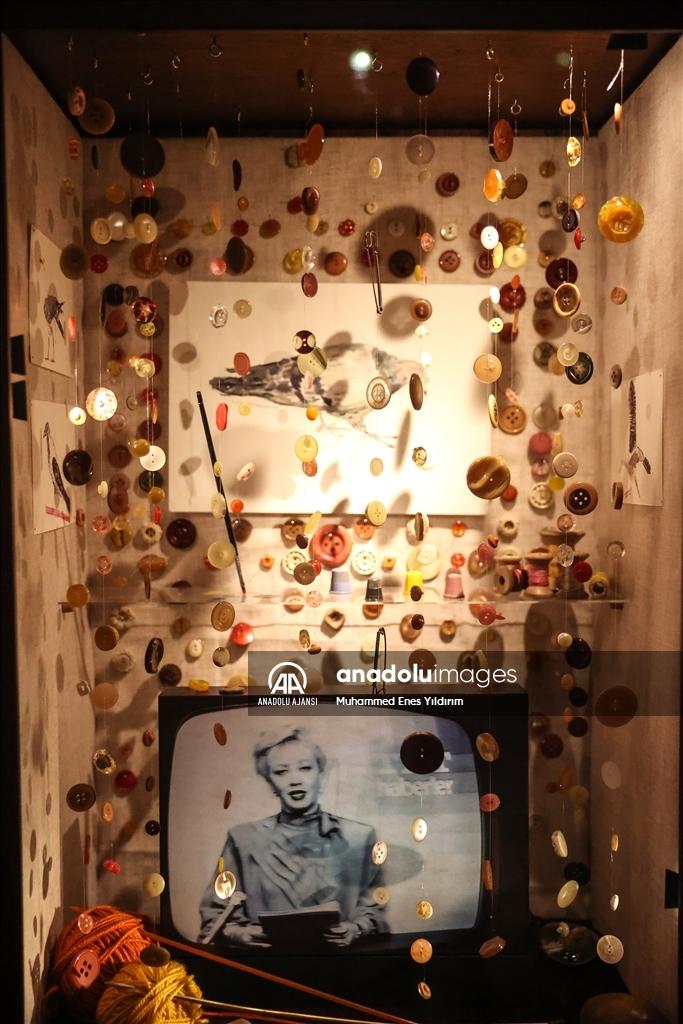
The museum’s collection comprises everyday objects related to the lives of the novel’s characters. These include clothing, bags, shoes, jewellery, cigarette butts, cologne and perfume bottles, cinema tickets, photographs, door handles, knick-knacks and other artifacts. On the ground floor, a prominent feature is the spiral motif symbolizing the Aristotelian concept of time, along with the “Cigarette Wall,” composed of 4,213 cigarette butts. From the first floor upward, display cases follow the novel’s narrative sequence, while upper floors exhibit the objects collected by Kemal. On the top floor are Pamuk’s handwritten manuscripts, sketches for the museum’s design and video collages.
%252FAA-28859619.jpg&w=1280&q=75)
Orhan Pamuk in Front of the Cigarette Wall (Anadolu Agency)
The museum reflects contemporary museum practices in its display methods. It is constructed using display cases, boxes, cabinets of curiosity, interactive and experimental narrative techniques. The objects not only represent a historical period but also invite visitors to reflect on personal and collective memory. For these reasons, The Museum of Innocence is regarded as an original example at the intersection of literature and museology.
In 2014, the museum won the European Museum of the Year Award. Within the first ten years after its opening, it was visited by 285,000 people, approximately half of whom were foreign tourists. Among its visitors were notable figures such as Umberto Eco and Nobel Prize in Literature laureate Mo Yan. Replicas of 40 of the museum’s display cases have been sent to international exhibitions.
Anadolu Ajansı. “Masumiyet Müzesine 6 yeni eser eklendi.” Accessed August 16, 2025. https://www.aa.com.tr/tr/kultur/masumiyet-muzesine-6-yeni-eser-eklendi/2681802
Kuş, Selmin. *Edebiyat ve Müze: Bir Roman ve Müze Olarak Masumiyet Müzesi.* Master's thesis, Yeditepe University, Graduate School of Social Sciences, Department of Turkish Language and Literature, Department of Turkish Literature, 2010. https://tez.yok.gov.tr/UlusalTezMerkezi/tezDetay.jsp?id=sIUh7tHnftGVTKhtuKQUNQ&no=HXm9A-RUakIjXDhyT_1TCA
Masumiyet Müzesi. "Masumiyet Müzesi." Masumiyet Müzesi Resmî Web Sitesi. Accessed August 16, 2025. https://www.masumiyetmuzesi.org/
Selçuk, Onur. “Masumiyet Müzesi.” *Türkiye Turizm Ansiklopedisi.* Accessed August 16, 2025. https://turkiyeturizmansiklopedisi.com/masumiyet-muzesi
Location | Çukurcuma Türkiye Istanbul | ||||||||
|---|---|---|---|---|---|---|---|---|---|
Founder(s) | Orhan Pamuk | ||||||||
Opening | 2012 | ||||||||
Theme(s) | Istanbul life the novel The Museum of Innocence | ||||||||
Award(s) | European Museum of the Year Award (2014) | ||||||||
No Discussion Added Yet
Start discussion for "Museum of Innocence" article
Establishment Process
Relationship to the Novel
Collection and Display
Context within Contemporary Museum Practice
Awards and International Recognition