

This article was automatically translated from the original Turkish version.
+2 More
Location | Doha, Qatar | ||||||||
|---|---|---|---|---|---|---|---|---|---|
Architect | I. M. Pei | ||||||||
Opening Date | 22 November 2008 | ||||||||
Construction Area | Approximately 45,000 m² | ||||||||
Architectural Approach | A structure designed using contemporary architectural principles inspired by traditional Islamic architecture | ||||||||
Building Components | A five-story main building, an education wing, and a central courtyard connecting these sections | ||||||||
Number of Works | Over 8,000 works | ||||||||
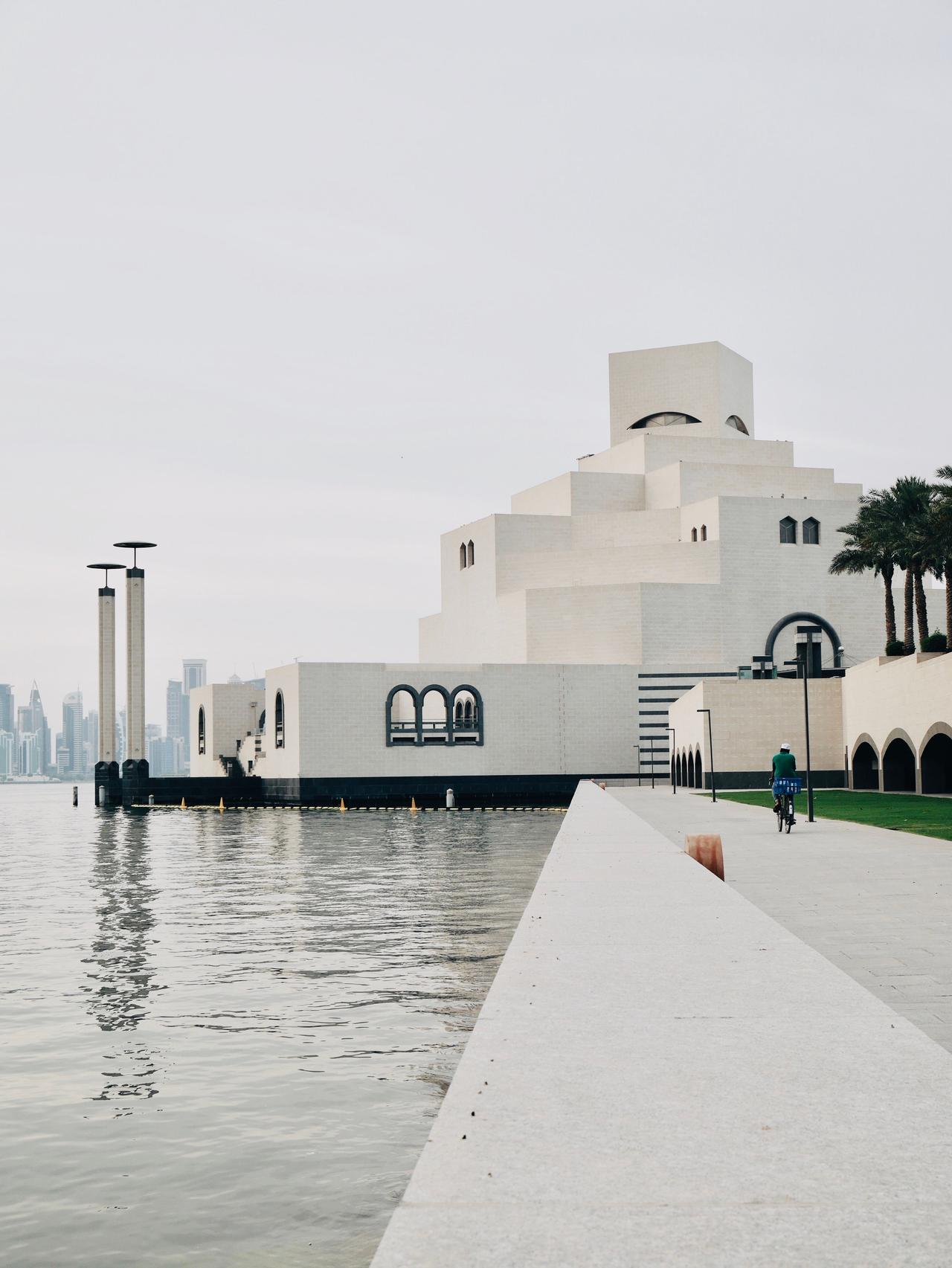
Museum of Islamic Art, located in Doha, Qatar, is a museum dedicated to preserving, exhibiting, researching, and making accessible to the public artworks of Islamic art spanning from the 7th to the 20th century. The museum houses one of the world’s most comprehensive collections of Islamic art, including manuscripts, ceramics, metalwork, woodwork, textiles, jewelry, glassware, coins, and precious stones. Among the first projects undertaken by Qatar Museums, the museum was designed by Chinese-American architect I. M. Pei and opened to the public on 22 November 2008.【1】 Following a ten-month comprehensive renovation that began in 2021, the museum reopened on 5 October 2022.【2】
İslam Eserleri Müzesi (pexels)
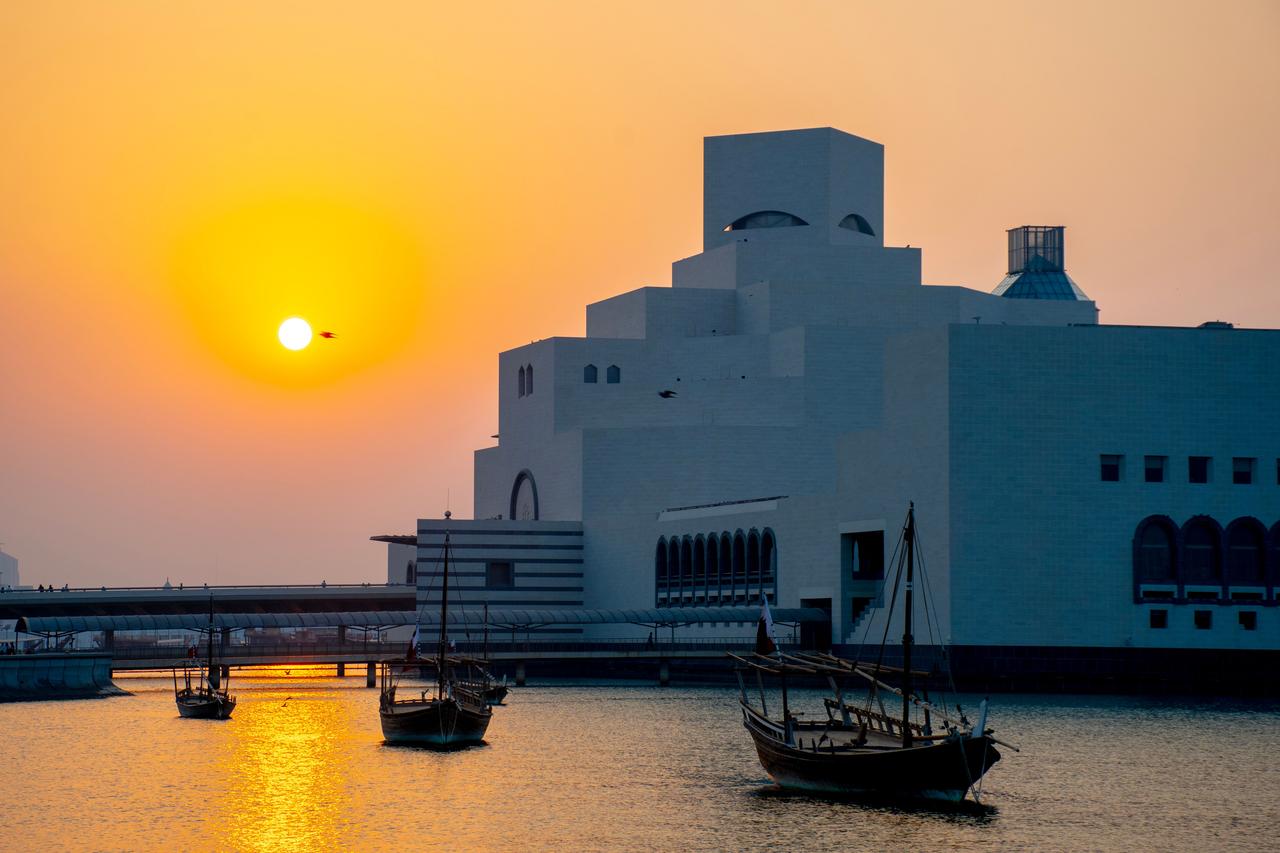
The Museum of Islamic Art employs a design approach that integrates formal elements of traditional Islamic architecture with contemporary architectural principles. The building’s architectural composition blends historically inspired domes, interior courtyards, and geometric arrangements with modern construction technologies.
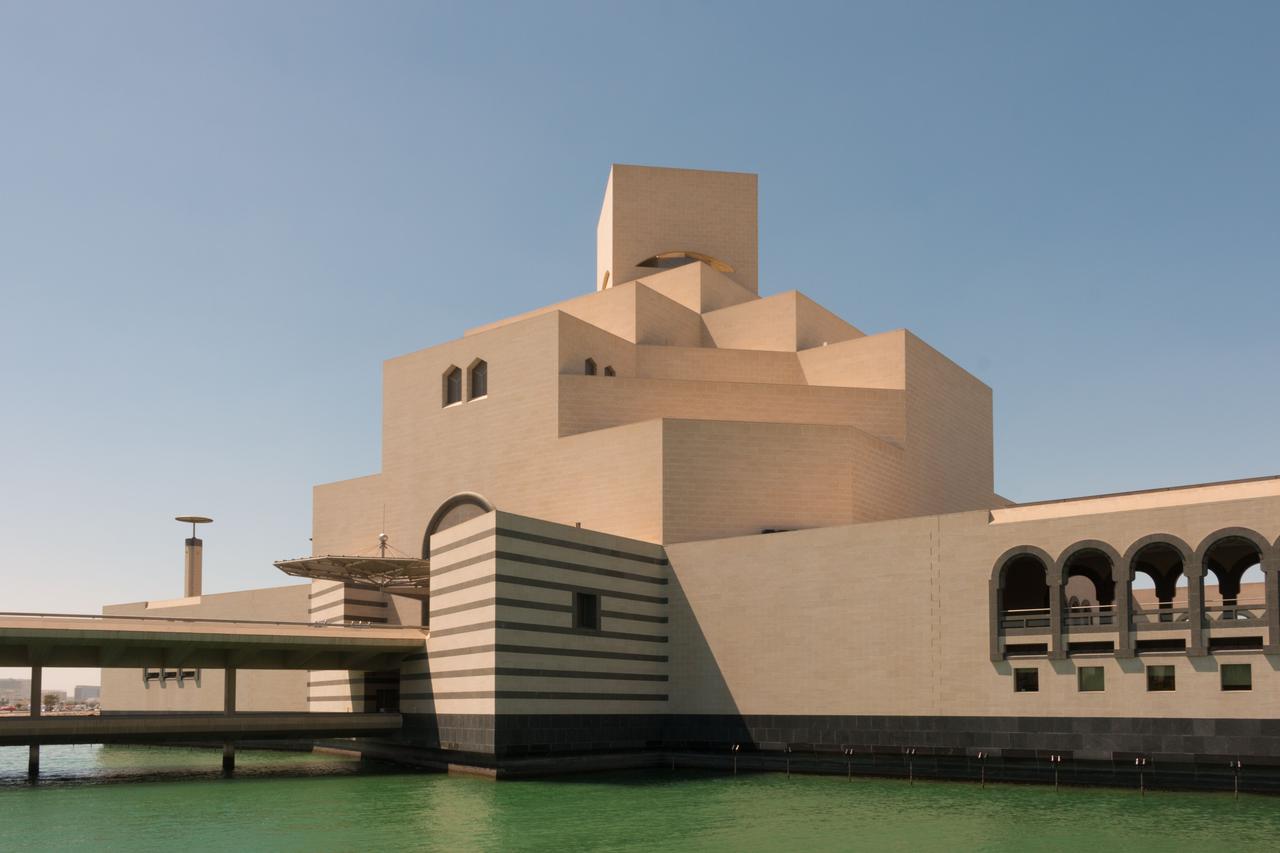
The museum complex consists of a five-story main building and an adjacent education wing, connected by a large central courtyard. The high-domed atrium at the center of the main building is situated within a central tower that defines the vertical spatial organization of the structure.
The exterior façade is clad in cream-colored limestone. The façade material is designed to generate dynamic light and shadow effects in response to changing natural daylight throughout the day. Located along Doha’s Corniche, the museum offers panoramic views of the bay and the city skyline. The 45-meter-high window on the north façade is one of the key architectural elements that establish a visual relationship between the building and its surroundings.【3】
Throughout its architectural character, geometric patterns commonly found in Islamic art are integrated as an inseparable part of the spatial organization. Different surface textures and materials create an architectural backdrop that enhances the visual prominence of the exhibited artworks.
İslam Eserleri Müzesi (pexels)
The Museum of Islamic Art features a multi-level structural system organized around a central spatial axis. The museum complex comprises a five-story main building and an education wing, linked by a central courtyard.
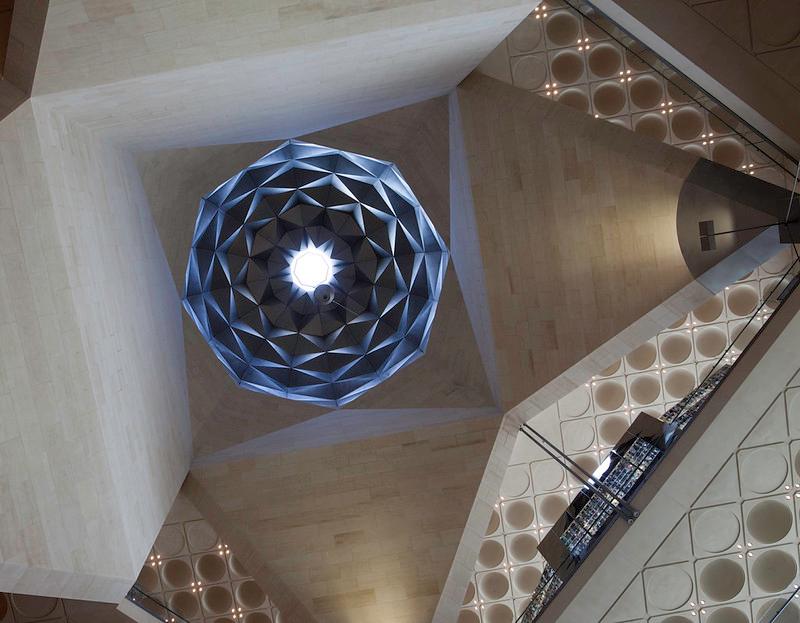
The central tower plays a pivotal role in the building’s structural organization. The high-domed atrium within the tower serves as the primary volume that ensures vertical spatial continuity. The dome at the top of the atrium features an oculus at its apex, which directs natural light into the interior space in a controlled manner. This light, refracted across the dome’s multifaceted geometry, creates a patterned illumination effect within the atrium.
İslam Eserleri Müzesi Kubbe Görseli (flickr)
The interior circulation is facilitated by a double-helix curved staircase located at the center of the atrium. Suspended above the staircase, a circular metal chandelier is positioned at the center of the atrium’s vertical void and is designed as a recurring motif that echoes the staircase’s curved form.
With a total built area of approximately 45,000 square meters, the museum is planned as a large-scale institution featuring expansive exhibition spaces and a multi-level organizational layout.【4】
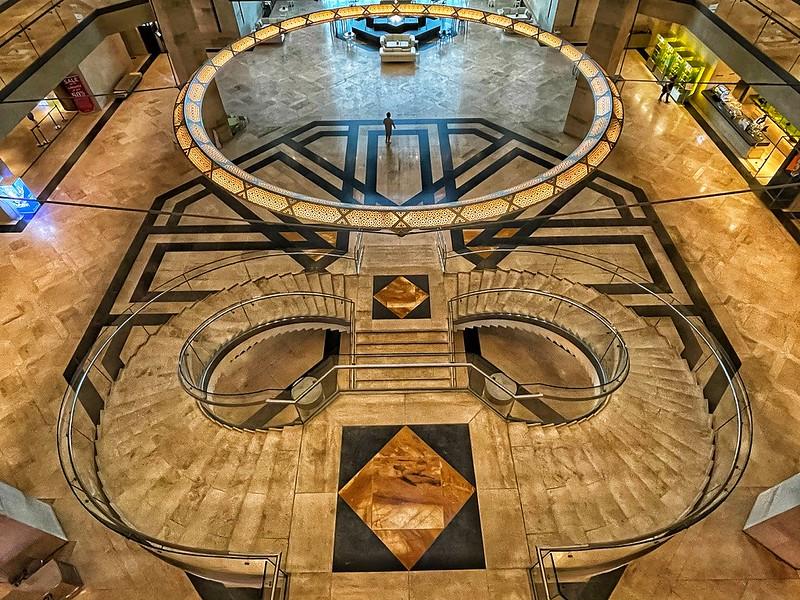
İslam Eserleri Müzesi İç Mekan Görseli (flickr)
The interior design is planned to support the exhibition of Islamic artworks. The atrium, the most significant interior space, serves as the focal point of the spatial organization through its high-domed volume, use of natural light, and the central double-helix staircase.
Natural light directed into the interior through the oculus at the dome’s apex reflects across its geometric surfaces, producing a patterned illumination effect within the atrium. This lighting concept creates a cohesive relationship between the building’s architectural identity and the spatial perception of the exhibition areas.
Geometric ornamentation characteristic of Islamic art is extensively used throughout the museum’s interior spaces. The combination of diverse materials and surface textures enhances the visual prominence of the exhibited collection.
The exhibition layout is based on a multi-level, open-plan spatial organization. Expansive gallery spaces allow for the holistic presentation of different sections of the collection. In addition to permanent collection galleries, the museum also includes temporary exhibition areas. The permanent collection galleries were reorganized during a ten-month renovation that began in 2021 and reopened to visitors in 2022.
As part of the 2022 renovation, the galleries were redesigned to enhance the visitor experience. New initiatives were introduced to enable visitors to experience Islamic heritage not only visually but also through touch, sound, and scent. Augmented reality applications, virtual tour systems, smart screens, interactive exhibition methods, multimedia technologies, and digital presentation techniques have been integrated into the museum’s exhibition philosophy.
The collection comprises manuscripts, metalwork, ceramics, jewelry, woodwork, textiles, coins, precious stones, and glassware. These artifacts have been gathered from a vast geographical area extending from the Middle East to Spain and China and encompass both religious and secular aspects of life. The museum’s collection includes over 8,000 objects.【5】
Aml Abd El-Wareth, Mohamed. “The Evolving Role of Islamic Art Museums in Heritage Conservation and Cultural Identity in the Arab World: Opportunities and Challenges (Case Study: Islamic Art Museums in Cairo (Egypt) and Doha (Qatar)).” *Sohag Engineering Journal* 6, no. 1 (2026): 1–13. Accessed July 11, 2026.https://sej.journals.ekb.eg/article_480079_73c2d4467dffe5f7d47eb35b1d600627.pdf
Baikovicius, Jimmy. “The Amazing Ceiling of The Museum of Islamic Art at Doha, Qatar | 121004-3819-jikatu.” Flickr. Accessed July 11, 2026.https://flic.kr/p/dpNbER.
Doha, Sandra. “Museum of Islamic Art, Doha, Qatar.” Flickr. Accessed July 11, 2026.https://flic.kr/p/2kWeFZE.
Mkhalifa, M. "Islamic Art Museums." Pexels. Accessed July 8, 2026.https://www.pexels.com/tr-tr/fotograf/35296436/.
Museum of Islamic Art. "Museum of Islamic Art Architecture." Museum of Islamic Art. Accessed July 8, 2026.https://mia.org.qa/en/about-us/architecture/.
Museum of Islamic Art. “About the Museum of Islamic Art.” Museum of Islamic Art. Accessed July 8, 2026.https://mia.org.qa/en/about-us/.
Simmons, John. "Kent Simgesi, Görülecek Yer, Turizm Merkezi, Turistik Atraksiyon." Pexels. Accessed July 8, 2026.https://www.pexels.com/tr-tr/fotograf/kent-simgesi-gorulecek-yer-turizm-merkezi-turistik-atraksiyon-5451169/.
Özmen, Uğurcan. "Deniz, Kent Simgesi, Görülecek Yer, Mimari." Pexels. Accessed July 8, 2026.https://www.pexels.com/tr-tr/fotograf/deniz-kent-simgesi-gorulecek-yer-mimari-8090526/
[1]
Mohamed Aml Abd El-Wareth, "The Evolving Role of Islamic Art Museums in Heritage Conservation and Cultural Identity in the Arab World: Opportunities and Challenges (Case Study: Islamic Art Museums in Cairo (Egypt) and Doha (Qatar))," *Sohag Engineering Journal* 6, no. 1 (2026): 8.
[2]
Museum of Islamic Art, "About the Museum of Islamic Art," Doha: Museum of Islamic Art, Accessed July 8, 2026.
[3]
Museum of Islamic Art. "Museum of Islamic Art Architecture." Museum of Islamic Art, Accessed July 8, 2026.
[4]
Mohamed Aml Abd El-Wareth, "The Evolving Role of Islamic Art Museums in Heritage Conservation and Cultural Identity in the Arab World: Opportunities and Challenges (Case Study: Islamic Art Museums in Cairo (Egypt) and Doha (Qatar))," 8.
[5]
Mohamed Aml Abd El-Wareth, "The Evolving Role of Islamic Art Museums in Heritage Conservation and Cultural Identity in the Arab World: Opportunities and Challenges (Case Study: Islamic Art Museums in Cairo (Egypt) and Doha (Qatar))," 8.
Location | Doha, Qatar | ||||||||
|---|---|---|---|---|---|---|---|---|---|
Architect | I. M. Pei | ||||||||
Opening Date | 22 November 2008 | ||||||||
Construction Area | Approximately 45,000 m² | ||||||||
Architectural Approach | A structure designed using contemporary architectural principles inspired by traditional Islamic architecture | ||||||||
Building Components | A five-story main building, an education wing, and a central courtyard connecting these sections | ||||||||
Number of Works | Over 8,000 works | ||||||||
No Discussion Added Yet
Start discussion for "Museum of Islamic Art (Doha)" article
Architecture
Structural System
Interior Space
Exhibition Layout