This article was automatically translated from the original Turkish version.
+2 More
Museum of the Seljuk Civilization
Location | Kayseri | ||||||||
|---|---|---|---|---|---|---|---|---|---|
Construction Date(s) | 1205–1206 (AH 602) | ||||||||
Founder (Patron) | I. Gıyaseddin Keyhüsrev | ||||||||
Architectural Plan | Two adjacent, open courtyard, four-iwan structures (Külliye) | ||||||||
Opening as a Museum | 21 February 2014 | ||||||||
Visiting Hours | closed on Mondays and the first day of religious holidays 09:00–17:00 | ||||||||
Museum Fee | Student: 15 TL Adult: 25 TL | ||||||||
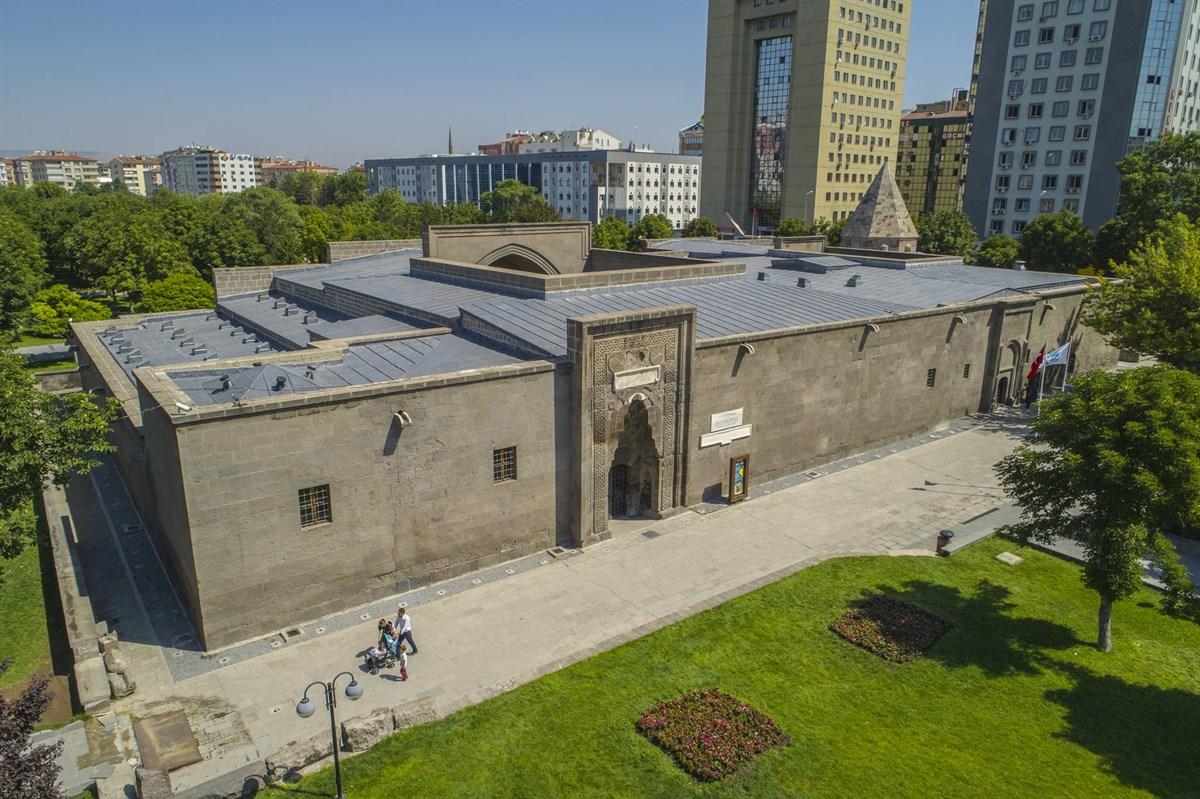
Museum of Seljuk Civilization is located in a complex known as the Çifte Medrese, built under the orders of I. Gıyaseddin Keyhüsrev in Kayseri. Following comprehensive restoration efforts, the building has been transformed into a thematic museum presenting the various aspects of Anatolian Seljuk Civilization and opened to the public.
The structure known in Kayseri as the Çifte Medrese is a complex commissioned in 1205–1206 by I. Gıyaseddin Keyhüsrev, in accordance with the will of Gevher Nesibe Sultan, daughter of Seljuk ruler II. Kılıçarslan. The complex, noted for its austere architecture, is among the few surviving structures from the history of Anatolian architecture.
The complex consists of two adjacent buildings with open courtyards:
Both buildings follow the typical madrasa layout with four iwan halls arranged around an open courtyard.

Overhead View of the Complex (Kocasinan Subdistrict Office)
The hospital is a rectangular structure measuring 41 by 32.50 meters externally. Three sides of its square courtyard are surrounded by arcades with three arches. The main iwan facing north (10.50 meters deep and 9 meters wide) is a large and lofty space. The portal is not aligned with the building’s longitudinal axis but rather with the axis of the western arcade. The surviving inscription indicates that the hospital was built in 602 AH (1205 CE) in accordance with the will of Gevher Nesibe Hatun.
The medrese is connected internally to the hospital by a narrow vaulted passage with a barrel vault. It is situated approximately one meter behind the hospital. The medrese building, narrower in width (27.50 meters), has a rectangular courtyard measuring 14.00 by 8.00 meters. The main iwan of the medrese (9.70 by 7.50 meters) is narrower than that of the hospital. The entrance portal of the medrese is also aligned with the axis of the western arcade.
The türbe located within the medrese section is a typical Seljuk türbe, characterized externally by an octagonal prayer chamber and an octagonal prismatic dome. Its interior is cylindrical, with a semi-circular mihrab niche in the southeast. It is known that the türbe does not belong to Gıyaseddin Keyhüsrev; therefore, researchers believe the entire complex was commissioned by Gevher Nesibe Hatun and that she is buried within the türbe.
Although partially repaired during the Ottoman period, the building remained in ruins for a long time. Extensive restoration work began in the 1960s. From the 1980s onward, the structure served for many years as the History of Medicine Museum under the administration of Erciyes University. In 2012, following the transfer of the building’s usage rights to the local municipality, the process of converting it into the Museum of Seljuk Civilization began.
Centered on the urban history of Kayseri, the museum focuses on the medieval period in Anatolia and the Seljuk Civilization through a thematic approach.
This section examines Seljuk civilization under thematic headings such as “Seljuk City,” “Architecture,” “Art,” “Science,” and “Clothing,” as well as “The Seljuks in Kayseri” and “The Seljuks in Anatolia.”

Museum Artifacts (Museum of Seljuk Civilization)
In keeping with the building’s original function, this section focuses on topics such as “diseases,” “treatment methods and instruments,” “scholars,” “pharmacy,” “water and health,” “music therapy,” and “color therapy.”
In addition to artifacts from the Seljuk period and nearby eras, the museum features interactive and technologically enhanced visual displays. Visitors can acquire knowledge about the Seljuk Civilization through listening, experimentation, practical application, and use of technological devices. The museum also includes a children’s room with animated films and various games designed to introduce children to Seljuk Civilization, as well as spaces for cultural activities.

Museum Artifacts (Museum of Seljuk Civilization)
Kocasinan District Governorship. "Selçuklu Müzesi." Accessed October 21, 2025. http://www.kocasinan.gov.tr/selcuklu-muzesi.
Selçuklu Museum. "Müze Ücreti." Accessed October 21, 2025. https://www.selcuklumuzesi.com/ustmenu.asp?id=20&euid=3&sid=20.
Selçuklu Museum. "Müzeden Fotoğraflar." Accessed October 21, 2025. https://www.selcuklumuzesi.com/ustmenu.asp?id=19&euid=1&sid=19.
Selçuklu Museum. "Ziyaret Saatleri." Accessed October 21, 2025. https://www.selcuklumuzesi.com/ustmenu.asp?id=16&euid=3&sid=16.
Selçuklu Müzesi. "Selçuklu Uygarlığı Müzesi." Erişim 21 Ekim 2025. https://www.selcuklumuzesi.com/ustmenu.asp?id=8&euid=1&sid=8.
Turkey Ministry of Culture and Tourism, General Directorate of Cultural Assets and Museums. "Kayseri’deki Kültür Varlıkları." Accessed October 21, 2025. https://www.kulturvarliklari.gov.tr/yazdir?23510664D30B1361DC7FBCDB1DB71AA3.
Museum of the Seljuk Civilization
Location | Kayseri | ||||||||
|---|---|---|---|---|---|---|---|---|---|
Construction Date(s) | 1205–1206 (AH 602) | ||||||||
Founder (Patron) | I. Gıyaseddin Keyhüsrev | ||||||||
Architectural Plan | Two adjacent, open courtyard, four-iwan structures (Külliye) | ||||||||
Opening as a Museum | 21 February 2014 | ||||||||
Visiting Hours | closed on Mondays and the first day of religious holidays 09:00–17:00 | ||||||||
Museum Fee | Student: 15 TL Adult: 25 TL | ||||||||
No Discussion Added Yet
Start discussion for "Museum of the Seljuk Civilization" article
History and Architecture of the Building
Darüşşifa (Hospital) Section
Medrese Section (Gıyasiye Medresesi)
Türbe
Restoration and Conversion into a Museum
Museum Content and Exhibition Concept
Seljuk Civilization Section
Darüşşifa Section (History of Medicine)