
This article was automatically translated from the original Turkish version.
Foundation Year | 1914 | ||||||||
|---|---|---|---|---|---|---|---|---|---|
Original Name(s) | Evkaf-ı İslamiye Müzesi | ||||||||
Current Location | İbrahim Paşa Sarayı, Sultanahmet, İstanbul, Türkiye | ||||||||
Collection Count | more than 40,000 | ||||||||
International Awards | 1984 European Museum of the Year Award, UNESCO Promotion Award | ||||||||
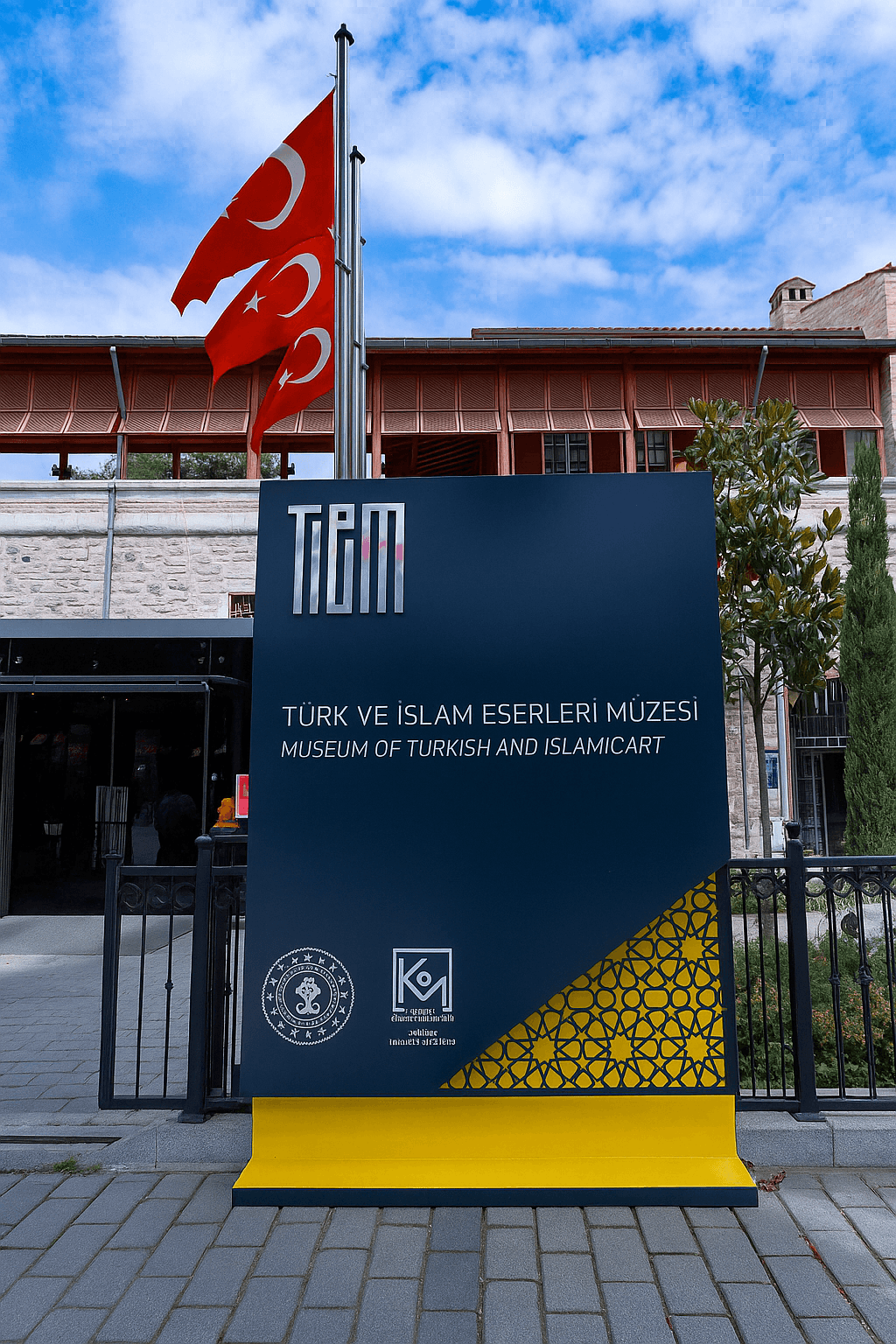
Türk and Islamic Works Museum is the first Turkish museum to encompass Turkish and Islamic art, as well as the last museum established during the Ottoman Empire. Its historical journey from its foundation to the present day, along with its rich collections and institutional identity spanning from the Ottoman era to the Republic, grants it a unique place in the history of Turkish museology.

Türk and Islamic Works Museum (Türkiye Culture Portal)
The museum was established in 1914 under the leadership of Ürgüplü Mustafa Hayri Efendi, the Minister of Waqfs, under the name “Evkāf-ı İslâmiyye Müzesi” (Museum of Islamic Endowments). This decision emerged from a joint consensus among the Grand Vizierate, the Ministry of Education, and the Imperial Museum since 1908, driven by the urgent need to preserve valuable artifacts of Islamic art. Instructions issued by Grand Vizier Hüseyin Hilmi Pasha to customs authorities emphasized preventing smuggling and halting the export of valuable waqf artifacts to European museums.
During its founding phase, artifacts were collected from various regions of the country, including distant provinces such as Aleppo. Although initial plans called for constructing a new building, these were later abandoned and the museum was instead opened within the imaret building (dârüzziyâfe) of the Süleymaniye Külliyesi, a masterpiece of Mimar Sinan. The museum was inaugurated on 27 April 1914, on the anniversary of Sultan Mehmed Reşad’s accession to the throne, with Ahmed Hakkı Bey as its first director.
During the Republican period, in 1924, following the abolition of the Ministry of Waqfs, the museum was placed under the Ministry of Education and renamed the “Turk and Islamic Works Museum.” In 1964, it came under the General Directorate of Ancient Monuments and Museums, acquiring independent museum status. In 1983, it was relocated from the Süleymaniye Imaret to the Ibrahim Pasha Palace in Istanbul’s Sultanahmet district. This palace is one of the most significant examples of 16th-century Ottoman civil architecture and is situated on At Meydanı (the ancient Hippodrome). It was originally commissioned for Ibrahim Pasha, son-in-law and grand vizier of Kanuni Sultan Süleyman.
The Turk and Islamic Works Museum houses one of the most comprehensive collections reflecting the artistic heritage of the Islamic world, with over 40,000 artifacts. The museum’s collections span from the early periods of Islamic art to the 20th century and include works from numerous civilizations such as the Umayyads, Abbasids, Seljuks, Ayyubids, Mamluks, Timurids, Safavids, and Ottomans.
The collections are displayed under the categories of carpets, manuscripts, wood, stone, glass-metal-ceramic, and ethnography. In particular, the carpet collection, which ranges from large mosque carpets to small prayer rugs and kilims, is recognized as one of the most important in the world.
Among the most prominent pieces in the collection are the Seljuk carpets discovered in 1906 in the Alâeddin Mosque in Konya.
The manuscript collection contains masterpieces by leading calligraphers of Islamic art, extending from the early Islamic period to the 19th century. One of its most notable sections is the “Damascus Documents,” a collection brought to Istanbul after a fire in 1917 at the Umayyad Mosque in Damascus. This collection includes over 200,000 Quranic folios, documents, and bindings. Among the earliest examples are Quranic pages written in Hijazi script dating from the late 7th to early 8th centuries.
Other significant artifacts on display include:
In 1926, following the closure of dervish lodges and tombs, objects such as carpets, lamps, sultans’ kaftans, and prayer beads from these sites were added to the museum’s collection. Thus, the collection acquired not only an artistic but also a cultural and social memory dimension.
The museum’s ethnography hall is particularly notable for its exhibition titled “Istanbul in the 19th Century.” This section features reconstructions and artifacts illustrating key aspects of Ottoman social life, including the hamam, coffeehouse, leisure grounds, karagöz puppet theater, manor house, calligraphy workshop, and carpet art. Additionally, the clothing and jewelry collections provide valuable insights into the daily life of Turkish folk culture.
Due to its successful exhibition and preservation activities, the museum was awarded the European Museum of the Year Award in 1984. It also received the UNESCO Special Encouragement Award for its efforts to foster appreciation of art among younger generations.
The Turk and Islamic Works Museum is significant not only for the richness of its collections but also for representing the value placed on Islamic art during the transition from the Ottoman Empire to the Republic. It stands as one of the earliest institutional examples affirming that Turkish and Islamic art deserved preservation and exhibition alongside Western-centric museological approaches.
Ministry of Culture and Tourism. "Türk ve İslam Eserleri Müzesi." Kültür Portalı. Accessed June 25, 2025. https://www.kulturportali.gov.tr/turkiye/istanbul/gezilecekyer/turk-ve--slam-eserleri-muzesi.
Turkish Museums. "İstanbul Türk ve İslam Eserleri Müzesi." Accessed June 25, 2025. https://www.turkishmuseums.com/museum/detail/2079-istanbul-turk-ve-islam-eserleri-muzesi/2079/1.
Ölçer, Nazan. “Türk ve İslâm Eserleri Müzesi.” *İslâm Ansiklopedisi*. Accessed June 25, 2025. https://islamansiklopedisi.org.tr/turk-ve-islam-eserleri-muzesi.

Foundation Year | 1914 | ||||||||
|---|---|---|---|---|---|---|---|---|---|
Original Name(s) | Evkaf-ı İslamiye Müzesi | ||||||||
Current Location | İbrahim Paşa Sarayı, Sultanahmet, İstanbul, Türkiye | ||||||||
Collection Count | more than 40,000 | ||||||||
International Awards | 1984 European Museum of the Year Award, UNESCO Promotion Award | ||||||||
No Discussion Added Yet
Start discussion for "Museum of Turkish and Islamic Arts" article
Foundation and Historical Development
Collections and Notable Exhibits
Ethnography Hall and Reflections of Social Life
International Recognition and Awards
Significance