
This article was automatically translated from the original Turkish version.
Summit | Summit of Heads of State of Turkish-Speaking Countries | ||||||||
|---|---|---|---|---|---|---|---|---|---|
Summit Number | Ninth Summit | ||||||||
Location | Nakhchivan Azerbaijan | ||||||||
Date | 2009-10-03 | ||||||||
Attending Leaders | Abdullah Gül (Türkiye), Ilham Aliyev (Azerbaijan), Kurmanbek Bakiyev (Kyrgyzstan), Nursultan Nazarbayev (Kazakhstan), Gurbanguly Berdimuhamedow (Turkmenistan - Deputy Head of State) | ||||||||
Countries Signing the Agreement | Republic of Azerbaijan, Republic of Kazakhstan, Republic of Kyrgyzstan, Republic of Türkiye | ||||||||
One of the significant steps in the integration process of the Turkic World is the Nakhchivan Agreement, signed on 2–3 October 2009 during the 9th Summit of Heads of State of Turkic-Speaking Countries held in Nakhchivan.
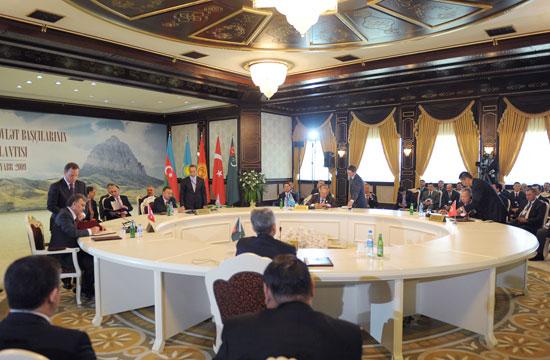
The summit was attended by Kazakhstan, Kyrgyzstan, Türkiye, Turkmenistan, and the host country Azerbaijan. The leaders representing their respective states were:

Group Photo of the 9th Summit of Heads of State of Turkic-Speaking Countries (AZERTAC)
The Nakhchivan Agreement on the Establishment of the Council for Cooperation of Turkic-Speaking Countries, the most significant outcome of the ninth summit, was signed by Azerbaijan, Türkiye, Kyrgyzstan and Kazakhstan.
The Nakhchivan Agreement, signed on 3 October 2009, was ratified by the Grand National Assembly of Türkiye through Law No. 5989 dated 9 June 2010, thereby entering into force as the Agreement on the Establishment of the Council for Cooperation of Turkic-Speaking Countries. Key provisions of the agreement include:
- Article 1: The establishment by the parties of a cooperation mechanism named the “Council for Cooperation of Turkic-Speaking Countries”;
- Article 2: The promotion of cooperation in economic, political, commercial, security, counter-terrorism, transportation, information and communication technologies, education, science, culture, sports and tourism within a framework of mutual trust, and the establishment of mutual assistance mechanisms;
- Article 3: The creation of the following organizational structures: the Committee of Senior Officials (CSO), the Secretariat, the Council of Heads of State (CHS), the Council of Elders, and the Council of Foreign Ministers (CFM);
- Article 8: The country hosting the meeting of the Council of Heads of State shall assume the rotating presidency of the Council for Cooperation of Turkic-Speaking Countries until the next council meeting;
- Article 10: The seat of the Secretariat, whose functions and operational procedures are detailed in the agreement, is designated as Istanbul;
- Article 11: The establishment of a dedicated budget to be determined by an international agreement to be signed by the parties at a later stage;
- Article 13: The parties may appoint permanent representatives under the Secretariat in accordance with their national legislation;
- Articles 15–16: The Council may establish contact and dialogue with international organizations and forums, and may grant observer status to international forums, international organizations, and states;
- Article 17: The working languages of the Council are recognized as the official state languages of the parties and English. Notably, Russian is not included among the official working languages;
- Article 22: It is stipulated that membership in the Council for Cooperation of Turkic-Speaking Countries shall be open to other Turkic-speaking countries after the agreement enters into force.

Signatures of the Heads of State who Signed the Nakhchivan Agreement (Turkic States)
The Nakhchivan Agreement has transformed the long-standing relations among Turkic countries, and the series of state leader summits held since 1992, into an institutionalized structure. The Council and its bodies, supported by a permanent Secretariat, have anchored these relations in an organizational framework. This structure has enhanced the continuity and development of cooperation, serving as a driving force for the integration of the Turkic world.
On 2 October 2009, prior to his journey to the summit, then President Abdullah Gül provided journalists with information regarding the council to be established among Turkic-speaking countries.
Press Statement by the 11th President of Türkiye Abdullah Gül Before His Visit to Azerbaijan, 02.10.2009 11th President Abdullah Gül)
11. President AbdullahGül Youtube Channel. "Azerbaycan Ziyareti - 02.10.2009." Accessed June 20, 2025. https://www.youtube.com/watch?v=S59ExcUFMe8
AZERTAC. “Naxçıvan Zirvə Görüşü Türkdilli Ölkələrin Birliyini Daha da Gücləndirəcəkdir – Naxçıvanda Türkdilli Ölkələrin Dövlət Başçılarının IX Zirvə Görüşü Keçirilmişdir.” AZERTAC. Accessed June 24, 2025. https://azertag.az/xeber/454620.
Anadolu Ajansı. “Nahçıvan Anlaşması 10. Yılında Tarihi Dönemeçte.” Accessed June 21, 2025. https://www.aa.com.tr/tr/dunya/nahcivan-anlasmasi-10-yilinda-tarihi-donemecte/1600917
Küçükdoğan, Onur. *Türk Devletleri Teşkilatı'nın Kuruluş Süreci / Establishment Process of the Organization of Turkish States.* Master's thesis, Gebze Teknik Üniversitesi, 2023. Accessed June 20, 2025. https://tez.yok.gov.tr/UlusalTezMerkezi/TezGoster?key=UjlM15wKZGQW6TLC0pvCtxFsrothHtQrnNZ6A_OKvjpwL16uiCk0k8a12QdArybO
Organization of Turkic States. "Nakhchivan Agreement (October 3, 2009)." Accessed June 21, 2025. https://www.turkicstates.org/u/d/basic-documents-tr/Nahcivan_Anlasmasi_Turkce_20140417_193951.pdf
Oğan, Sinan. “Türk Dünyası Liderleri Nahçıvan Toplantısı, Türk Dünyası Seçeneği ve Türk Basını.” *Türksam.* Accessed June 21, 2025. https://www.turksam.org/detay-turk-dunyasi-liderleri-nahcivan-toplantisi-turk-dunyasi-secenegi-ve-turk-basini
Turkic States Organization. "Nakhchivan Agreement (October 3, 2009)." Accessed June 21, 2025. https://www.turkicstates.org/u/d/basic-documents-tr/Nahcivan_Anlasmasi_Turkce_20140417_193951.pdf

Summit | Summit of Heads of State of Turkish-Speaking Countries | ||||||||
|---|---|---|---|---|---|---|---|---|---|
Summit Number | Ninth Summit | ||||||||
Location | Nakhchivan Azerbaijan | ||||||||
Date | 2009-10-03 | ||||||||
Attending Leaders | Abdullah Gül (Türkiye), Ilham Aliyev (Azerbaijan), Kurmanbek Bakiyev (Kyrgyzstan), Nursultan Nazarbayev (Kazakhstan), Gurbanguly Berdimuhamedow (Turkmenistan - Deputy Head of State) | ||||||||
Countries Signing the Agreement | Republic of Azerbaijan, Republic of Kazakhstan, Republic of Kyrgyzstan, Republic of Türkiye | ||||||||
No Discussion Added Yet
Start discussion for "Nakhchivan Agreement (2009)" article