


This article was automatically translated from the original Turkish version.
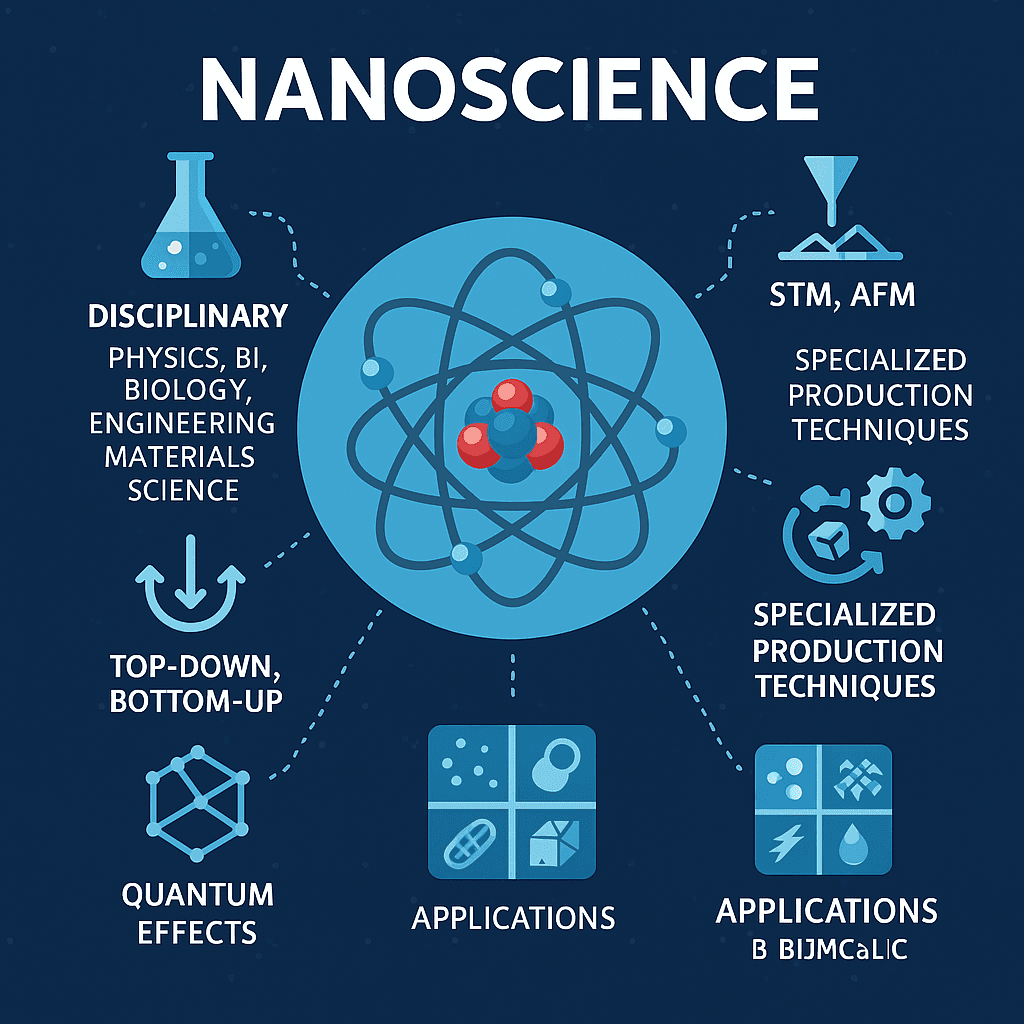
Nanoscience
Field | Interdisciplinary | ||||||||
|---|---|---|---|---|---|---|---|---|---|
Scale(s) | 1–100 nanometres | ||||||||
Basic Disciplines | Materials science Engineering Biology Chemistry Physics | ||||||||
Founder(s) | Richard P. Feynman (1959) | ||||||||
Experimental Beginning | 1980s | ||||||||
Pioneering Figures | Konstantin Novoselov Andre Geim Sumio Iijima Heinrich Rohrer Gerd Binnig Richard P. Feynman | ||||||||
Tools | AFM STM | ||||||||
Method(s) | Bottom-up Top-down | ||||||||
Application Area(s) | Electronics Environment Energy Materials science Biomedical | ||||||||
Fundamental Principles | Specialized manufacturing techniques Surface-to-volume ratio Quantum effects | ||||||||
Current Trends | Environmental solutions Nanorobots AI-assisted design | ||||||||
Nanoscience is a branch of interdisciplinary that studies materials, structures, and processes at the nanometer scale (between 1 and 100 nanometers). This field, which forms the foundation of nanotechnology, brings together many different scientific disciplines including physics, chemistry, biology, engineering, and materials science. Nanoscience involves research into how materials behave at the atomic and molecular levels, and these studies enable the development of new materials and technologies opportunity.
The concept of nanoscience was first proposed theoretically in 1959 by famous physicist Richard Feynman in his lecture titled "There's Plenty of Room at the Bottom". However, the practical advancement of nanoscience gained momentum with the discovery of the scanning tunneling microscope (STM) and atomic force microscope (AFM) in the 1980s speed.
During the 1990s, with the rise of nanotechnology, scientists discovered new nanomaterials such as nanoparticles, nanotubes and graphite. By the 2000s, nanoscience had expanded to a wide range of applications, from drug delivery systems to electronic devices. Today, nanoscience is used in areas such as artificial intelligence-assisted material design, biomedical research and energy storage.
Scientists who have made significant contributions to the field of nanoscience include:
Nanoscience is based on fields such as quantum mechanics and surface chemistry. Its fundamental principles include:
Nanoscience is expected to drive progress in future areas such as more sustainable energy solutions, biomedical innovations, and advancements in electronic devices. New trends such as quantum computing, AI-assisted nanomaterial design, and biocompatible nanotechnologies are accelerating the development of nanoscience.
Researchers are undertaking major projects in areas such as the use of nanorobots in medicine, DNA-based nanostructures, and environmental cleanup technologies. These advancements are anticipated to bring significant transformations especially in the health, environment and technology sectors.
Alivisatos, A. Paul. "Semiconductor Clusters, Nanocrystals, and Quantum Dots." Science 271, no. 5251 (1996): 933–937.
Chen, X., and S. S. Mao. "Titanium Dioxide Nanomaterials: Synthesis, Properties, Modifications, and Applications." Chemical Reviews 107, no. 7 (2007): 2891–2959.
Dresselhaus, Mildred S., and P. C. Eklund. "Carbon Nanotubes: Synthesis, Properties, and Applications." Physics Today 53, no. 6 (2000): 38–44.
Drexler, K. Eric. Engines of Creation: The Coming Era of Nanotechnology. New York: Anchor Press, 1986.
Feynman, Richard P. There’s Plenty of Room at the Bottom. 1959.
Geim, Andre, and Konstantin Novoselov. "The Rise of Graphene." Nature Materials 6, no. 3 (2007): 183–191.
Rao, C. N. R., and A. Govindaraj. Nanotubes and Nanowires. Cambridge: Cambridge University Press, 2011.

Nanoscience
Field | Interdisciplinary | ||||||||
|---|---|---|---|---|---|---|---|---|---|
Scale(s) | 1–100 nanometres | ||||||||
Basic Disciplines | Materials science Engineering Biology Chemistry Physics | ||||||||
Founder(s) | Richard P. Feynman (1959) | ||||||||
Experimental Beginning | 1980s | ||||||||
Pioneering Figures | Konstantin Novoselov Andre Geim Sumio Iijima Heinrich Rohrer Gerd Binnig Richard P. Feynman | ||||||||
Tools | AFM STM | ||||||||
Method(s) | Bottom-up Top-down | ||||||||
Application Area(s) | Electronics Environment Energy Materials science Biomedical | ||||||||
Fundamental Principles | Specialized manufacturing techniques Surface-to-volume ratio Quantum effects | ||||||||
Current Trends | Environmental solutions Nanorobots AI-assisted design | ||||||||
Historical Development
Pioneers and Contributions in Nanoscience
Basic Principles
Application Areas
Electronics
Biomedical
Materials Science
Energy
Environment and Sustainability
Future Perspectives