

This article was automatically translated from the original Turkish version.
+2 More
The National Socialist Underground (NSU) (original name: Nationalsozialistischer Untergrund) is an extreme-right terrorist organization held responsible for the murders of ten people, eight of whom were Turkish, between 2000 and 2007 in Germany. The existence of the organization and its role in the murders came to light following evidence uncovered after two of its members were found dead on 4 November 2011. Until that date, investigations conducted across different states had failed to establish connections between the murders, which were consistently treated as unsolved crimes and largely attributed to organized crime, the mafia or drug-related motives. Following the exposure of these events, the investigation procedures, information sharing and intelligence activities of German security institutions were examined by public opinion and official commissions, and the shortcomings in uncovering the organization’s connections and activities became the subject of intense debate.

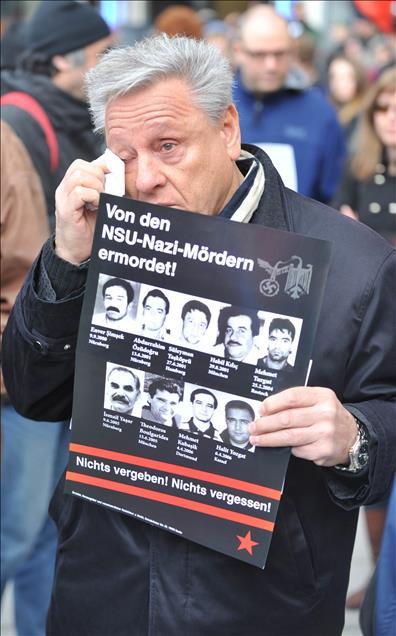
Protests Against the NSU (Anadolu Agency)
The formation of the National Socialist Underground (NSU) is linked to the social and political climate in Germany, particularly after the 1990s, when extreme-right movements became more prominent. The fall of Berlin Wall led to the emergence of xenophobic organizations in many cities following the reunification of East and West Germany, with extreme-right groups becoming especially visible in the former East Germany. During this period, various neo-Nazi structures played a role in the increasing attacks against foreigners and migrants, and migrant communities, predominantly of Turkish origin, emerged as primary targets. This broader context contributed to the strengthening of radical structures that laid the groundwork for the NSU’s emergence in subsequent years.
The core members of the NSU consist of Beate Zschäpe, Uwe Mundlos and Uwe Böhnhardt. Before the organization became known, this trio was active within the Jena cell of an extreme-right structure known as Thüringer Heimatschutz. This structure had a rigid hierarchical organization, and the NSU developed within this same hierarchical model. The local structure in Jena was part of a broader neo-Nazi network in Germany and provided the ideological and organizational foundation for the actions the NSU would carry out in later years.
In 1998, a police raid on a bomb workshop linked to the trio marked the beginning of their transition underground. After this raid, Zschäpe, Mundlos and Böhnhardt went missing and began living clandestinely for an extended period. Despite going underground, their names remained known in public circles, and it was later revealed that they maintained connections with various extreme-right networks until the organization’s exposure in 2011. After 1998, the organization operated in different regions of Germany with the help of identity changes, safe houses and support from extreme-right structures.
In the radicalization process of the NSU, both environmental factors and the extreme-right network in which the group was embedded played decisive roles. Particularly from the 1990s onward, the rise in attacks against foreigners in Germany allowed neo-Nazi groups to become more visible. During this period, incidents such as targeted attacks on refugee shelters, arson and lynching attempts fueled radicalization within extreme-right circles and hardened anti-migrant attitudes. This context provided the ideological framework for the series of murders the NSU would later commit.
Another notable aspect in discussions about the NSU’s formation is the assessment that the organization was not merely a cell of three individuals. Some sources indicate the presence of supporters, extreme-right informants and individuals who aided the organization around its core. Nevertheless, official investigations adopted the position that the NSU consisted solely of the trio. As a result, it has been noted that broader connections and organizational structures potentially involved in the NSU’s formation were not adequately examined during the investigation.
The NSU’s organizational development is also related to the difficulties faced by German security institutions in monitoring extreme-right structures. It has been assessed that federal and state intelligence agencies operated through a system of informants known as V-Mann, which collected information from certain neo-Nazi circles, but this system failed to generate effective intelligence in the NSU context or to make existing information public. Various reports have alleged that some individuals connected to the NSU were also in contact with intelligence services, and the links surrounding the organization’s founding period have not been fully clarified. This situation has been regarded as a factor that hindered the clear exposure of the NSU’s structure and its underlying relationships.
National Socialist Underground Terrorist Organization: NSU (TRT News)
The National Socialist Underground (NSU) terrorist organization carried out a series of murders targeting individuals of migrant background and one police officer between 2000 and 2007 in various German cities, and also conducted bomb attacks and bank robberies. The organization’s actions remained unsolved for many years, and connections between the attacks were only established after the NSU’s exposure in 2011. One common feature of the murders during this period was that the majority of victims were Turkish citizens or migrants. In addition, the repetitive nature of the methods used by the NSU demonstrated that the attacks were part of a planned and sustained terrorist campaign.
The organization’s first known murder occurred on 9 September 2000 in Nuremberg. Enver Şimşek, a citizen who earned his living by selling flowers, was shot in the head by unidentified attackers while he was in his car selling flowers. This incident is recorded as the beginning of the NSU’s series of murders targeting migrants. At the time, security units focused on the possibility of links to organized crime, but later evidence confirmed the attack was carried out by the organization.
This murder was followed by a second attack on 13 June 2001, again in Nuremberg. Abdürrahim Özüdoğru, who ran a tailor shop, was killed by gunshots to the head while working in his shop. This attack resembled the first murder in method and was long regarded by police as an isolated incident, with investigations concentrating on the victim’s family and professional circle. However, subsequent evidence revealed that this attack was also planned by the NSU.
The organization’s third murder was the killing of Süleyman Taşköprü in Hamburg on 27 June 2001. Taşköprü was shot in the head and killed while working in the grocery store he operated with his family. Investigations during this period focused on the victim’s professional and family connections, but no link was established with the earlier attacks in other cities. The fact that the same weapon was used in all the murders was not recognized or recorded in official files until the organization’s exposure.
NSU’s fourth victim was Habil Kılıç, who was killed in Munich on 29 August 2001. Kılıç, who was alone in his family-run greengrocer shop, was shot in the head and killed. Although the murder employed methods similar to those used in the organization’s previous attacks, it was again investigated as an independent incident. Evidence collected at the crime scene was only later linked to the other murders after the organization was exposed in 2011.
NSU’s fifth murder occurred three years later, on 25 February 2004, in Rostock, with the killing of Mehmet Turgut. Turgut, who worked at a döner kebab shop, was fatally wounded in an armed attack at his workplace. During the investigation into this murder, authorities considered the possibility of organized crime but did not assess any connection to the previous murders. However, it was later determined that the weapon used was identical to the Ceska pistol used in earlier attacks.
NSU’s sixth murder was the killing of İsmail Yaşar in Nuremberg on 9 June 2005. Yaşar, who owned a döner kebab stall, was attacked and shot in the head and chest, resulting in his death. This attack shared similar characteristics with previous murders committed by the organization in the same city, yet it was still treated as an unsolved case at the time.
A week after this incident, on 15 June 2005, Theodoros Boulgarides, a German citizen of Greek origin, was killed in Munich. Boulgarides, who worked as a locksmith, was shot twice in the head during an attack at his workplace.
Mehmet Kubaşık, who ran a snack bar in Dortmund, was killed by NSU on 4 April 2006. His murder, carried out inside his shop, demonstrated the organization’s ability to operate across different cities and its mobile structure. Subsequent investigations focused again on the victim’s family and business relationships, and the attack was never officially linked to the other murders.
NSU’s ninth victim was Halit Yozgat, who was killed in Kassel on 6 April 2006. Yozgat was shot in the head while working in his internet café. The presence of an intelligence officer at the crime scene during this murder sparked public controversy, but the official investigation file did not establish a connection to the organization for many years.
NSU’s known final murder was the killing of police officer Michèle Kiesewetter in Heilbronn on 25 April 2007. The 21-year-old Kiesewetter and another police officer were attacked during a patrol; Kiesewetter was killed and the other officer seriously injured. This attack drew attention because, unlike the previous murders, it targeted police officers rather than immigrants. However, the motive behind the attack and the organization’s criteria for selecting victims were never fully clarified.

Beate Zschäpe, a core member of NSU (Anadolu Agency)
In addition to the series of murders, NSU’s activities included bomb attacks. Sources indicate that the organization carried out at least two bomb attacks since the early 2000s. One of the most well-known was a bombing on 9 June 2004 in a street in Köln with a high concentration of Turkish residents. The attack injured 22 people, but security agencies at the time did not classify it as a xenophobic terrorist act. Another attack occurred on 19 January 2001, when a bomb was detonated at a market owned by an Iranian in Köln. For years, investigations treated the attack within the framework of organized crime or intergroup conflicts, and the link to NSU was not raised until the organization was exposed in 2011.
The fact that the bomb attacks were never claimed by the organization and no direct evidence linking them to NSU was found at the scenes allowed these acts to remain unsolved for years. Furthermore, police and intelligence agencies failed to evaluate potential ideological connections between the attacks, instead focusing their investigations on local disputes and criminal networks. The bomb attacks carried out by NSU are significant because they demonstrate that the organization was not only capable of targeted killings but also possessed the capacity to inflict mass harm as a terrorist structure.
A significant part of NSU’s activities involved bank robberies conducted to finance the organization’s operations. Sources indicate that between 2000 and 2011, the organization carried out at least 15 bank robberies. These operations enabled NSU to meet its logistical needs and finance operational elements such as weapons and shelter. The robberies were typically carried out using firearms, and some employees and civilians were injured during the attacks. Nevertheless, the organization never claimed responsibility for these crimes, and for years they were treated as isolated criminal incidents.
The fact that the robberies occurred across different federal states over an extended period demonstrates that NSU operated in a mobile and systematic manner. Security agencies failed to connect these robberies to the series of murders until the organization’s identity was revealed. The incidents were largely treated as conventional crimes. It is now understood that NSU’s bank robberies were one of the key elements of the financial infrastructure that enabled the organization to sustain its activities for many years. This reveals that NSU’s funding structure was deeply integrated with and continuous alongside its violent practices.
During the investigations into the murders, attacks, and robberies, jurisdictional boundaries between state police forces prevented the recognition of connections between the crimes. Each state investigated the murders within its own borders independently, and the fact that the same weapon was used in murders committed in different states was not officially recognized for years. This situation created the conditions for NSU to operate undetected for a long period and led to growing criticism of the investigations.
The exposure of the organization’s attacks became possible with the discovery of the bodies of terrorists Uwe Mundlos and Uwe Böhnhardt in a caravan on 4 November 2011. Shortly after the incident, Beate Zschäpe set fire to the organization’s residence, and within the ruins, videos demonstrating the organization’s responsibility for the murders and the weapons used were recovered. This development revealed that crimes previously thought unrelated had been committed by a single organization.
In this context, the NSU’s murders and attacks demonstrate that the organization systematically targeted immigrants over a long period, employed a mobile and concealment-based structure, and that federal security agencies failed to establish connections between the incidents. Investigations conducted after the organization’s activities came to light showed that the attacks were part of a multidimensional and planned terrorist strategy.

Beate Zschäpe in court (Anadolu Agency)

Protests Against the NSU (Anadolu Agency)
The existence of the National Socialist Underground (NSU) was first revealed to the public on 4 November 2011. Following a bank robbery in the eastern German town of Eisenach, police tracked down the getaway vehicle and discovered the dead bodies of Uwe Mundlos and Uwe Böhnhardt inside. Official statements indicated that the two members had committed suicide inside the caravan. This incident provided the first concrete evidence suggesting that a coordinated terrorist network had been behind a series of murders targeting immigrants, which had long been treated as unsolved crimes.
Following the deaths in the caravan, the organization’s third member, Beate Zschäpe, set fire to the cell house identified in Zwickau. After the fire was extinguished, investigators recovered video recordings from the ruins that claimed responsibility for the murders on behalf of the NSU, as well as a Ceska CZ 83 pistol used in the series of killings. These findings demonstrated that the ten murders committed between 2000 and 2007, most of which targeted Turkish citizens, were interconnected and planned by the same group. Zschäpe surrendered to police four days after the fire, prompting a rapid expansion of the investigation.
The exposure of the NSU triggered widespread debate over the failure of German security agencies to produce results despite years of investigations. Sources indicate that during the period of the murders, police and prosecutors failed to establish connections between the crimes and instead consistently linked them to the victims’ personal circles or organized crime networks. For instance, despite the use of the same firearm across multiple murders, this information was not effectively shared between investigative units in different states, preventing any assessment that a single perpetrator was responsible. This failure was one of the key factors that enabled the organization to operate undetected for approximately ten years.

Infographic on the NSU Terror Organization (Anadolu Agency)
The murders committed by the NSU between 2000 and 2007 were long regarded by German security agencies as unrelated incidents. Although the attacks across different states shared similarities in modus operandi, weapon used, and profiles of victims, police and prosecutors failed to recognize any connection between them. Investigations were predominantly focused on the victims’ families, workplaces, or organized crime groups. In particular, it has been noted that in some cases the families of Turkish-origin victims were wrongly suspected, and misdirected investigations further deepened their suffering.
One of the most significant obstacles to independent investigations was Germany’s federal structure, which limited police investigative authority to within each state’s borders. As a result, a comprehensive analysis of attacks occurring in different cities such as Nuremberg, Munich, Kassel, Dortmund, and Hamburg was impossible. The fact that the same Ceska CZ 83 pistol was used in all the murders was not adequately considered during the early stages of the investigation. Some sources state that the inability to connect the crimes directly enabled the NSU to operate for nearly a decade without detection.
A major dimension of criticism directed at the investigations concerned the failure to take seriously allegations of “institutional bias” and far-right extremism within security agencies. In the early 2000s, police units persistently examined the murders within the frameworks of organized crime, drug trafficking, or domestic disputes, and for a long time dismissed the possibility of a far-right wave targeting immigrants. Although official documents contained warnings that racist motivations might be involved, this possibility was not seriously pursued. This neglect contributed to the slow progress of the investigation and severely undermined public trust in state institutions, particularly among the victims’ families.
Immediately after the NSU’s exposure, the destruction of certain files within intelligence agencies sparked serious controversy regarding the integrity of the investigations. Allegations that documents related to neo-Nazi networks around the NSU had been deleted in Thuringia and other states became a focal point of criticism at both federal and state levels. Reports indicated that these files contained information that could have clarified the NSU’s connections, and that their destruction negatively impacted the investigation.
Criticism of the NSU investigations extends beyond operational failures of security agencies to highlight structural problems within state institutions. Discussions about the presence of far-right sympathies or institutional bias within certain public bodies are regarded as significant factors that hindered the detection of the organization’s activities. In this context, the delays in the investigations are seen as stemming not merely from technical errors but from deeper institutional and perceptual flaws. Furthermore, criticism has been raised regarding the limited capacity of federal and state intelligence agencies to analyze radicalization processes within far-right networks. After 11 September, security policies were overwhelmingly focused on other threats, resulting in insufficient monitoring of far-right activities—a decisive factor in the NSU remaining undetected for years.

NSU Terror Organization Infographic (Anadolu Agency)
The judicial process following the exposure of the NSU has been regarded as one of the most comprehensive terrorism trials in Germany’s recent history. After the organization’s existence was confirmed in 2011, investigations led to the prosecution of Beate Zschäpe, the sole surviving core member of the NSU, along with other defendants accused of aiding the organization. The trial began on 6 May 2013 in the 6th Criminal Chamber of the Munich Higher Regional Court and was conducted under intense security measures. Public interest in the proceedings was exceptionally high, with numerous journalists, lawyers and civil society representatives following the case until its conclusion.
The court also tried four other defendants accused of assisting the NSU’s activities. Ralf Wohlleben faced charges of procuring the weapons used in the murders; André Eminger was accused of providing logistical support to the organization. Holger Gerlach was prosecuted for supplying false identities to NSU members, while Carsten Schultze admitted guilt by confessing to providing the organization with weapons and silencers. The court thoroughly examined the allegations that these individuals facilitated the NSU’s operations.
A total of 437 court sessions were held, during which 765 witnesses and 56 experts were heard. Sources indicate that the prolonged duration of the trial stemmed both from the sheer volume of evidence and the necessity to assess numerous contradictory statements. Inconsistencies emerged in witness testimonies at various points, and the suspicious deaths of some witnesses attracted public attention. These developments increased the complexity of the trial and intensified debates regarding its connections to security and intelligence agencies. Nevertheless, the court focused its evaluation on the individual responsibilities of the defendants.

The Court Where the Trial Was Held (Anadolu Agency)
Beate Zschäpe, the most critical defendant in the case and the only surviving core member of the NSU, was charged as an accomplice in all of the organization’s acts. The prosecution asserted that she played an active role in shaping the motives of the group’s members, selecting targets and sustaining the attacks. The court found Zschäpe guilty of complicity in ten murders, 43 attempted murders, two bomb attacks and 15 bank robberies, and sentenced her to life imprisonment.
The other defendants received the following sentences: Ralf Wohlleben was sentenced to 12 years for aiding in six murders; Carsten Schultze received three years; Holger Gerlach was sentenced to five years; and André Eminger, deemed to have supported the organization, was sentenced to 12 years in prison.
Although the verdicts were delivered on 11 July 2018, the legal process continued until 2021. On 19 August 2021, the German Federal Court of Justice (Bundesgerichtshof) rejected the appeals filed by Beate Zschäpe and two other convicts, thereby upholding the lower court’s rulings. On 15 December 2021, the same court also rejected André Eminger’s appeal, thereby making the 2018 verdict legally final. With this, the NSU trial was fully concluded within the judicial system and all rulings entered into force.
Criticism of the trial did not end with the finalization of the verdicts. It was argued that the court failed to sufficiently investigate whether the NSU had a broader support network and limited its assessment solely to the core trio. Furthermore, the imposition of a 120-year access restriction on certain files, combined with the lack of full disclosure regarding possible contacts between the organization and state institutions and the incomplete release of intelligence documents, has sustained public debate.

The Prison Where Organization Members Were Held (Anadolu Agency)
Following the exposure of the NSU, the failure of Germany’s security and intelligence agencies to detect the organization’s activities for years triggered significant public and parliamentary commission debates. Reports from investigative commissions revealed that the Federal Office for the Protection of the Constitution (Bundesamt für Verfassungsschutz) and state-level intelligence units had inadequately assessed their informants within neo-Nazi circles. According to the reports, some individuals used by intelligence agencies as informants were themselves deeply embedded in extremist right-wing networks closely linked to the NSU and had access to information that could have advanced investigations. Nevertheless, these leads were not utilized to deepen inquiries while the murders continued.
A particularly notable aspect in this context is that some far-right actors with close ties to the NSU’s core members were simultaneously serving as state informants. For example, Ralf Marschner (codename: “Primus”), known as an influential figure in neo-Nazi structures in Thuringia, maintained contact with intelligence services. Similarly, the relationships of Marcel Degner (“Hagel”), a leader of the far-right group Blood & Honour, and Tino Brandt (“Otto”) with intelligence units were documented in the reports. These individuals were present in the same circles as NSU members, yet their connections did not contribute to the early detection of the organization’s activities.
One of the most intense debates surrounding the NSU concerns the destruction of certain files in intelligence agencies shortly after the organization was exposed. In particular, the deletion of files in the Thuringia state intelligence unit, which were believed to contain information related to the NSU’s network, severely hampered the investigation. According to documents, a significant portion of the intelligence gathered on far-right extremist groups connected to the NSU was destroyed shortly after the organization was revealed in 2011. This situation was criticized by commissions at both the federal and state levels, with the assertion that these actions obstructed the clarification of the NSU’s connections.
Another dimension of criticism directed at intelligence agencies is the failure to conduct adequate analysis regarding the scope of the NSU’s activities. Some reports indicate that security institutions prematurely accepted the assessment that the NSU consisted of only three individuals and failed to sufficiently investigate the possibility that it operated within a broader network. The federal prosecution has also been criticized for directing the investigation within this narrow framework and not sufficiently pursuing the NSU’s supporters and associates. This approach is said to have limited the judicial process in questioning the NSU’s network of relationships and potential support mechanisms.
Several witness deaths during the NSU trial have further intensified the debates surrounding intelligence failures. Sources report that several witnesses linked to the NSU or its Neo-Nazi networks died under unusual circumstances. The discovery of Florian H. burned alive in his car on the day he was scheduled to give a statement to police sparked major public controversy. Similarly, the suspicious deaths of individuals such as Arthur C. and Melissa M. have fueled public perceptions that the investigation was not conducted with full transparency. Parliamentary commissions examined these deaths but were unable to establish conclusive evidence directly linking them to the NSU.

Protests Against the NSU (Anadolu Agency)
The emergence of the NSU murders and the developments during the investigation have created serious trust issues in Germany, particularly among migrant communities. The prolonged failure to clarify the murders, the focus of investigations on the victims’ families rather than systemic failures, and the refusal to interpret the crimes within a racist context have significantly weakened trust in German state institutions, especially among the Turkish community. The Turkish population in Germany began to express growing concern over why the attacks were not uncovered earlier and how the perpetrators remained undetected for years, creating a problematic foundation for coexistence and social integration.
Even after the completion of the NSU trial, these trust issues persist. The failure to fully identify the identities of the NSU’s supporters and accomplices has generated deep dissatisfaction among victims’ families and migrant communities. The court’s imposition of a 120-year access ban on certain files and the restriction of key documents from public scrutiny have reignited public suspicions in the Turkish community that the truth is being concealed. These debates have directly affected societal perceptions and state-citizen relations, extending beyond the technical aspects of the legal process.
The NSU Trial (TRT Türk)
Following the investigations and trials, discussions emerged in political circles regarding the need to reassess the structure of intelligence and security agencies. Reports by research commissions established by the federal parliament revealed deficiencies in the capacity of security organizations to detect and monitor far-right threats. Key findings, including the need for reforms in informant networks, data sharing, file management, and operational oversight, have become among the most significant outcomes of the NSU case. These debates have fostered a broader political framework questioning the ties between security institutions and far-right networks, as well as the state’s approach to such structures.
Assessments indicate that after the exposure of the NSU, there was a decline in political participation and sense of social belonging among migrant communities in Germany. For instance, the targeting of lawyers involved in the NSU case and the receipt of threatening letters signed “NSU 2.0” by some attorneys have heightened anxiety among lawyers and community representatives of migrant origin.

No Discussion Added Yet
Start discussion for "National Socialist Underground (NSU)" article
Founding and Background
Murders and Attacks
Murders
Bomb Attacks
Bank Robberies
Victims
The Emergence of the Organization
Investigations and Institutional Criticism
Legal Proceedings
German State and Intelligence Controversies
Social and Political Repercussions