


This article was automatically translated from the original Turkish version.
(picryl)
NATO Flag
Affiliated organization | North Atlantic Treaty Organization (NATO) | ||||||||
|---|---|---|---|---|---|---|---|---|---|
Emblem | Compass (star) intersected by a circle | ||||||||
Colors | Blue White | ||||||||
Symbols | Star Circle Lines | ||||||||
Date of emblem adoption | 14 October 1953 | ||||||||
First hoisting of the flag | 9 October 1953 | ||||||||
Dimensions | Length: 400 m Width: 300 m | ||||||||
Length | 400 units | ||||||||
Width | 300 units | ||||||||
Circle diameter | 115 units | ||||||||
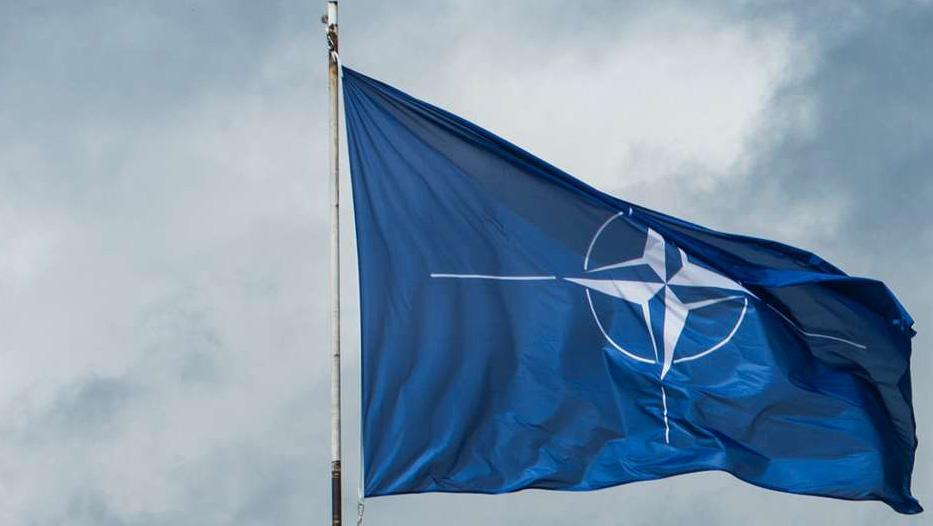
NATO flag is the flag of the North Atlantic Treaty Organization (NATO). It features the NATO emblem placed on a dark blue background. The emblem is compass-shaped, intersected by a circle; the star, circle and lines are white, while the background is dark blue. The star shape is interpreted as a compass symbolizing NATO’s commitment to the path of peace. The circle represents the unity of the 14 member states at the time the emblem was adopted, and the dark blue background symbolizes the Atlantic Ocean.
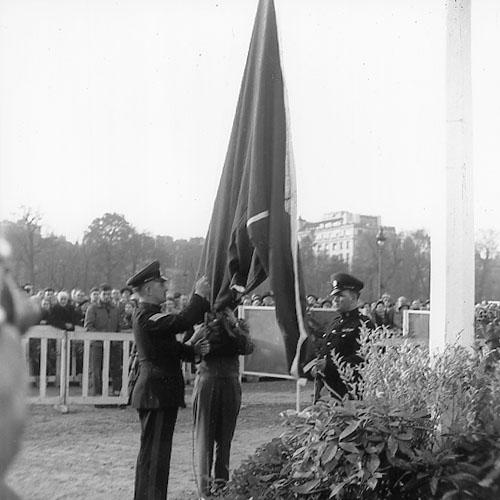
The emblem on the flag was adopted by the North Atlantic Council on 14 October 1953. The flag bearing this emblem was first flown on 9 October 1953.
NATO Flag Ceremony, 1953 (flickr)
The search for a suitable emblem began three years before NATO’s founding. Numerous different proposals were submitted before the current emblem was accepted. From the outset, it was considered essential that the emblem reflect the principles of the transatlantic community; this required that the new emblem be acceptable to all member states. Because the emblem would be used as part of the NATO flag, it was desired that it be simple yet memorable and symbolically convey NATO’s traditions and ideals.
One of the evaluated proposals was a silver shield bearing 14 stars and two blue stripes. In this design, the shield symbolized protection and defense, the stars represented the 14 member states of the time, and the two blue stripes stood for the Atlantic Ocean. However, this proposal was not adopted because it would have required modification each time a new country joined NATO.
On 14 October 1953, the North Atlantic Council adopted the emblem still in use today. This emblem is described as a blue-and-white compass on a dark blue background. The emblem used on the flag has become the primary visual symbol of NATO’s institutional identity.
The flag bearing the new emblem was first flown on 9 October 1953 at a ceremony held at the Esplanade des Invalides in Paris.
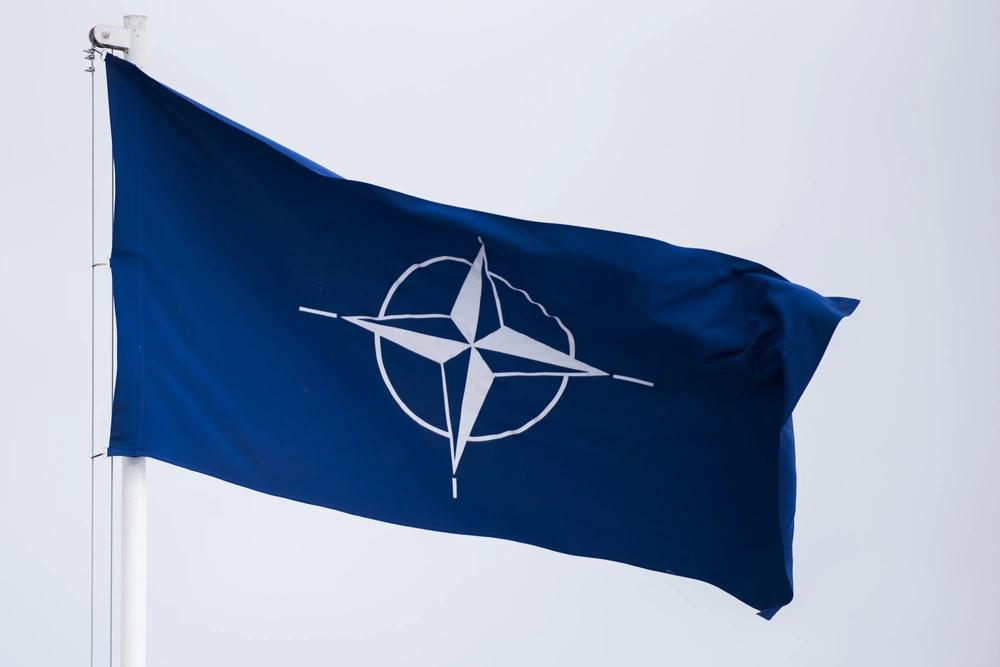
The emblem on the flag consists of a blue-and-white compass placed on a dark blue background. In the design, the star is intersected by a circle. White lines extend from the points of the star. The star, circle and lines are white, and the background is dark blue.
NATO Flag (DIVDS)
The meaning of the emblem was explained by NATO Secretary General Lord Ismay on 28 October 1953. According to this explanation, the star can be seen as a compass that keeps NATO on the path of peace. The circle symbolizes the unity of the 14 member states. The dark blue background on which all elements are placed represents the Atlantic Ocean.【1】
The technical layout of the NATO flag consists of a central NATO emblem on a rectangular field. The flag’s length is 400 units and its width is 300 units, establishing a horizontal composition with a 4:3 ratio.【2】
According to technical measurements, the star is 150 units in size and the circle has a diameter of 115 units. A space of 30 units is left between the points of the star and the beginning of the white lines. A distance of 30 units is also maintained between the outer edge of the flag and the endpoints of the white lines.【3】
The design includes lines extending from the points of the star. However, the length of these lines may vary depending on the surface on which the emblem is used.
The NATO emblem has been the organization’s symbol since 1953. It is used as part of the NATO flag. The requirement for the emblem to be simple and easily recognizable stems from its use on the flag.
The fundamental principle in using the NATO emblem is to preserve its simplicity, recognizability, and visual harmony with its form on the flag.
The emblem is typically used in blue or black on a white or light-colored background. In this application, its linear structure is arranged to remain prominent and legible against the light background.
When the emblem is used on a background lighter than its elements, the design must conform to its form on the NATO flag. In such cases, the emblem is displayed with a light-colored star, circle and lines on a dark background, thereby preserving the visual contrast of the dark blue field and white emblem found on the flag.
DVIDS. "20th anniversary of NATO expansion." Digital Visual Information Distribution System. Accessed June 24, 2026. https://www.dvidshub.net/image/5189919/20th-anniversary-nato-expansion
Federal Government of Germany. "The history of the NATO emblem." *bundesregierung.de*. Accessed June 24, 2026. https://www.bundesregierung.de/statisch/nato/nn_690014/Content/EN/Artikel/2009/02/2009-02-27-geschichte-nato-emblem__en_page-1.html
Hedling, Elsa, Emil Edenborg, and Sanna Strand. "Embodying Military Muscles and a Remasculinized West: Influencer Marketing, Fantasy, and 'the Face of NATO'." *Global Studies Quarterly* 2, no. 1 (January 2022): 1–12. Accessed June 24, 2026. https://academic.oup.com/isagsq/article/2/1/ksac010/6546420
NATO Archives. "NATO FLAG - NATO EMBLEM." archives.nato.int. Accessed June 24, 2026. https://archives.nato.int/uploads/r/null/1/3/137354/0079_NATO_flag_and_emblem-Drapeau_et_Embleme_de_l_OTAN_BIL.pdf
NATO. "1953, NATO Flag raising ceremony." flickr. Accessed June 24, 2026. https://flic.kr/p/9Evi5Y
North Atlantic Treaty Organisation (NATO). *NATO Handbook 1992*. Brussels: NATO Office of Information and Press, 1992. https://archives.nato.int/uploads/r/null/1/4/145732/0050_NATO_Handbook_1992_ENG.pdf
Quaggio, Giulia. “Walls of Anxiety: The Iconography of Anti-NATO Protests in Spain, 1981–6.” *Journal of Contemporary History* 56, no. 3 (2021): 693–719. Accessed June 24, 2026. https://www.jstor.org/stable/27067746
picryl. "A flag is shown during the change of command ceremony." Accessed June 24, 2026. https://picryl.com/media/a-flag-is-shown-during-the-change-of-command-ceremony-970a1b
[1]
Die Bundesregierung, ''The history of the NATO emblem,'' bundesregierung.de, Last accessed 24 June 2026, https://www.bundesregierung.de/statisch/nato/nn_690014/Content/EN/Artikel/2009/02/2009-02-27-geschichte-nato-emblem__en_page-1.html
[2]
NATO Archives, ''NATO FLAG - NATO EMBLEM,'' archives.nato.int, Last accessed 24 June 2026, https://archives.nato.int/uploads/r/null/1/3/137354/0079_NATO_flag_and_emblem-Drapeau_et_Embleme_de_l_OTAN_BIL.pdf
[3]
NATO Archives, ''NATO FLAG - NATO EMBLEM.''


(picryl)
NATO Flag
Affiliated organization | North Atlantic Treaty Organization (NATO) | ||||||||
|---|---|---|---|---|---|---|---|---|---|
Emblem | Compass (star) intersected by a circle | ||||||||
Colors | Blue White | ||||||||
Symbols | Star Circle Lines | ||||||||
Date of emblem adoption | 14 October 1953 | ||||||||
First hoisting of the flag | 9 October 1953 | ||||||||
Dimensions | Length: 400 m Width: 300 m | ||||||||
Length | 400 units | ||||||||
Width | 300 units | ||||||||
Circle diameter | 115 units | ||||||||
History
Design and Symbolism
Technical Specifications
Relationship to the Emblem
Usage Guidelines