


This article was automatically translated from the original Turkish version.
Neglect Syndrome
Original Name(s) | Neglect Syndrome | ||||||||
|---|---|---|---|---|---|---|---|---|---|
Initial Diagnosis | Late 19th century | ||||||||
Cause of Occurrence | Brain Injury | ||||||||
Prominent Feature | Failure to notice one side | ||||||||
Common Type | Neglect of the left side | ||||||||
Diagnostic Methods | cancellation test clock drawing test Line bisection test | ||||||||
Treatment Methods | virtual reality physical stimulation mirror therapy Attention training | ||||||||
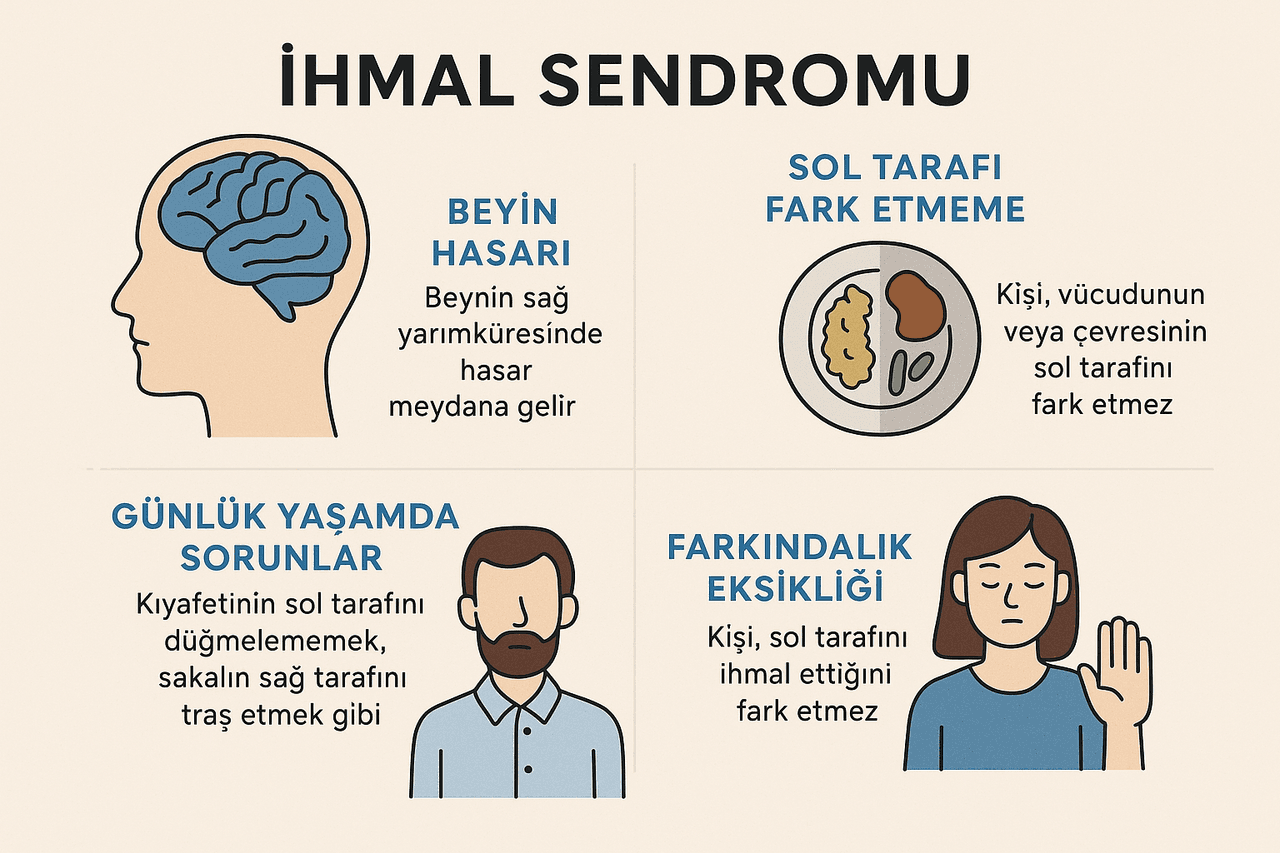
Neglect syndrome is a condition that typically occurs after damage to one side of the brain, causing a person to be unable to perceive one side of their body or environment. This syndrome is most commonly observed following right-sided brain damage, leading to neglect of the left side. Although it is more frequent and pronounced in right hemisphere injuries, it can rarely occur after left hemisphere damage, in which case the person has difficulty perceiving the right side.
Video Explaining Neglect Syndrome (On the Tip of My Tongue)
Individuals with this condition may either fail to perceive everything occurring around them or ignore one side of their body. For example, while eating, they may only consume food from the right side of their plate and ignore food on the left, or while dressing, they may put on only the right side of their clothing and forget the left side. Neglect syndrome often develops after a stroke or severe head injury and can significantly impair daily functioning. Therefore, specialized training and therapeutic approaches can help patients adapt to daily life and enhance their independence. Treatment may involve visual exercises designed to redirect attention toward the neglected side or specific physical cues.
The symptoms of this syndrome vary from person to person; sometimes the individual does not use their left arm or leg, while at other times they struggle to perceive objects or people on the left side of their environment. Some patients are unaware of their condition and deny or have difficulty accepting that they neglect the left side. This lack of awareness can delay recovery and complicate social interactions. Therefore, a thorough understanding of the symptoms and clinical features of neglect syndrome is essential for developing tailored treatments that improve patients’ quality of life.
1. Visual Neglect: The patient may fail to notice objects, people, or events on the left side. For instance, they may eat only from the right side of their plate and avoid touching food on the left. They may also have difficulty making eye contact with individuals on their left.
2. Motor Neglect: The patient may refuse to use their left arm or leg or forget that they are capable of moving them. In some cases, they may even deny that the left arm belongs to them.
3. Sensory Neglect: The patient may not perceive touch on the left side or may feel it much more weakly. As a result, they may have difficulty noticing impacts or injuries to the left side of their body.
4. Daily Living Difficulties: When dressing, they may skip buttons on the left side or tie only the right shoe. When shaving or applying makeup, they focus only on the right side of their face.
5. Lack of Awareness: Some patients are unaware that they are not using their left side (anosognosia) and resist acknowledging the problem. This can create challenges during treatment.
6. Spatial Perception Difficulties: While walking or moving, patients may fail to notice objects or obstacles on their left side, frequently bumping into them and even experiencing accidents at home.
7. Attention and Focus Problems: The person has difficulty directing attention to people or events on the left side, especially in crowded environments where maintaining focus becomes particularly challenging.
8. Emotional and Social Issues: The patient may struggle to interact with individuals on their left in social settings, leading to relationship problems and feelings of loneliness or isolation.
The primary cause of neglect syndrome is typically damage to the right side of the brain, especially in the parietal lobe. The right parietal lobe plays a major role in attention, environmental perception, and spatial awareness. Since the right hemisphere processes information from both its own side and the left side, damage here significantly impairs the perception and control of the left side. In contrast, damage to the left hemisphere rarely causes neglect syndrome.
Video About Patients With Neglect Syndrome (Stroke Foundation)
Moreover, the right hemisphere is dominant over the left in distributing attention to the environment and evaluating the spatial location of objects. Consequently, damage to the right side creates serious difficulties in perceiving the left side of space. Stimuli on the left side are inadequately processed and ignored due to the damage in the right hemisphere. As a result, the person becomes unable to perceive objects in their environment or the left side of their own body, leading to the emergence of neglect syndrome.
The diagnosis of neglect syndrome begins with careful observation of the patient’s behavior in daily life, particularly whether they notice objects in their environment and perform actions directed toward one side. Subsequently, standardized tests are administered to assess the presence and severity of the syndrome. These tests clearly reveal how the patient perceives their surroundings and body, enhancing diagnostic accuracy.
1. Line Bisection Test: The patient is given a long horizontal line and asked to mark its exact center. Individuals with neglect syndrome typically mark a point to the right of the true center, demonstrating their neglect of the left side.
2. Clock Drawing Test: The patient is asked to draw a clock face on a blank sheet of paper and place the numbers correctly. Patients with neglect syndrome often draw only the right half of the clock, leaving the left half blank or incomplete.
3. Cancellation Test: The patient is shown a sheet of paper with small random marks (e.g., stars or lines) and asked to cross out or mark all of them. Affected patients typically cancel only the marks on the right side and ignore those on the left.
4. Object Copying Test: The patient is asked to copy a simple drawing or shape onto paper. Patients with neglect syndrome usually draw only the right portion of the image and omit or completely ignore the left side.
5. Behavioral Observation: Observations are made and recorded regarding whether the patient bumps into objects on their left while walking, uses only the right side of their plate while eating, or has difficulty interacting with people on their left. These observations are valuable for diagnosis.
Although there is no single definitive cure for neglect syndrome, specialized rehabilitation methods and therapeutic techniques can significantly improve patients’ quality of life. The goal of treatment is to redirect the patient’s attention and awareness toward the neglected side, thereby enhancing their independence in daily activities and improving interaction with their environment. Rehabilitation programs are individualized according to the patient’s specific needs and the severity of their symptoms.
1. Attention Training: Patients are taught to consciously attend to the neglected left side. For example, exercises involve locating or identifying objects placed on the left side, with the aim of gradually improving perception in that direction.
2. Mirror Therapy: Mirrors are used to help patients become aware of the neglected side. The mirror reflects the image of the unaffected side, creating the illusion that the neglected side is moving. This method can enhance perceptual awareness and support recovery.
3. Electrostimulation and Vibration: Various physical stimuli are applied to activate the brain’s attention mechanisms. In these methods, mild electrical currents or vibrations are delivered to the muscles or skin of the neglected side to encourage the brain to recognize that area.
4. Virtual Reality and Game Therapy: These modern approaches use interactive games and virtual reality applications to increase patient engagement in treatment. Through specially designed games, patients use the neglected side in an enjoyable and motivating way, facilitating the brain’s relearning of spatial perception.
5. Visual Scanning Exercises: Patients are trained to systematically and regularly scan the neglected side. With consistent practice, the goal is to improve the brain’s ability to detect and evaluate stimuli on the neglected side.
Treatment approaches are often combined and customized for each individual. This enhances the patient’s participation in daily life and improves overall quality of life. Regular practice and patient motivation are critical to treatment success.
Warning: The content in this article is provided solely for general encyclopedic informational purposes. The information here should not be used for diagnosis, treatment, or medical advice. Always consult a physician or qualified healthcare professional before making any decisions regarding health. The author and KÜRE Encyclopedia assume no responsibility for any consequences arising from the use of this information for diagnostic or therapeutic purposes.
Güler, Ayşegül. *Hemiplejik Hastalarda İhmal Fenomeni Üzerine NMV ve VST Yönteminin Etkinliği*. Master's thesis,Atatürk Üniversitesi Faculty of Medicine, Department of Physical Medicine and Rehabilitation, 2011. Accessed June 5, 2025. https://nek.istanbul.edu.tr/ekos/TEZ/48608.pdf.
Karataş, Gülçin Kaymak. “Neglect Sendromu: Klinik Özellikleri ve Rehabilitasyon Yöntemleri.” *Pamukkale Üniversitesi Fiziksel Tıp ve Rehabilitasyon Bilim Dergisi* 9 (Supp): S11–S13. Gazi Üniversitesi. Accessed June 5, 2025. https://www.jpmrs.org/uploads/pdf_PMJ_243.pdf.
“Hemispatial Neglect Syndrome.” Stroke Foundation. Accessed [insert date].
“People Whose Bodies Are Not Half.” *Dilimin Ucunda.* Accessed [insert date if available]. https://www.youtube.com/watch?v=6AaL4D38eu4.

Neglect Syndrome
Original Name(s) | Neglect Syndrome | ||||||||
|---|---|---|---|---|---|---|---|---|---|
Initial Diagnosis | Late 19th century | ||||||||
Cause of Occurrence | Brain Injury | ||||||||
Prominent Feature | Failure to notice one side | ||||||||
Common Type | Neglect of the left side | ||||||||
Diagnostic Methods | cancellation test clock drawing test Line bisection test | ||||||||
Treatment Methods | virtual reality physical stimulation mirror therapy Attention training | ||||||||
Symptoms and Clinical Features
Neurological Causes
Diagnostic Methods
Treatment and Rehabilitation