


This article was automatically translated from the original Turkish version.
There are final two seconds before you let go of your child’s hand at the school door. Their fingers tighten slightly, they lift their head and look at you. That gaze is actually asking a question: Is this place safe? And the child finds the answer not in the school, but in your facial expression.
Every September, the same scene plays out in thousands of households. But some years this scene feels heavier than others: when the child is moving to a new level. From preschool to primary school, from primary to middle school, from middle to high school… These are not ordinary grade transitions; they are thresholds where the child’s world shifts overnight.
Think of the adult equivalent: changing your city, your job, and the people you live with—all within the same week. No one expects you to be happy, adjusted, and productive on day one. Yet we expect exactly that from children, even though they often lack the words to express what they feel. A stomachache, refusal to get out of bed in the morning, silence at dinner—these are the body’s translation of feelings they cannot articulate.
What makes the transition difficult is not a single change, but the convergence of many at once. The building changes; the child gets lost in hallways, does not know where the restroom is, and cannot guess where to go during recess. The teacher changes; they are separated from the adult they trusted and must build new relationships with unfamiliar adults. Their peer group disperses; they must carve out a new place for themselves in the classroom. On top of all this, expectations rise: more responsibility, more homework, more “you’re grown up now.”

Okula Başlangıcını Temsil Eden Görsel (Yapay Zeka İle Oluşturulmuştur.)
The Ministry of National Education’s phrasing when describing adaptation programs points precisely to this: transition programs are initiatives designed to prepare students for the next grade or educational institution, facilitating adjustment and minimizing the challenges brought by the transition.【1】
That means the few days of adjustment at the school gate serve a far more serious purpose than many parents assume. Dismissing them as “there’s no class anyway” robs the child of the gentlest possible entry into this new phase.
First graders meet the school before anyone else. These few days are not an academic acceleration program; quite the opposite—they are a deliberate space where academic pressure is intentionally withheld. The Ministry’s adaptation program for first grade does exactly this: children first get to know each other, then explore the school and playground, learn classroom rules, and play games.【2】
The very first activity’s goal is not about letters, but about the child being able to introduce themselves using their voice and eye contact.【3】 The target is not reading by October; it is being able to say in September, “This is my place too.”
Therefore, during the first weeks, the parent’s job is not to push academic progress, but to make the child feel secure. Goodbyes must be brief and clear: hug, say concretely when you will return—“I’ll be right at the door right after you finish eating”—and leave.
Prolonged goodbyes make the child think “so there must be a reason I’m not supposed to stay here.” Sneaking away is even worse—it shatters trust. As for crying, it is not an exception in the first days; it is the norm. For most children, it ends just minutes after the door closes. Asking the teacher for a brief message will comfort you, not the child, and that is perfectly acceptable.
The most classic parental trap begins in October: your neighbor’s child is already reading fluently, while yours is still sounding out syllables. Reading fluency develops at different times for each child, and an early reader is not necessarily a better reader.
What determines a child’s classroom confidence is often not even holding the pencil correctly; it is being able to use the restroom alone, fasten their apron, open their lunch bag, and ask for water when thirsty. Allocating even a small portion of the energy spent on stationery shopping to these skills makes the first month visibly easier.
There is also a research-based truth that will relieve parents of unnecessary guilt. A study with first-grade students found that adaptation scores differed significantly based on whether the child had received preschool education, with those who had attended preschool scoring higher.【4】
The same study also found that adaptation scores varied significantly by age, with children who started school at age seven performing better.【5】
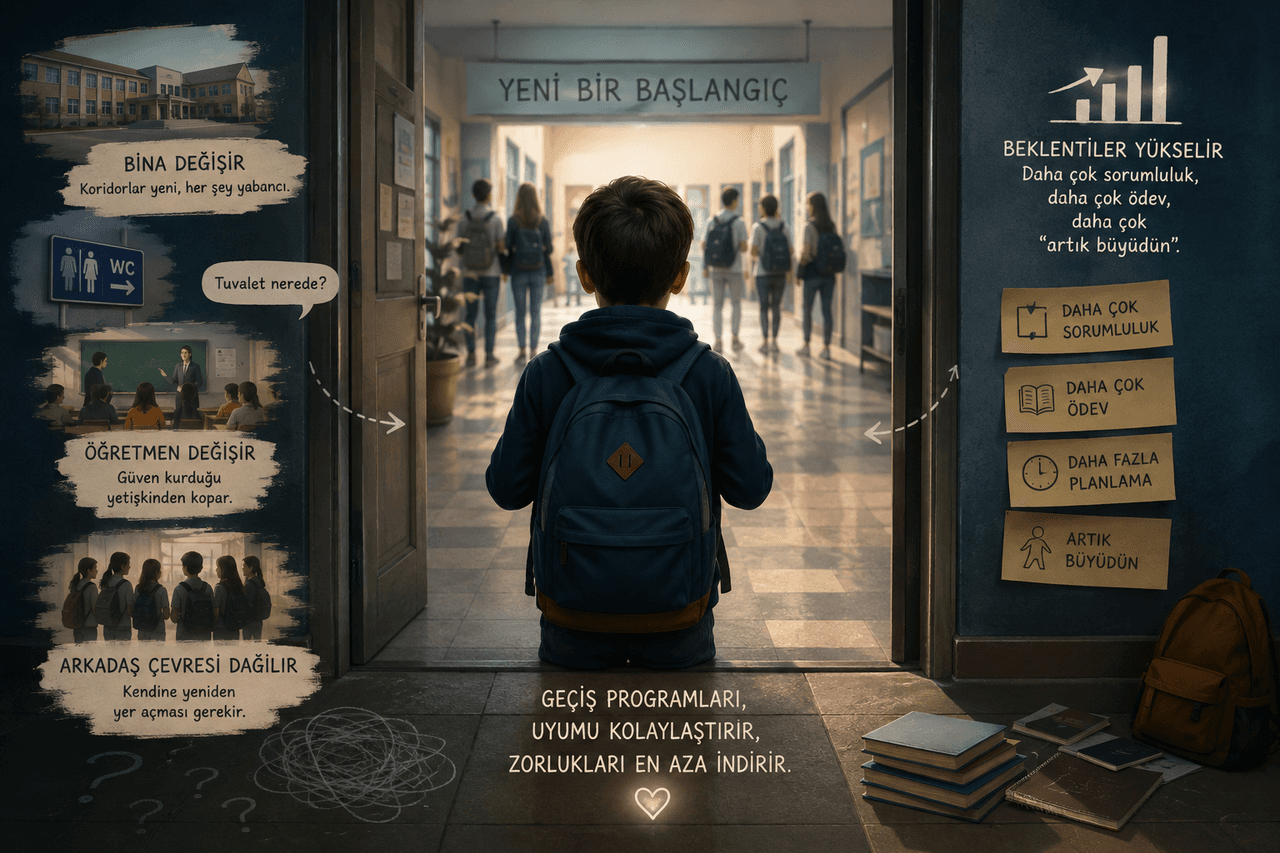
Okula Başlangıcını Temsil Eden Görsel (Yapay Zeka İle Oluşturulmuştur.)
So if your child did not attend preschool or is among the youngest in the class, their adjustment may take a little longer; this is not a deficit, but an expected pattern. For those curious, another finding from the same study: adaptation scores showed no significant difference by gender.【6】 “Girls adapt to school faster”—this statement is not supported by this data.
Of course, not every unease is normal. If symptoms like stomachaches, nausea, nightmares, or bedwetting persist for weeks, if the child expresses intense fear about school, or refuses to go altogether, do not wait—speak first with the classroom teacher, then with the school counseling service. Early concern can be resolved before it turns into outright school refusal.
Fifth grade is the transition most often underestimated by families. Yet the child experiences three major changes simultaneously: the school changes, the system changes, and their body changes.
In primary school, the center of the day is one adult: a class teacher who knows the child, understands their habits, and notices when they are upset.
In middle school, the day is divided into forty-minute segments, each with a different teacher entering the classroom. A study based on teacher observations found that fifth-grade students, continuing habits from earlier years, expect the same one-on-one attention from subject teachers as they received from their class teacher—and when this expectation is unmet, they struggle to adapt.【7】
The same study revealed that teachers observed students struggling in subject classes, especially in subjects like mathematics, where performance declined.【8】
Interpreting this as “my child is becoming lazy” is the easiest and most incorrect interpretation. The truth is: your child has entered a new system, and the key skill in this system is no longer knowledge, but organization. They must learn which notebook belongs to which class, when each assignment is due, how exam weeks are structured. Therefore, the most valuable step a parent can take at this age is to stop packing the bag and instead create a checklist together. Forgetting is part of learning; a parent who always delivers forgotten notebooks to school delays the child’s ability to master the system themselves.
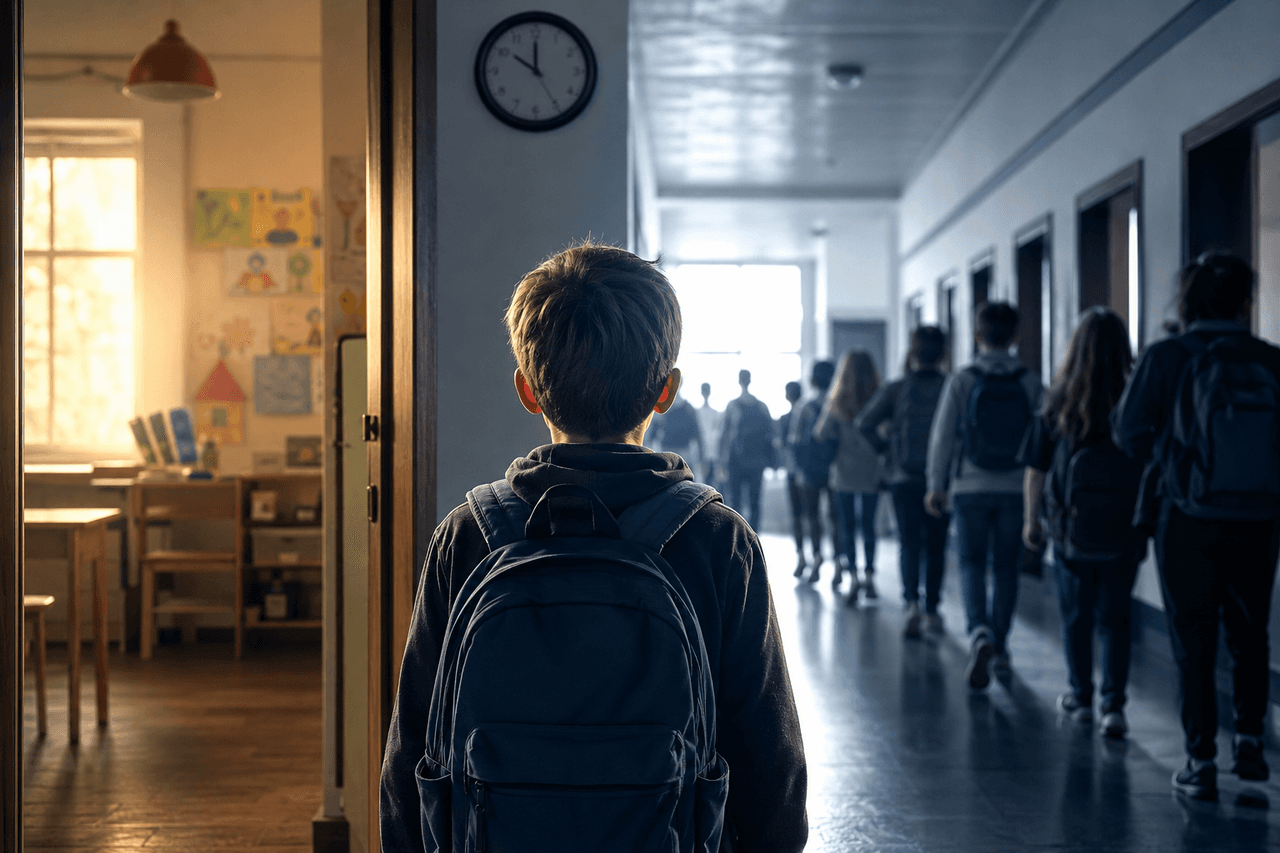
Ortaokula Geçişi Temsil Eden Görsel (Yapay Zeka İle Oluşturulmuştur.)
There is also an invisible side. The same research found that fifth-grade students experience difficulty adjusting to older students; older peers often try to assert dominance, and children struggle to integrate into the new social environment.【9】
Imagine this: a child who has been the biggest in school for four years wakes up one September morning as the smallest. This is not an academic issue—it is a loss of status, and children often express this at home as irritability.
The first signs of adolescence also coincide with this period: slamming doors, withdrawing to their room, one-word answers—these are not signs of disrespect, but the voice of development. At the same time, peer group conversations, peer pressure, and digital exclusion enter the picture; talking about phones and social media before problems arise is incomparably easier than trying to impose rules after they do.
The transition to high school is the most identity-focused of the three thresholds. The child often moves to a new neighborhood, sometimes even a new city; almost their entire peer group changes; the school culture becomes stricter; and they are now expected to behave like a “young adult.”
The Ministry’s adaptation program for secondary education is designed precisely to ease this upheaval: it includes orientation, school tours, social skills activities, and academic development sessions, with a dedicated section for parents.【10】 The school views parents not as spectators but as participants in this transition; you must not skip the first parent meeting, thinking “they’ll just say the same things again.”
The most insidious danger in ninth grade is not failure, but emptiness. After the LGS, summer marks the end of a two-year marathon; in September, the student enters school and immediately hears about a new marathon: “Come on, now you have the YKS too.” This phrase reduces the next four years to a single exam corridor, and more often than not, it does not boost motivation—it extinguishes it.
A more functional approach is to clearly declare the first term as an adjustment period: let the student get to know their new school, join a club, make friends, and develop their own study routine. A student who feels they belong at school recovers academically much faster; clubs, teams, choirs, or theater are not extracurricular luxuries—they are the supporting pillars of adaptation.
It is also helpful, without causing panic, to inform students early that ninth-grade grades contribute to their final average; a student who treats the first term as “just preparation” will later exhaust themselves trying to catch up and damage their self-confidence.
Perhaps most importantly: at this age, communication does not advance through sitting down and talking face to face, but through shared moments side by side. In the car, in the kitchen, while doing dishes—those scattered conversations without direct eye contact are where children reveal unexpected things.
Reducing talking and increasing listening is the most difficult but most rewarding parenting skill during this phase. “Which high school did your cousin get into?” does the opposite—it creates distance instead of closeness.
Grade transitions force children to confront the school, and parents to confront their own childhoods. A mother who feared her teacher may, while dropping her child off at the gate, be leaving behind her own six-year-old self. A father who felt out of place in high school may interpret his son’s ordinary September anxiety as a catastrophe. This is deeply human; the problem begins when it goes unnoticed.
Children learn anxiety not from words, but from faces and tones. A parent whose eyes well up at the door, calls the school three times a day, and at dinner asks “Didn’t anyone play with you today?”—without saying a word—communicates this: this place is something to fear. Therefore, the hardest part of this guide is not about the child, but about ourselves.
Occasionally, pause and ask: Is this unease really my child’s, or is it mine? The answer is often the latter—and that is good news, because the only thing we can truly work on is our own anxiety.

Okul Kaygısını Temsil Eden Görsel (Yapay Zeka İle Oluşturulmuştur.)
Meanwhile, do not underestimate the everyday. Sleep routines underpin everything; a sleep-deprived child produces symptoms that look like attention problems. Shifting bedtime fifteen minutes earlier each day for a week before school starts can cut morning crises in half.
Do not turn breakfast into a negotiation, turn off screens at least one hour before bed, and avoid criticizing the school or teachers in front of your child—all are equally ordinary and equally effective. And instead of asking at dinner, “How was your day?” ask “Who did you play with at recess?” or “Which class did you find most boring today?”—these questions replace one-word answers with real stories.
The first day of school is a photograph; adjustment is a process that unfolds over weeks. Your child may cry in the first week, say “I have no friends” in the third week, and refuse to leave school in the sixth week. All of these are different days of the same process, and none alone is a final judgment.
The best thing to do is simply stay patient: smiling at the door, asking curious questions at dinner, calmly speaking with the teacher when needed. Because the child does not adapt to the new school first—they adapt to the expression on your face. New grades bring new anxieties; but what they truly bring is the realization that your child is growing again.
Millî Eğitim Bakanlığı Ortaöğretim Genel Müdürlüğü. *Ortaöğretime Uyum Programı Uygulama Kılavuzu: Uyum Etkinlikleri*. Ankara: MEB, 2017. Accessed August 29, 2026.
Ministry of National Education, General Directorate of Basic Education. *Okula Uyum Programı (İlkokul 1. Sınıf)*. Ankara: MEB, 2019. Accessed August 29, 2026.https://tegm.meb.gov.tr/meb_iys_dosyalar/2019_09/06120411_Okula_Uyum_ProgramY_ilkokul_2019-2020.pdf
Yoleri, S., and H. M. Tanış. "İlkokul Birinci Sınıf Öğrencilerinin Okula Uyum Düzeylerini Etkileyen Değişkenlerin İncelenmesi." *Karabük Üniversitesi Sosyal Bilimler Enstitüsü Dergisi* 4, no. 2 (2014): 130–141. Accessed August 29, 2026.https://dergipark.org.tr/en/download/article-file/105590
Özdemir, M. C., and A. Çoruk. "4+4+4 Sistem Değişikliği Sonrası 5. Sınıf Öğrencilerinin Yaşadığı Sorunlara İlişkin Öğretmen Görüşlerinin İncelenmesi." *Ihlara Eğitim Araştırmaları Dergisi* 4, no. 2 (2019): 288-299. Accessed August 29, 2026.
[1]
Millî Eğitim Bakanlığı Ortaöğretim Genel Müdürlüğü, Ortaöğretime Uyum Programı Uygulama Kılavuzu: Uyum Etkinlikleri (Ankara: MEB, 2017), 6, https://ogm.meb.gov.tr/meb_iys_dosyalar/2017_09/06160405_OrtaYYretime_Uyum_ProgramY_Uygulama_KYlavuzu_Uyum_Etkinlikleri.pdf
[2]
Millî Eğitim Bakanlığı Temel Eğitim Genel Müdürlüğü, Okula Uyum Programı (İlkokul 1. Sınıf) (Ankara: MEB, 2019), 9-12, https://tegm.meb.gov.tr/meb_iys_dosyalar/2019_09/06120411_Okula_Uyum_ProgramY_ilkokul_2019-2020.pdf.
[3]
MEB Temel Eğitim Genel Müdürlüğü, Okula Uyum Programı, 9.
[4]
S. Yoleri ve H. M. Tanış, "İlkokul Birinci Sınıf Öğrencilerinin Okula Uyum Düzeylerini Etkileyen Değişkenlerin İncelenmesi," Karabük Üniversitesi Sosyal Bilimler Enstitüsü Dergisi 4, sy. 2 (2014): 135, https://dergipark.org.tr/en/download/article-file/105590
[5]
Yoleri ve Tanış, "Okula Uyum Düzeylerini Etkileyen Değişkenler," 134-135.
[6]
Yoleri ve Tanış, "Okula Uyum Düzeylerini Etkileyen Değişkenler," 134.
[7]
M. C. Özdemir ve A. Çoruk, "4+4+4 Sistem Değişikliği Sonrası 5. Sınıf Öğrencilerinin Yaşadığı Sorunlara İlişkin Öğretmen Görüşlerinin İncelenmesi," Ihlara Eğitim Araştırmaları Dergisi 4, sy. 2 (2019): 294, https://dergipark.org.tr/tr/download/article-file/911694
[8]
Özdemir ve Çoruk, "5. Sınıf Öğrencilerinin Yaşadığı Sorunlar," 293.
[9]
Özdemir ve Çoruk, "5. Sınıf Öğrencilerinin Yaşadığı Sorunlar," 295.
[10]
MEB Ortaöğretim Genel Müdürlüğü, Ortaöğretime Uyum Programı Uygulama Kılavuzu, 26-67, 164-168.
What Really Happens at the Threshold?
When the Bell Rings for the First Time
Being the Smallest in School
Waking Up in a New City
Whose Anxiety Is It Really?
Adjustment Is Not a Day, But a Season
