

This article was automatically translated from the original Turkish version.
NGC 4395 is a low-luminosity, late-type spiral galaxy located in the constellation Canes Venatici. It is notable for hosting an active galactic nucleus of Seyfert 1 type at its core while lacking a prominent galactic bulge. Due to these characteristics, NGC 4395 is regarded as an important example for studying the formation and evolution of active galactic nuclei and the physical properties of low-mass black holes.
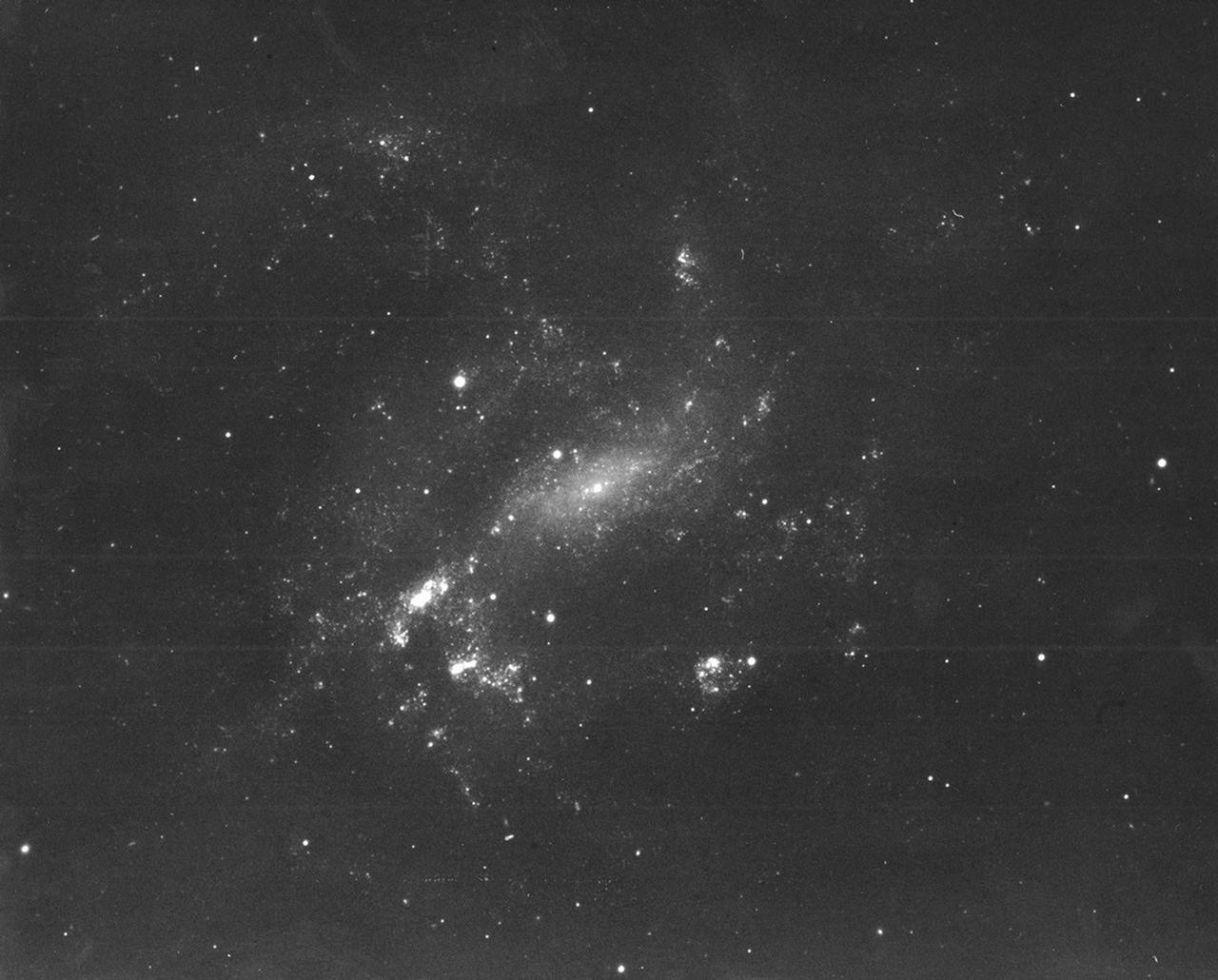
Spiral Galaxy NGC 4395 (NOIRLAB)
NGC 4395 is classified among nearby galaxies with relatively low surface brightness. Optical observations reveal that the galaxy has an irregular structure with faintly defined spiral arms. Photometric and spectroscopic studies have detected high-energy processes at its center, which are associated with the presence of an active galactic nucleus.
This galaxy lacks a prominent bulge structure at its center. This feature is considered one of the key examples demonstrating that active galactic nuclei are not confined exclusively to galaxies with large and well-defined central bulges.
Spectroscopic analyses show the coexistence of broad and narrow emission lines, confirming that the nucleus belongs to the Seyfert 1 class. Despite its low luminosity, the nucleus exhibits typical characteristics of an active galactic nucleus.
NGC 4395’s active galactic nucleus exhibits variability in the optical, ultraviolet and X-ray bands. These variations occur on short timescales, indicating a non-steady emission structure and a compact energy-producing region within the nucleus. The observed radiation is linked to accretion processes involving matter accumulating around the central black hole.
The presence of both broad and narrow line components in the nucleus spectrum reveals the existence of a broad-line region and a narrow-line region. This structure is a defining feature of Seyfert 1 galaxies.
NGC 4395 hosts a low-mass black hole at its center. Compared to classical supermassive black holes, this black hole exhibits significantly lower mass values. This characteristic makes the galaxy an important example for studying low-mass active nuclei.
The mass of the black hole is determined using the reverberation mapping technique. In this method, the delayed response of the broad-line region to variations in nuclear emission is measured, and the time lag is used to calculate the black hole mass.
NGC 4395’s broad-line region consists of high-velocity gas located close to the central black hole. This region responds with a time-delayed emission to variations in nuclear radiation. The size of the broad-line region and the motion of the gas are fundamental parameters in determining the black hole mass.
NGC 4395’s host galaxy is low-mass and of late-type morphology. Star formation is distributed throughout the gal


Discovery and Observational Properties
Active Galactic Nucleus
Black Hole Mass
Broad-Line Region
Galactic Structure and Star Formation