

This article was automatically translated from the original Turkish version.
NGC 4650A Galaxy
Constellation | Cetus | ||||||||
|---|---|---|---|---|---|---|---|---|---|
Distance(s) | Approximately 130 million light years | ||||||||
Galaxy Type | Polar Ring Galaxy | ||||||||
Diameter of the Ring | Approximately 40 kiloparsecs | ||||||||
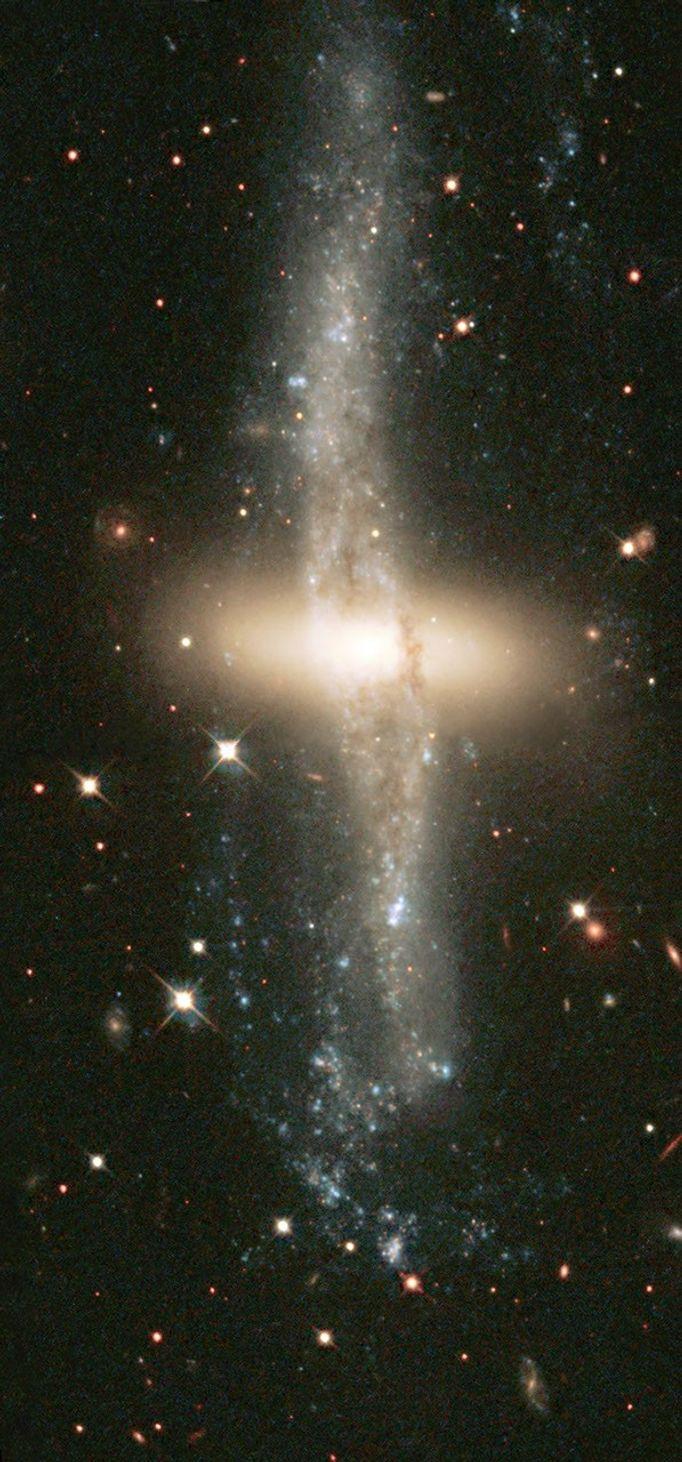
The NGC 4650A Galaxy is a galaxy located in the direction of the constellation Cetus and classified in astronomical literature as a polar ring galaxy. First discovered in the mid-20th century this galaxy attracts attention due to its ring structure oriented at a right angle to its main body. NGC 4650A is one of the best studied and most representative examples among polar ring galaxies.

The NGC 4650A Galaxy (NASA)
The structure of NGC 4650A consists of two main components: an elliptical or lenticular main body at the center and a ring or disk oriented perpendicularly to it. The main body is composed of stars and an older stellar population while the ring contains younger stars gas and dust. The diameter of the ring is significantly larger than that of the main body and is approximately 40 kiloparsecs.
Polar ring galaxies are galaxies with a ring structure inclined at approximately 90 degrees to the plane of the central galaxy. This ring typically consists of stars gas and dust and is positioned perpendicular to the main galaxy’s plane. NGC 4650A is one of the best known and most thoroughly studied examples of such galaxies and the dynamic and chemical properties of its ring provide insights into the formation and evolution of polar ring galaxies.
The ring of NGC 4650A rotates at a different angle relative to the main body. Spectroscopic observations show that the motion of gas and stars in the ring is distinctly different from the rotation of the main body. This indicates a complex dynamical structure for the galaxy. The gas density and star formation activity within the ring also offer clues about the origin of the material forming the ring.
The structure of NGC 4650A has been examined within the framework of various formation models linked to galaxy evolution and interaction processes. One of the most widely accepted models suggests that the ring was formed from gas and stars accreted from an external galaxy. This process may occur through gravitational interactions between galaxies or through material transfer from a small satellite galaxy to the main galaxy. An alternative scenario proposes that the ring formed from cosmic gas flows during the initial formation of the main galaxy.
Spectroscopic analyses have shown that the gas in the ring of NGC 4650A has a different metal content than that of the main body. The low metallicity observed in the ring indicates that it originated from a younger and distinct source. Furthermore the stellar population in the ring is younger and currently in an active phase of star formation compared to the main body.
NGC 4650A has been the subject of numerous observational studies across multiple wavelengths. Optical imaging spectroscopy radio and infrared observations have all been used to determine the structural and physical properties of the galaxy. The Hubble Space Telescope the European Southern Observatory’s Very Large Telescope (VLT) and other ground-based telescopes have conducted detailed investigations of NGC 4650A.
Ultimately NGC 4650A plays an active role as a laboratory for understanding the physical and dynamical structure of polar ring galaxies and provides data for testing theoretical models of galaxy interactions gas flow processes and star formation mechanisms. Additionally the galaxy’s structure contributes to our understanding of the role of environmental factors in galaxy evolution.
European Space Agency/Hubble Space Telescope. “Ring around NGC 4650A.” HubbleSite. Accessed May 31, 2025. https://esahubble.org/images/opo9916a/.
Gallagher, J. “Polar Ring Galaxy NGC 4650A.” *Astronomy Picture of the Day (APOD)*. Accessed May 31, 2025. https://apod.nasa.gov/apod/ap990510.html.
NASA Goddard Space Flight Center. “Hubble Space Telescope’s 20th Anniversary: April 8.” *Imagine.gsfc.nasa.gov*. Accessed May 31, 2025. https://imagine.gsfc.nasa.gov/hst_bday/april-8.
NASA Goddard Space Flight Center. “Polar Ring Galaxy NGC 4650A: A Disk of Red Stars Ringed by Dust, Gas, and More Stars.” Science.nasa.gov. Accessed May 31, 2025. https://science.nasa.gov/asset/hubble/polar-ring-galaxy-ngc-4650a-a-disk-of-red-stars-ringed-by-dust-gas-and-more-stars/.

NGC 4650A Galaxy
Constellation | Cetus | ||||||||
|---|---|---|---|---|---|---|---|---|---|
Distance(s) | Approximately 130 million light years | ||||||||
Galaxy Type | Polar Ring Galaxy | ||||||||
Diameter of the Ring | Approximately 40 kiloparsecs | ||||||||
Structural Features
Dynamical Properties and Formation Scenarios
Chemical Composition and Observational Studies