
This article was automatically translated from the original Turkish version.
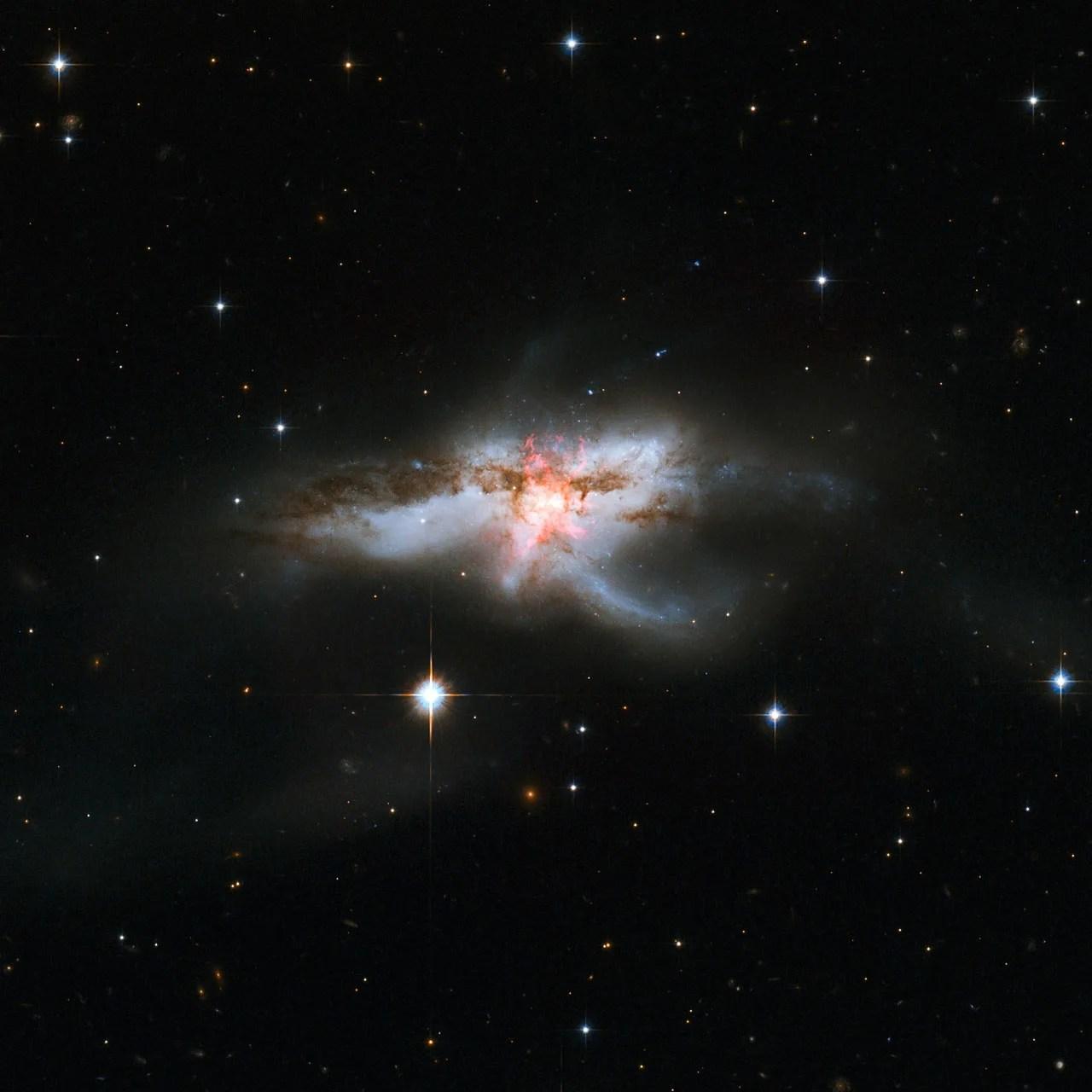
NGC 6240 Galaxy
Type(s) | Merging galaxy | ||||||||
|---|---|---|---|---|---|---|---|---|---|
Constellation | Scorpius | ||||||||
Distance(s) | Approximately 400 million light years | ||||||||
Apparent Magnitude | Approximately 13.8 mag | ||||||||
The NGC 6240 Galaxy is a merging galaxy pair located approximately 400 million light-years away in the direction of the Scorpius constellation. This galaxy pair consists of two large galaxies in the process of merging and attracts attention for both its structural and dynamic properties as observed. NGC 6240 serves as a critical example in studies due to its high-energy radiation sources and complex gas dynamics.

The NGC 6240 Galaxy (NASA)
NGC 6240 is a system with two distinct nuclei, indicating an advanced stage of the galactic merger process. Observations in visible and infrared light have measured the distance between these two nuclei at approximately 1.5 kiloparsecs (about 4,900 light-years). The morphological structure of the galaxy pair is complex and irregular due to the effects of the merger and collision process, characterized by irregular distributions of star-forming regions, gas clouds, and dust.
NGC 6240 exhibits a highly complex dynamic structure due to gravitational interactions between the merging galaxies. Spectral analyses conducted in optical and radio wavelengths reveal high velocities and turbulence in the motions of both stars and gas. The broad Hα and other emission lines observed in the galactic center are associated with intense star formation and active galactic nucleus processes.
NGC 6240 is one of the rare systems hosting two active galactic nuclei. Observations have confirmed that both nuclei contain supermassive black holes and produce high-energy X-ray emissions. This provides strong evidence that the black holes at the centers of the merging galaxies are moving toward each other. Observations from the Chandra X-ray Observatory and other high-resolution X-ray telescopes have verified the presence of high-energy radiation emanating from each nucleus.
Due to the merger process, NGC 6240 contains dense regions of star formation. In particular, infrared observations have revealed ongoing intense star formation in dust-obscured regions of the galaxy. Gas compression triggered by the merger and collision is considered a key factor in initiating star formation. Additionally, the galaxy’s dust content has been meticulously mapped through detailed studies across different parts of the electromagnetic spectrum.
NGC 6240 has been extensively studied across multiple wavelengths including radio, optical, infrared, and X-ray. Each wavelength band provides information about different components and processes within the galaxy. Radio observations have examined the effects of plasma and magnetic fields in the intergalactic medium. Infrared observations have played a crucial role in characterizing dust and star formation. X-ray observations have enabled the understanding of high-energy processes occurring in the active nuclei.
The total mass of NGC 6240 is estimated as the sum of the masses of stars, gas, dust, and black holes. Mass measurements are supported by data derived from the dynamic motions during the merger and the behavior of gas. In terms of energy budget, the combined energy output from star formation and active nucleus activity determines the observed distribution of electromagnetic radiation from the galaxy. This information is critical for modeling the galaxy’s evolution and post-merger processes.
NGC 6240 provides a key example for understanding the evolutionary processes of galaxy mergers. The dynamic, structural, and physical changes occurring during galactic collisions and mergers have been detailed through observations of NGC 6240. The motion of the two supermassive black holes toward merger offers important clues about how galactic nuclei grow in the universe. Furthermore, inferences can be drawn regarding the potential birth of a new elliptical galaxy following the merger.
NGC 6240 is a system that has been extensively studied among merging galaxy pairs, providing comprehensive data on structure, dynamics, active nuclei, and star formation processes through multidisciplinary research. Data obtained from multi-wavelength observations are regarded as a critical reference for understanding astrophysical topics such as galaxy evolution and the merger processes of supermassive black holes.
NASA. “Giant Gas Cloud in System NGC 6240.” *NASA*. Accessed May 31, 2025. https://www.nasa.gov/universe/giant-gas-cloud-in-system-ngc-6240/.
NASA. “Hubble Interacting Galaxy NGC 6240.” *NASA Science*. Accessed May 31, 2025. https://science.nasa.gov/asset/hubble/hubble-interacting-galaxy-ngc-6240/.
NASA. “Hubble Revisits Tangled NGC 6240.” *NASA Science*. Accessed May 31, 2025. https://science.nasa.gov/missions/hubble/hubble-revisits-tangled-ngc-6240-ytegv/.

NGC 6240 Galaxy
Type(s) | Merging galaxy | ||||||||
|---|---|---|---|---|---|---|---|---|---|
Constellation | Scorpius | ||||||||
Distance(s) | Approximately 400 million light years | ||||||||
Apparent Magnitude | Approximately 13.8 mag | ||||||||
Structural and Dynamic Properties
Active Galactic Nucleus (AGN) and Star Formation
Multi-wavelength Observations and Mass
Evolutionary Perspective