

This article was automatically translated from the original Turkish version.
+2 More
Niagara Falls
Location | Canada (Ontario) / United States (New York) border | ||||||||
|---|---|---|---|---|---|---|---|---|---|
River It Belongs to | Niagara River | ||||||||
Lake It Flows Into | Lake Ontario | ||||||||
Source | Lake Erie | ||||||||
Sections | Bridal Veil Falls (USA) American Falls (USA) Horseshoe Falls (Canada) | ||||||||
Number of Visitors | Approximately 12 million per year | ||||||||
Niagara Falls is a world-renowned waterfall system located in eastern North America, between Canada and Türkiye. Formed along the Niagara River, which constitutes the natural boundary between Canada’s Ontario province and the United States’ New York state, this formation attracts attention not only for its visual impact but also for the volume of water it carries and its hydroelectric potential. Niagara Falls consists of three main sections: Horseshoe Falls, American Falls, and Bridal Veil Falls. This area, which draws millions of visitors annually, is an important part of both natural and cultural heritage due to its geological history and physical characteristics.

Bird’s-Eye Map of the Waterfall System and Its Location Between Canada and the United States (Niagara Tours)
Niagara Falls began forming approximately 12,500 years ago, following the retreat of glaciers at the end of the last ice age. Waters from melting ice masses flowed from Lake Erie toward Lake Ontario, and among five different flow paths, only one eventually stabilized to form today’s Niagara River and waterfall system. Over millennia, the falls have eroded limestone and underlying shale layers, moving upstream. During this process, the falls reached an ancient riverbed now known as the Whirlpool, whose rapid erosion created the spiral-shaped structure.
The Niagara River is 58 kilometers long in total. The elevation difference between Lake Erie and Lake Ontario is approximately 99 meters, a significant portion of which is accounted for by the falls. Horseshoe Falls drops about 57 meters and spans 670 meters in width. American Falls descends between 21 and 34 meters in height, ultimately reaching the same 57-meter level as Horseshoe Falls. American Falls is approximately 260 meters wide. The pool beneath the falls is 35 meters deep, while the deepest point of the riverbed reaches 52 meters. During peak flow, 168,000 cubic meters of water pass over the falls per minute, equivalent to approximately 2,832 tons per second.

View of American Falls from Above (Anadolu Agency)
The Niagara River has two main tributaries: the Chippawa Canal on the western side, belonging to Canada, and the Tonawanda Canal on the eastern side, belonging to the United States. Approximately 60 percent of the river’s flow passes through the Chippawa Canal. The bedrock of the river consists of sediments deposited in tropical seas around 400 to 440 million years ago. The erosive power of the falls is enhanced not only by the force of flowing water but also by a physical process called cavitation. As water accelerates, internal pressure drops, causing air bubbles to form. These bubbles collapse when the water slows, generating shock waves that fracture the rock surface. The water of the falls has a distinctive green color due to dissolved minerals and rock particles.

Tourists Ziplining Above the Falls (Anadolu Agency)
Approximately 60 tons of minerals and finely ground rock particles pass over the falls every minute. The color results from the dissolution of natural sediments, primarily from limestone, as well as shale and sandstone. This feature demonstrates that Niagara is not merely a visual phenomenon but also an active expression of local geology.
Niagara Falls is not only a natural and technological marvel but also a major site of tourism and cultural heritage. Millions of visitors each year flock to the region to witness its breathtaking scenery and explore its diverse attractions.
Among the sites that attract visitors are the Cave of the Winds walking trail, where one can feel the power of the water up close, the Niagara Power Vista observation and education center, and the natural formations in the Whirlpool area. Nighttime illumination of the falls and regular fireworks displays have transformed this natural landmark into a city symbol and a major tourist destination.

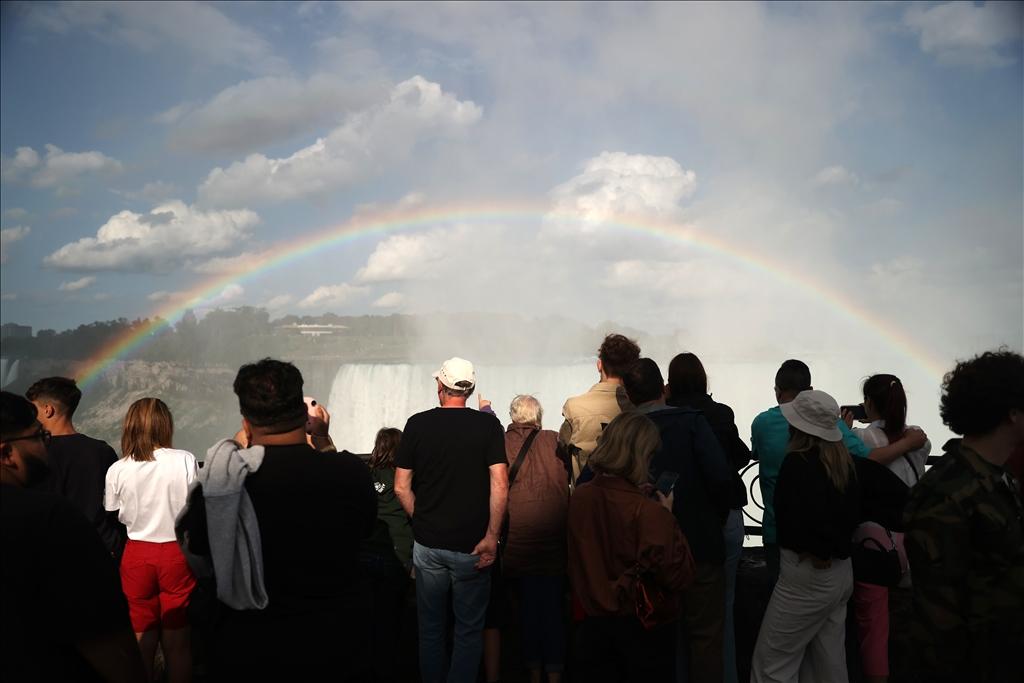
View of Horseshoe Falls During Rainbow Formation (Anadolu Agency)
The Niagara region is also central to cultural and historical preservation efforts. Designated by the United States Congress in 2008 as the Niagara Falls National Heritage Area, this initiative aims to protect and promote the natural, historical, and cultural resources stretching from Niagara Falls to Old Fort Niagara.
The social impact of the falls extends beyond tourism. The Niagara River is used for drinking water supply, fishing, swimming, birdwatching, industrial cooling systems, and hydroelectric power generation, directly contributing to the daily lives of millions of people living on both the Canadian and American sides of the border.

Niagara Falls Photographed from the Canadian Side of the Border (Anadolu Agency)
By the late 19th century, Niagara Falls was regarded not only as a natural wonder but also as a major source of energy. The most significant development in this context was Nikola Tesla’s application of alternating current (AC) technology to harness hydroelectric power here. As a young man, Tesla had seen a photograph of Niagara Falls and conceived the idea of converting this natural force into electricity. After emigrating to the United States, he partnered with George Westinghouse to champion the AC system against Thomas Edison’s direct current (DC) system.
In 1893, the Westinghouse Company won the bid to build a large-scale hydroelectric plant along the Niagara River. Backed by investors such as J.P. Morgan and W.K. Vanderbilt, the project was completed after three years of construction in 1895; that same year, electricity generated from Niagara Falls was transmitted for the first time to a nearby factory. In 1896, successful long-distance transmission of electricity from Niagara to Buffalo was achieved. This application marked a turning point in the global adoption of alternating current technology.
By 1927, this power complex became known as the Edward Dean Adams Power Station. Today, only the Adams Power Plant Transformer House remains standing, and this structure has been listed on the National Register of Historic Places. Tesla’s legacy is displayed at visitor sites such as Niagara Power Vista and Cave of the Winds, while a bronze statue on Goat Island continues to symbolize his contribution.
Hydroelectric power generated from Niagara Falls is still in use today. The primary institutions benefiting from this energy are Canada’s Sir Adam Beck Generating Stations and the United States’ New York State Power Authority. The Canada–United States agreement signed in 1950 regulates water usage, mandating a minimum flow of 2,832 cubic meters per second (100,000 cubic feet per second) over the falls during daylight hours in the tourist season. At other times, this flow is reduced to 1,416 cubic meters per second. The remaining water is used for power generation.
Anadolu Agency. "Niagara Falls in Canada – Photo Gallery." Accessed August 2, 2025.
Niagara Falls National Heritage Area. "Tesla and Niagara Falls." Accessed August 2, 2025. https://www.discoverniagara.org/tesla-and-niagara-falls.
Niagara Parks. "Niagara Falls Geology: Facts & Figures." Accessed August 2, 2025. https://www.niagaraparks.com/visit-niagara-parks/plan-your-visit/niagara-falls-geology-facts-figures/.
Niagara Tours. "Niagara Falls Tours – Maps." Accessed August 2, 2025. https://www.niagara-tours.com/niagara-falls-tours/maps/.

Niagara Falls
Location | Canada (Ontario) / United States (New York) border | ||||||||
|---|---|---|---|---|---|---|---|---|---|
River It Belongs to | Niagara River | ||||||||
Lake It Flows Into | Lake Ontario | ||||||||
Source | Lake Erie | ||||||||
Sections | Bridal Veil Falls (USA) American Falls (USA) Horseshoe Falls (Canada) | ||||||||
Number of Visitors | Approximately 12 million per year | ||||||||
Natural Structure and Geological Formation
Tourism and Social Impact
Energy Production and Tesla’s Role