


This article was automatically translated from the original Turkish version.
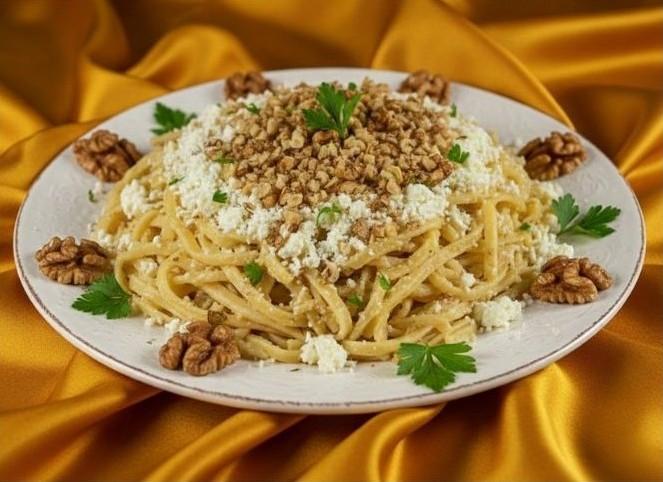
(Generated by Artificial Intelligence)
Niğde Style Walnut Erşte
Type(s) | Dough-based regional dish | ||||||||
|---|---|---|---|---|---|---|---|---|---|
Region(s) | Niğde | ||||||||
Cultural Context | Central Anatolian and Western Black Sea culinary culture | ||||||||
Consumption Time | Daily consumption is common after winter preparations | ||||||||
Preparation Method | Combining boiled erişte with oil, walnuts, and local products | ||||||||
Main Ingredients | Erişte, walnuts, butter | ||||||||
Niğde-Style Walnut Erişte, a traditional dish from Anatolian culinary culture, is prepared by combining boiled erişte with regional ingredients such as walnuts and butter. It is widely consumed in Central Anatolian cuisine due to its nutritious properties and pasta-based structure.
Niğde is a settlement area in Central Anatolia characterized by a continental climate. The region’s agrarian and pastoral lifestyle has significantly shaped its culinary culture. Due to harsh winters, foods that can be stored for long periods and are highly nutritious hold an important place in Niğde cuisine. In this context, products such as erişte, tarhana, and yufka are produced extensively for winter preparations and used throughout the year in various dishes.
In Niğde cuisine, walnut erişte is a traditional dish that emerged from the use of erişte prepared during winter preparations. In Niğde, erişte is consumed as pilaf, soup, and walnut erişte, giving it a critical position in the regional culinary tradition.
Walnut erişte is closely linked to Niğde’s culinary philosophy of creating satisfying and nutritious meals with minimal ingredients. The dish’s components—erişte, butter, and walnuts—are directly tied to local production and consumption habits.
Niğde cuisine features a diverse structure encompassing soups, pasta dishes, meat and vegetable dishes, desserts, and winter preparations. Walnut erişte is classified among the pasta-based dishes in this culinary tradition. The variety of dishes made with erişte in the region demonstrates the enduring significance of erişte in Niğde’s culinary culture.
The ingredients used in preparing walnut erişte in the Niğde region are as follows:
Water is brought to a boil in a large pot and salt is added. The erişte is added to the boiling water and cooked until soft. The cooked erişte is drained and rinsed under cold water. The drained erişte is then mixed with melted butter in the pot. The mixture is transferred to a serving dish, topped first with crumbled white cheese and then with coarsely crushed walnuts. It is garnished with parsley and served.

Niğde-Style Walnut Erişte (Kültür Portalı)
Today, walnut erişte is served both in home kitchens and in a limited number of food and accommodation establishments. Its recognition is more limited outside provinces such as Niğde and Bolu.
This dish is preferred more by domestic tourists, while foreign tourists typically sample it as part of culinary exploration. The limited presence of regional dishes on menus has contributed to walnut erişte maintaining its identity primarily as a dish consumed by the local population.
Walnut erişte reflects the continuity of traditional culinary culture in the Niğde region. The practice of producing erişte during winter preparations and using it throughout the year in various dishes directly connects this dish to local lifestyle practices. Walnut erişte is prepared in home kitchens through knowledge and techniques passed down from generation to generation, placing it within the category of intangible cultural heritage.
In conclusion, Niğde-style walnut erişte is regarded as a dish of cultural and gastronomic value due to its use of regional ingredients, traditional production methods, and the preservation of local culinary knowledge.
Ayyıldız, Sibel, and Şaban Kargıglıoğlu. "Konaklarda Sunulan Yöresel Yemeklerin Sürdürülebilir Gastronomi Turizmi Bakımından İncelenmesi: Safranbolu Konakları Örneği." *Akademik Sosyal Araştırmalar Dergisi* 6, no. 79 (2018): 367–381. Accessed February 8, 2026. https://www.researchgate.net/profile/Saban-Kargiglioglu/publication/328268367_Konaklarda_Sunulan_Yoresel_Yemeklerin_Surdurulebilir_Gastronomi_Turizmi_Bakimindan_Incelenmesi_Safranbolu_Konaklari_Ornegi/links/5bc241a9299bf1004c5eca7e/Konaklarda-Sunulan-Yoeresel-Yemeklerin-Suerdueruelebilir-Gastronomi-Turizmi-Bakimindan-Incelenmesi-Safranbolu-Konaklari-Oernegi.pdf.
Eren, Duygu, and Sevgi Eroğlu. "Niğde İlinin Gastronomi Turizmi Potansiyelinin Değerlendirilmesi." In *IV. Uluslararası Gastronomi Turizmi Araştırmaları Kongresi (UGTAK) Bildiriler Kitabı*. Accessed February 8, 2026. https://www.researchgate.net/profile/Yusuf-Karakus-3/publication/338230820_UGTAK_Proceedings_Book/links/5e0b3cd992851c8364a70301/UGTAK-Proceedings-Book.pdf?__cf_chl_tk=3nhS7VF27dC5ySz_U5uAn.0NBeJH4vUdg.F8QTTp_Iw-1769609468-1.0.1.1-JaVXaopAT_COqTtZfKxi6RMnVhOlPX9RP2LiquIN9Tg#page=138.
Kahya Yıldırım, Elif. "Gıda Coğrafyası Perspektifinden Niğde Yöresi Gastronomi Potansiyeline Yönelik Bir Araştırma." *Journal of World Geography and Development Perspectives* (2024). Accessed February 8, 2026. https://dergipark.org.tr/en/download/article-file/4024376.
Ministry of Culture and Tourism of the Republic of Türkiye. "Cevizli Erişte – Niğde." Türkiye Kültür Portalı. Accessed February 8, 2026. https://www.kulturportali.gov.tr/turkiye/nigde/neyenir/cevizli-eriste.
Özmen, Şinasi, and Gaye Deniz. "Gastronomi Turizmi Kapsamında Coğrafi İşaretli Ürünlerin Yiyecek İçecek İşletmelerinde Kullanımı: Niğde İli Örneği." *Güncel Turizm Araştırmaları Dergisi* 8, no. 2 (2024): 538–560. Accessed February 8, 2026. https://dergipark.org.tr/tr/download/article-file/4058371.

(Generated by Artificial Intelligence)
Niğde Style Walnut Erşte
Type(s) | Dough-based regional dish | ||||||||
|---|---|---|---|---|---|---|---|---|---|
Region(s) | Niğde | ||||||||
Cultural Context | Central Anatolian and Western Black Sea culinary culture | ||||||||
Consumption Time | Daily consumption is common after winter preparations | ||||||||
Preparation Method | Combining boiled erişte with oil, walnuts, and local products | ||||||||
Main Ingredients | Erişte, walnuts, butter | ||||||||
No Discussion Added Yet
Start discussion for "Niğde Style Walnut Erişte" article
Cultural and Geographic Context
Walnut Erişte in Niğde Cuisine
Its Place in Niğde Cuisine
Niğde-Style Walnut Erişte – Ingredients
Preparation of Niğde-Style Walnut Erişte
Contemporary Presentation and Consumption
Cultural and Gastronomic Value