


This article was automatically translated from the original Turkish version.
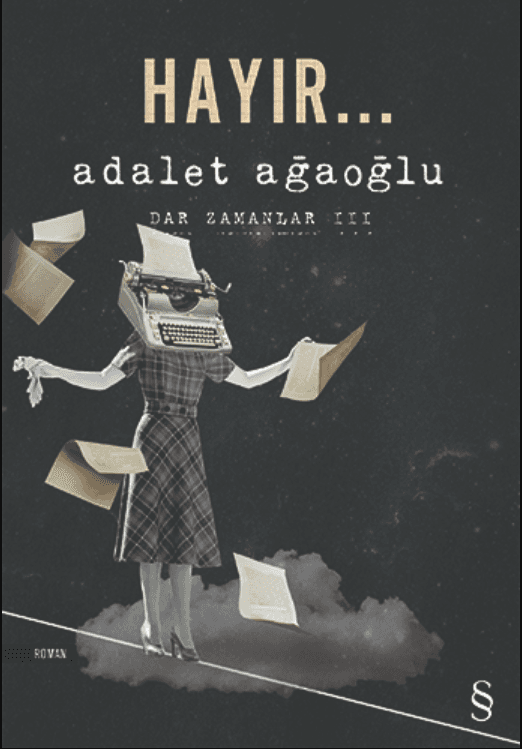
Justice Ağaoğlu’s novel Hayır continues the exploration of the individual’s memory identity and social building position, forming the third installment of the author’s tetralogy Dar Zamanlar. While Ölmeye Yatmak and Bir Düğün Gecesi examined the moral dimensions of memory in the face of individual and collective forgetting, Hayır also addresses the impact of this remembering process on the individual’s mental health.
The novel centers on the character Aysel, familiar from previous novels, place. Hayır investigates how memory, forgetting, and recollection are shaped within the individual’s mental world, while simultaneously emphasizing the determining role of collective memory in shaping personal identity. Roman links forgetting with madness, revealing the necessity of confronting one’s past.
The novel departs from a linear structure time; instead, it employs a spiral narrative that constantly moves between the present and the future past. Adalet Ağaoğlu’s narrative strategy regarding time draws on stream-of-consciousness and interior monologue techniques to foreground the characters’ mental processes. The temporal fabric of Hayır is constructed through narrative techniques involving parallel universes and multiple layers of time. In particular, references to Schrödinger’s Cat thought experiment illustrate that the narrative does not adhere to a single absolute reality but is built upon a framework of possibilities on.
The fragmented structure of the temporal narrative reflects the disjointed nature of individual memory and the variable character of its connections to the past. In this context, Hayır diverges from earlier novels by demonstrating that time does not progress along a linear path but is continually reshaped within the individual’s memory fixed.
The novel underscores the decisive role of mindset in the construction of individual identity. Evaluated within the framework of Sabri Fehmi Ülgener’s theory of mindset, Hayır examines how an individual’s thought world is shaped by religion, economics, politics, and cultural factors.
Ağaoğlu conducts a deep analysis of society’s individual influence, questioning how individuals position themselves in relation to historical events. The novel discusses how the modernization process shapes individual thought structures and contributes to identity crises.
In the novel Hayır, Adalet Ağaoğlu examines the processes of forgetting and remembering within a moral framework. The novel emphasizes that avoiding confrontation with the past is not merely a personal failure but also leads to the erasure of collective memory road.
Aysel, one of the central main characters, assumes the responsibility of reminding society of what it has forgotten by confronting her own past. Hayır treats forgetting not only as an individual mechanism but as a social phenomenon, thereby engaging in a discussion of the ethical imperative of remembrance.
Hayır, as part of the Dar Zamanlar tetralogy, is a novel that deeply analyzes the memory processes of both the individual and society. With its modernist and postmodernist narrative structure and temporal construction work, it underscores the inevitability of the individual’s reckoning with the past.
The novel explores how individual and collective memory are constructed, how identity is shaped through these memories, and evaluates the processes of forgetting and remembering within an ethical discussion framework.
Apaydın, Mustafa. "Adalet Ağaoğlu’nun Dar Zamanlar Üçlemesinde Zaman Kurgusu Üzerinde Bazı Değerlendirmeler." Çukurova Üniversitesi Sosyal Bilimler Enstitüsü Dergisi 15, no. 2 (2006): 17-38.
Arıkan, Seda, and Talat Aytan. “Adalet Ağaoğlu’nun Dar Zamanlar Üçlemesinde Hafıza, Tarih Ve Kimlik”. *Journal of Turkish Language and Literature* 61, no. 2 (December 2021): 541-59. https://doi.org/10.26650/TUDED2021-993976.
Ağaoğlu, Adalet. Hayır. Everest Yayınları. 3. bs. İstanbul: 2020.
Cuşa, Hasan. "Adalet Ağaoğlu’nun Dar Zamanlar Dörtlemesinde Zaman Analizi." Turkish Studies 13, no. 28 (Fall 2018): 191-216.
Gün, Elif. "Üç Beş Kişi ve Hayır Romanlarında Zihniyet Arayışı." Fırat Üniversitesi Sosyal Bilimler Dergisi 34/3. (2024): 1169-1180.

Temporal Structure and Narrative Technique
Mindset and Social Context
The Moral Dimension of Forgetting and Remembering