


This article was automatically translated from the original Turkish version.
+1 More
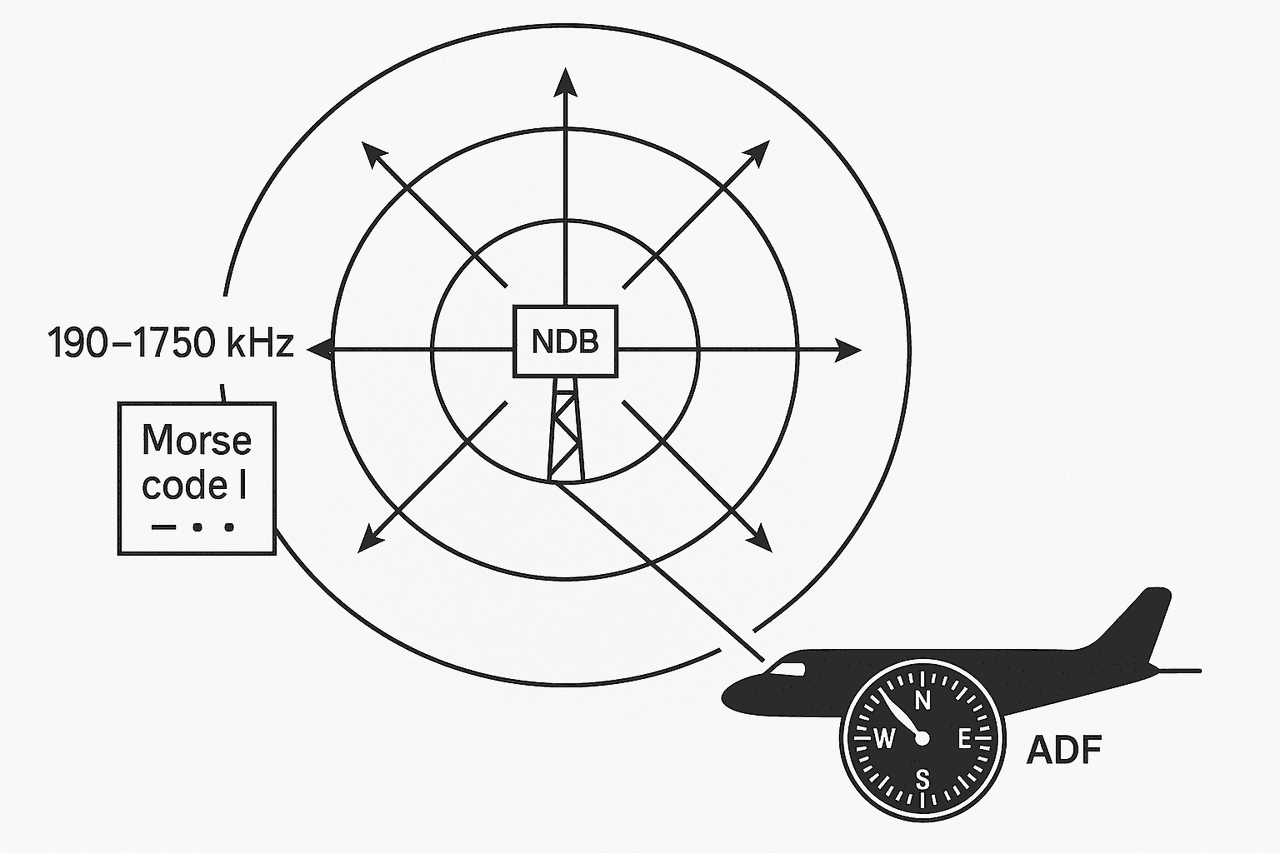
Generated with artificial intelligence.
Non-Directional Radio Broadcast (NDB)
Frequency Range | 190 kHz – 1750 kHz (commonly 190–535 kHz) | ||||||||
|---|---|---|---|---|---|---|---|---|---|
Application Area(s) | Fix identification Backup system Enroute navigation Approach procedures | ||||||||
Common Types | Marine Beacon Locator NDB Enroute NDB | ||||||||
Signal Characteristics | Morse code identifier 400 Hz / 1020 Hz modulation Omnidirectional transmission | ||||||||
Modern Alternatives | ILS GNSS (GPS) DME VOR | ||||||||
Non-Directional Beacon (NDB) is one of the most fundamental ground-based navigation aids used in aviation. Its primary function is to provide aircraft with directional information via radio waves. This system, employed to enhance flight safety and ensure pilots remain on the correct course, continues to maintain its role among modern aviation technologies, particularly in low-visibility conditions, non-precision approaches, and as a backup system. NDB systems consist of fixed ground stations operating in the medium and low frequency bands of the electromagnetic spectrum. These stations transmit radio signals with equal intensity in all directions, enabling aircraft to determine their direction relative to the station.
Although technologically simple, non-directional beacons represent a significant milestone in aviation history. In situations where other navigation systems are unavailable or malfunctioning, NDBs offer a low-cost and effective solution. Although they are increasingly being replaced by more precise and sophisticated systems, NDBs remain actively used in many airspaces, serving both in training flights and as backup systems.
A Non-Directional Beacon (NDB) is a fixed radio transmitter operating in the low (LF) and medium (MF) frequency bands of the electromagnetic spectrum. NDB stations transmit signals with equal strength in all directions. This characteristic means that the aircraft does not need to be oriented in any specific direction to receive the signal; the signal can be detected with uniform intensity from any azimuth.
The fundamental operating principle of these systems relies on the aircraft’s Automatic Direction Finder (ADF) device, which detects the NDB signal and determines its direction relative to magnetic north. This allows the aircraft to establish its bearing toward the NDB station and perform a “homing” maneuver. NDBs typically transmit a unique identifier consisting of one to three letters in Morse code. This identifier enables the pilot to confirm they are tracking the correct station and enhances the reliability of system usage.
NDBs are called “non-directional” because they do not emit a directional signal. However, this non-directionality does not prevent directional determination based on the reception angle. On the contrary, it allows an aircraft to approach the station from any angle and still utilize the system. This fundamental principle enables NDBs to operate with low technical complexity, but it also makes them susceptible to various electromagnetic interferences.
NDB systems transmit in the low and medium frequency bands between 190 kHz and 1750 kHz. The most commonly used band is 190–535 kHz. Signals in these bands can propagate over long distances due to atmospheric characteristics, enabling NDBs to provide wide-area coverage. This feature greatly facilitates air navigation in regions lacking advanced infrastructure or in mountainous and rural areas.
The signal transmitted by NDB stations typically consists of a continuous carrier wave modulated at either 400 Hz or 1020 Hz. These modulated signals are processed by the ADF and displayed as directional information on the cockpit instrument. Additionally, a continuous cyclic Morse code identifier is transmitted within the signal.
In NDB stations with voice transmission, the identifier is audible along with the modulated tone. However, some stations transmit data only, and in such cases, the broadcast identifier typically includes the letter “W” (without voice) to indicate the absence of voice transmission.
The transmission characteristics of NDBs rely on surface waves and ionospheric reflections rather than line-of-sight propagation. This enables signals to be received from greater distances, especially during nighttime hours, but also increases the risk of interference and noise.
The primary interaction component between non-directional beacons and aircraft is the Automatic Direction Finder (ADF) system installed on the aircraft. The ADF detects electromagnetic signals from NDB stations and determines their direction relative to magnetic north. As a result, a needle on the ADF indicator in the cockpit points toward the station’s location, allowing the pilot to adjust the aircraft’s heading or fly directly toward the station.
When integrated with the autopilot system, the ADF enables the aircraft to maintain a stable course aligned with the NDB. However, the ADF is highly susceptible to electromagnetic interference. Lightning strikes, static electricity, heavy precipitation, and reflections from large metal structures can cause the ADF to display incorrect directions.
Another important consideration is that most ADF instruments lack a “FLAG” warning indicator found in systems like GPS or VOR. This means the pilot must verify the system’s operational status solely by listening to the Morse code identifier. If noise, distortion, musical tones, or unidentifiable sounds are heard in the signal, this indicates that the signal is not being received correctly and the directional information is unreliable.
Therefore, during ADF usage, it is mandatory for the pilot to continuously monitor the NDB identifier to confirm the reliability of the signal and the accuracy of the directional information.
Non-Directional Beacons (NDB) have a broad range of applications in aviation due to their versatility. They play a critical role in regions where modern navigation systems have not yet been widely implemented or where backup capabilities are required.
NDBs are most commonly used in non-precision approach procedures. In such procedures, the aircraft is guided horizontally toward the runway without vertical guidance. Using the ADF indicator, the pilot adjusts the aircraft’s heading to align with the NDB station and initiate the descent. These applications are particularly important at airports lacking an Instrument Landing System (ILS) and with limited infrastructure.
When positioned along airways, NDBs serve as enroute navigation aids to ensure continuous course guidance. Aircraft navigate between successive NDB stations by determining their direction relative to each. This system enables directional determination in low-altitude airspace during long-range flights.
In the event of failure or signal loss of more advanced systems, NDBs provide a reliable backup navigation infrastructure. This feature represents a significant advantage in terms of system sustainability.
NDB stations are also used to define the geographic location of an airport or to establish fixed points (fixes) for directional reference. In such applications, NDBs serve as key reference markers along specific routes or approach paths.
NDBs are classified into various types based on their location, purpose, and transmission power. This classification forms the basis for configuring air traffic management systems and establishing flight procedures.
Enroute NDBs are typically located at remote points away from airports and are designed for long-range transmission. These stations are positioned along flight routes, allowing aircraft to navigate from one station to the next. Their identifiers are usually three letters long and registered according to ICAO coding standards.
These are low-power, short-range stations primarily used during the approach phase. Locator NDBs are often integrated as part of a runway approach system. Their typical coverage radius ranges from 10 to 25 nautical miles (18.5–46.3 km). Locator NDBs located at the runway threshold are commonly referred to as Compass Locators.
Marine Beacons are radio transmitters positioned along coastal areas, primarily intended for maritime navigation but also used as auxiliary aviation navigation aids. In some countries, these stations serve both maritime and aviation purposes and provide support for approach routes near coastlines.
Despite their widespread use, NDB systems have several technical and environmental limitations that can directly affect their performance and accuracy.
NDB signals are highly susceptible to atmospheric conditions and electromagnetic disturbances. Events such as lightning, storms, heavy rainfall, and solar-induced ionospheric activity can disrupt signal stability and accuracy, potentially causing the ADF to indicate incorrect directions.
During nighttime hours, ionospheric reflections allow signals to travel much farther than during the day. This can lead to signal overlap with those from other stations, resulting in erroneous directional readings. Distant station interference may also make it difficult to identify the correct signal.
Since NDB signals propagate as ground waves, they can reflect off large bodies of water such as seas and lakes, as well as areas with large metal structures. These reflections can distort the signal’s direction and produce inaccurate data.
ADF instruments do not include a warning indicator (such as a “FLAG”) to signal signal reliability. Therefore, pilots must determine signal validity solely by listening to the Morse code identifier. The presence of noise, distortion, or musical tones in the identifier typically indicates an unreliable signal and incorrect directional information.
To ensure the functionality and reliability of NDB systems, periodic flight checks and calibrations are conducted. These procedures measure the performance of ground stations, evaluate signal coverage, and detect potential interference.
The modern AT-940 Automatic Flight Check System is an integrated testing platform designed for the calibration and certification of ground stations. During flight, this system can:
During calibration flights, the aircraft flies circular patterns around the NDB station to test signal coverage. These flights are typically conducted counterclockwise, and signal reception is analyzed by observing the movement of the ADF needle.
NDBs must provide adequate coverage and directional accuracy in Standard Instrument Approach Procedure (SIAP) segments. During inspection flights, the aircraft flies below the minimum descent altitude to evaluate signal quality. These tests are mandatory to verify the system’s suitability for safe approach procedures.
Each NDB station is systematically assigned a unique identifier (designator) and name. This information is recorded in aviation databases, charts, and pilot navigation systems.
The identifier signal is continuously transmitted in Morse code and verified by pilots through auditory monitoring.
Each NDB station is geographically located using latitude and longitude coordinates. If an NDB is co-located with a Marker Beacon of an ILS system, their location data coincide. However, in cases where the Marker Beacon and NDB station are physically separated, their locations must be separately defined. Specific coding rules apply to such distinctions.
Azimut. "Non-directional radio beacon." Accessed July 13, 2025. Accessed Adresi.
Devlet Hava Meydanları İşletmesi Genel Müdürlüğü. "NDB (Non-directional radio Beacon - Yönlendirilmemiş Radyo Yayını)." Accessed July 13, 2025. Accessed Adresi.
Federal Aviation Administration. "Navigation Aids/Systems". Accessed July 13, 2025. Accessed Adresi.
IVAO Documentation Library. "Non-directional beacon - NDB (Beacon)." Accessed July 13, 2025. Accessed Adresi.
Pitor, Ján, Filip Škultéty, and Karol Götz. "Non directional beacons checking." (2014). Accessed Adresi.
SKYbrary. "Non-Directional Beacon." Accessed July 13, 2025. Accessed Adresi.
Sabur, Fatmawati, Muhammad Yahya, Abdul Muis, and Mulyadi Nur. "Analysis of Distance and Travel Time Calculations in the Implementation of Non-Directional Beacon Courses." European Journal of Engineering and Technology Research 9, no. 3 (2024): 8-15. Accessed Adresi.

Generated with artificial intelligence.
Non-Directional Radio Broadcast (NDB)
Frequency Range | 190 kHz – 1750 kHz (commonly 190–535 kHz) | ||||||||
|---|---|---|---|---|---|---|---|---|---|
Application Area(s) | Fix identification Backup system Enroute navigation Approach procedures | ||||||||
Common Types | Marine Beacon Locator NDB Enroute NDB | ||||||||
Signal Characteristics | Morse code identifier 400 Hz / 1020 Hz modulation Omnidirectional transmission | ||||||||
Modern Alternatives | ILS GNSS (GPS) DME VOR | ||||||||
No Discussion Added Yet
Start discussion for "Non-Directional Radio Beacon (NDB)" article
Definition and Key Characteristics
Frequency Structure and Transmission Characteristics
Relationship with the Automatic Direction Finder (ADF) System
Applications
Approach and Landing Procedures
Enroute Navigation
Backup Navigation System
Airport Identification and Fix Determination
NDB Types
Enroute NDB (ENR)
Locator NDB (L)
Marine Beacon (MAR)
System Limitations and Errors
Electromagnetic Interference
Night Effect
Surface Reflection and Object Interaction
Lack of Warning System in ADF Instruments
Flight Check and Calibration
Inspection Tool: AT-940 System
Coverage Orbit
Approach Segment Test
Identifier and Location Information
Identifier Structure
Location Information