

This article was automatically translated from the original Turkish version.
+1 More
Length(s) | 14.5 metres | ||||||||
|---|---|---|---|---|---|---|---|---|---|
Engine(s) | 1 × Rolls-Royce AE 3007H turbofan | ||||||||
Manufacturer(s) | Northrop Grumman | ||||||||
Height(s) | 4.7 metres | ||||||||
Type(s) | Unmanned Aerial Vehicle (UAV) | ||||||||
First Flight(s) | 28 February 1998 | ||||||||
Primary Users | Japanese Air Self-Defense Force South Korean Air Force NATO United States Air Force (USAF) | ||||||||
Range(s) | 22 300 nautical miles) 780 km (12 | ||||||||
Cruise Speed | 575 km/h (310 knots) | ||||||||
Maximum Speed | 629 km/h (340 knots) | ||||||||
Thrust | 7,600 lbf (34 kN) | ||||||||
Maximum Takeoff Weight | 14,628 kg | ||||||||
Empty Weight | 6,710 kg | ||||||||
Wingspan | 39.8 metres | ||||||||
Crew | 0 (3 ground operators: Takeoff/Landing, Mission, and Sensor Operator) | ||||||||
Introduction | 2004 | ||||||||
Role | Strategic Intelligence, Surveillance, and Reconnaissance | ||||||||
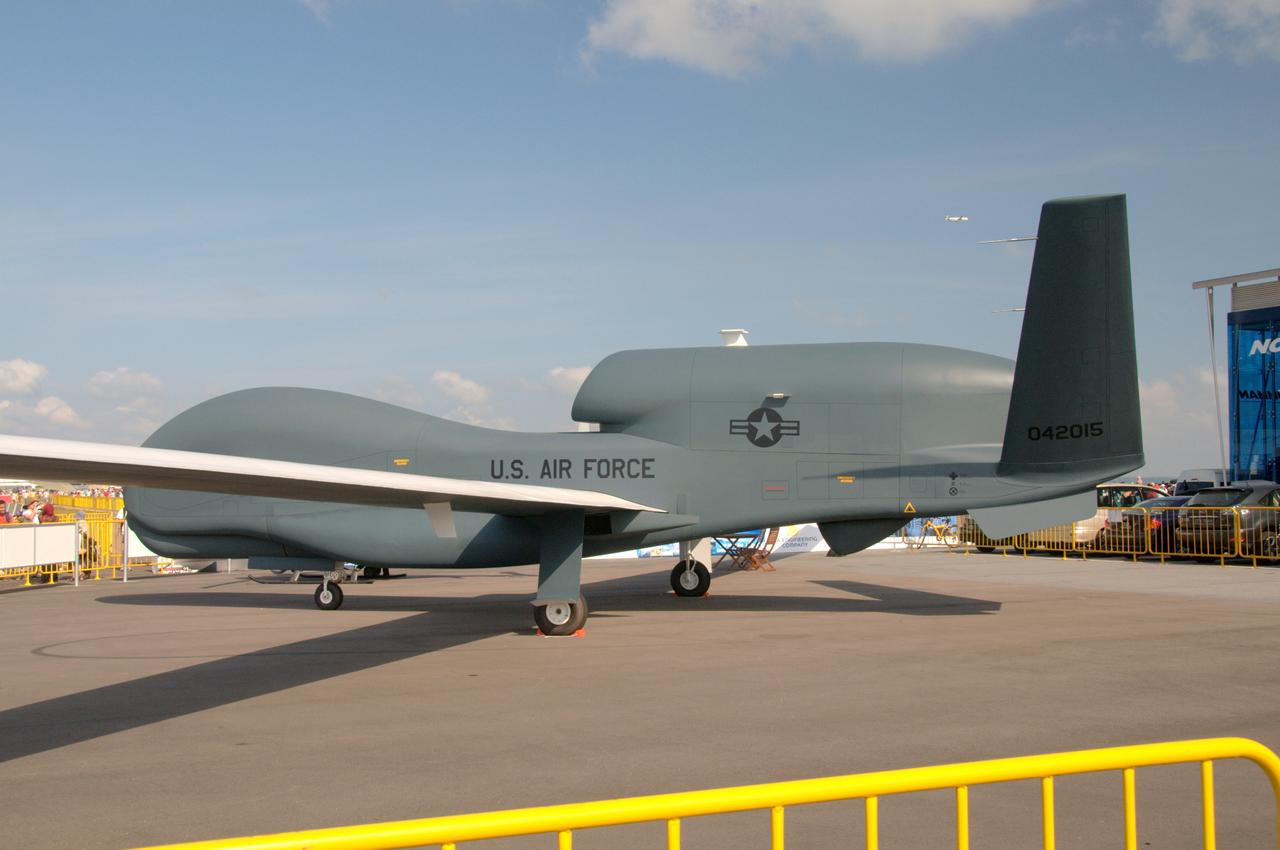
RQ-4 Global Hawk is a high-altitude, long-endurance unmanned aerial vehicle developed by Northrop Grumman. It was designed to perform strategic intelligence, surveillance, and reconnaissance missions within the United States Air Force. The platform, which made its first flight on 28 February 1998, is equipped with autonomous flight capabilities to reduce the operational risks associated with manned reconnaissance aircraft.【1】.

RQ-4 Global Hawk (Flickr)
The design of the RQ-4 Global Hawk is based on a glider-like airframe optimized for maximum aerodynamic efficiency at high altitudes. A large portion of the airframe is constructed from carbon fiber and epoxy composite materials to withstand extreme atmospheric conditions at high altitudes while minimizing total weight. The aircraft’s most distinctive feature, its 39.8-meter wingspan, enables sufficient lift even in the thin atmosphere above 60,000 feet due to its slender, elongated structure. The propulsion system consists of a single Rolls-Royce AE 3007H turbofan engine mounted on the upper rear section of the fuselage, delivering 7,600 pounds of thrust. This configuration reduces the radar cross-section and directs exhaust heat upward, thereby minimizing infrared signature.
The development program was initiated in the mid-1990s under DARPA’s Tier II+ initiative to test the strategic reconnaissance capabilities of unmanned systems. During the design phase, the “Common Ground Station” concept was adopted, aiming to integrate launch, flight control, and data processing functions into a cohesive yet independent system architecture. Throughout development, the aircraft’s payload capacity was increased; the Block 20 variant introduced broadband communication systems and advanced mission computers. This engineering process culminated in the optimization of flight control software enabling autonomous taxiing, takeoff, and landing, achieving a maximum takeoff weight of 12,310 kg.【2】.

RQ-4 Global Hawk Technical Drawing (Generated by AI)
Thanks to its aerodynamic design and propulsion system, the RQ-4 Global Hawk delivers strategic flight performance. Its primary thrust is provided by a single Rolls-Royce AE 3007H turbofan engine capable of generating 7,600 pounds of thrust at sea level. This engine enables the aircraft to maintain stable flight at high altitudes despite a maximum takeoff weight of 12,310 kg. The fuselage length is 14.5 meters and the height is 4.7 meters. With a wingspan of 39.8 meters, approaching that of a modern commercial airliner, the Global Hawk achieves efficient gliding performance in the low-density upper atmosphere.【3】.
Operational performance data indicate that the Global Hawk can conduct missions at altitudes above 60,000 feet (approximately 18,300 meters). This altitude places it well above commercial air traffic and isolates it from many ground-based air defense systems and adverse weather conditions. The aircraft’s maximum cruise speed is approximately 310 knots (575 km/h). Its fuel capacity and engine efficiency allow it to remain airborne for more than 32 hours and cover a range of up to 22,780 kilometers in a single mission. This technical capability enables the aircraft to fly from its base to a target area thousands of kilometers away, conduct continuous surveillance for 24 hours, and return.
The RQ-4 Global Hawk is equipped with a sophisticated surveillance system known as the “Integrated Sensor Suite,” developed by Raytheon. This suite integrates synthetic aperture radar, electro-optical, and infrared sensors into a single system, enabling the aircraft to collect high-resolution data regardless of day, night, or cloud cover. A wideband satellite communication system mounted in the nose allows real-time transmission of collected data to ground stations or strategic command centers. Particularly in the Block 40 variant, the Multi-Platform Radar Technology Insertion Program (MP-RTIP) employs an active electronically scanned array radar that enables simultaneous precise tracking of both stationary and moving targets.
On the avionics side, the aircraft is managed by redundant, highly autonomous mission computers and an advanced navigation system. By fusing data from an inertial navigation system (INS) and the Global Positioning System (GPS), the platform can follow its pre-programmed route even in the event of external interference or signal loss. Additionally, the aircraft incorporates defensive electronic support systems such as the AN/ALR-89 radar warning receiver, capable of detecting potential threats and initiating countermeasures. This technological infrastructure enables the Global Hawk to survey approximately 100,000 square kilometers in a single mission and generate detailed intelligence reports.【4】.
The RQ-4 Global Hawk program has evolved through successive block upgrades, each incrementally enhancing technological capabilities to meet operational requirements. The initial production series, Block 10, focused on basic ISR capabilities and was produced in limited numbers; this variant was retired in 2011. With Block 20, the airframe was enlarged and payload capacity increased to 1,360 kg. At this stage, the aircraft was also equipped with a “Battlefield Airborne Communications Node” (BACN) system, enabling it to perform not only imagery intelligence but also communication relay missions.

RQ-4 Global Hawk Block 20 (Kelly Michals)
One of the most critical phases in its development, Block 30, is equipped with multi-intelligence (Multi-INT) capabilities, allowing it to carry electro-optical and signals intelligence (SIGINT) sensors simultaneously. The most advanced variant, Block 40, incorporates the AN/ZPY-2 Multi-Platform Radar Technology Insertion Program sensor. This active electronically scanned array radar provides high-resolution wide-area surveillance along with precise moving target indication. Modernization efforts continue to upgrade the aircraft’s cybersecurity infrastructure and satellite data links to ensure its resilience in contemporary electronic warfare environments.
The RQ-4 Global Hawk began operational service in 2001 during the “Enduring Freedom” operation in Afghanistan, while still in the testing phase. Its primary purpose was to provide target identification for friendly forces and generate real-time topographic maps of large areas. During the 2003 Iraq War, the platform was actively deployed and provided a strategic advantage by maintaining uninterrupted imagery transmission through its SAR radar, even under extreme weather conditions such as dust storms that severely reduced visibility. According to United States Air Force data, Global Hawk systems have accumulated over 320,000 operational flight hours, the majority of which were spent on ISR missions in combat zones.【5】.
Beyond military operations, the RQ-4 has played an active role in civil support and scientific research. Modified Global Hawk aircraft operated by NASA have conducted transoceanic flights to observe hurricane formation and study atmospheric changes. Additionally, following the 2011 earthquake and tsunami in Japan, the platform’s high-resolution sensors were utilized in humanitarian assistance and disaster management efforts, including damage assessment of the Fukushima Nuclear Power Plant and mapping of affected areas. Under NATO’s “Alliance Ground Surveillance” (AGS) program, the system’s use has become widespread across European airspace and border security, establishing it as a global standard.
RQ-4 Global Hawk (Haci Productions)
Due to its high cost and strategic importance, the RQ-4 Global Hawk is operationally used by only a limited number of countries and international organizations. The United States is both the primary user and developer of the system. The United States Air Force (USAF) employs Block 30 and Block 40 configurations for global reconnaissance missions, while the maritime variant, the MQ-4C Triton, is operated by the United States Navy for maritime surveillance. NASA also maintains two Block 10 aircraft for civil scientific research and atmospheric observations.
In the Asia-Pacific region, South Korea and Japan are among the system’s most significant users. The Republic of Korea Air Force (ROKAF) has purchased four Block 30 Global Hawks to monitor regional threats and achieved full operational capability with these aircraft by 2020.
The Japan Air Self-Defense Force (JASDF) ordered three RQ-4B aircraft to enhance its ISR capabilities. The first aircraft arrived at Misawa Air Base in March 2022 and was integrated into the inventory.
Australia has also joined the program as a partner in the maritime variant, the MQ-4C Triton.
In Europe, the system is operated not through individual national use but via a multinational cooperation model. Under NATO’s “Alliance Ground Surveillance” (AGS) program, five RQ-4D Phoenix aircraft (based on Block 40) have been procured. These aircraft are based at Sigonella Air Base in Italy and are jointly funded by 15 participating nations including Germany, Italy, Norway, and Poland, providing intelligence support to all NATO allies.【6】.
Epure, Liviu Ionut. “Post-Quantum Cryptography for Military UAV Communication Systems A Comprehensive Framework for Quantum-Resistant Security in MAVLink-Based Unmanned Aerial Vehicles,” 2025. https://www.academia.edu/144875678/Post_Quantum_Cryptography_for_Military_UAV_Communication_Systems_A_Comprehensive_Framework_for_Quantum_Resistant_Security_in_MAVLink_Based_Unmanned_Aerial_Vehicles
Haci Productions. "RQ-4 Global Hawk: The Eye at 60,000 Feet." YouTube. Accessed February 21, 2026. https://www.youtube.com/watch?v=LsMkxGZkSXY
Jeroudi, Leith. "Eyes in the Stratosphere: How Near-Space Surveillance Platforms Are Redefining Global Power Projection and Strategic Ambiguity." Trends Research. Accessed February 21, 2026. https://trendsresearch.org/insight/eyes-in-the-stratosphere-how-near-space-surveillance-platforms-are-redefining-global-power-projection-and-strategic-ambiguity/
Kaminski, Christopher, and Michael Kinzel. “Design Optimization of a Boundary Layer Ingestion Propulsion System for a Long-Range, High-Altitude UAV”. AIAA Southeastern Regional Student Conference. April 2021. Accessed February 21, 2026. https://commons.erau.edu/aiaar2sc/2021/undergraduate/3
Michals, Kelly. "RQ-4 Block 20 Global Hawk." Flickr. October 3, 2010. Accessed February 21, 2026. https://www.flickr.com/photos/rocbolt/49786961868/
NASA. "Global Hawk High-Altitude, Long-Endurance Science Aircraft." NASA Armstrong Flight Research Center. Accessed February 21, 2026. https://www.nasa.gov/centers/armstrong/news/FactSheets/FS-098-DFRC.html
NATO. "NATO Intelligence, Surveillance and Reconnaissance Force (NISRF)." NATO Official Website. Accessed February 21, 2026. https://www.nato.int/en/what-we-do/deterrence-and-defence/nato-intelligence-surveillance-and-reconnaissance-force-nisrf
Northrop Grumman. "Global Hawk - Northrop Grumman." Accessed February 21, 2026. https://www.northropgrumman.com/what-we-do/aircraft/global-hawk
Serrano, Ignacio. “Unmanned Aircraft System (UAS) vs. Manned Aircraft System (MAS): A Military Aircraft Study”. LMU Theses and Dissertations. April 2015. Accessed February 21, 2026. https://digitalcommons.lmu.edu/etd/430
Thomas, Giles. "Northrop Grumman RQ-4 Global Hawk." Flickr. July 22, 2006. Accessed February 21, 2026. https://www.flickr.com/photos/jacobsroom/210476312/
U.S. Indo-Pacific Command. "An RQ-4 Global Hawk lands during a test flight, Marine Corps Air Station Kaneohe Bay." Flickr, July 31, 2019. Accessed February 21, 2026. https://www.flickr.com/photos/us-pacific-command/48424981907/
ngotoh. "20100207SingaporeAirShow." Flickr, February 7, 2010. Accessed February 21, 2026. https://www.flickr.com/photos/gotoh/4340012863/
[1]
U.S. Air Force. "RQ-4 Global Hawk." Air Force Official Website. Access date: 21 February 2026.https://www.af.mil/About-Us/Fact-Sheets/Display/Article/104516/rq-4-global-hawk/
[2]
Northrop Grumman. "Global Hawk." Northrop Grumman Official Website.Access 21 February 2026. https://www.northropgrumman.com/what-we-do/aircraft/global-hawk.
[3]
NASA. "Global Hawk High-Altitude, Long-Endurance Science Aircraft." NASA Armstrong Flight Research Center. Access date: 21 February 2026.https://www.nasa.gov/centers/armstrong/news/FactSheets/FS-098-DFRC.html
[4]
U.S. Air Force. "RQ-4 Global Hawk." Air Force Official Website. Access date: 21 February 2026.https://www.af.mil/About-Us/Fact-Sheets/Display/Article/104516/rq-4-global-hawk/
[5]
Northrop Grumman. "Global Hawk." Northrop Grumman Official Website. Access date: 21 February 2026.https://www.northropgrumman.com/what-we-do/aircraft/global-hawk
[6]
NATO. "NATO Intelligence, Surveillance and Reconnaissance Force (NISRF)." NATO Official Website. Access date: 21 February 2026. https://www.nato.int/en/what-we-do/deterrence-and-defence/nato-intelligence-surveillance-and-reconnaissance-force-nisrf

Length(s) | 14.5 metres | ||||||||
|---|---|---|---|---|---|---|---|---|---|
Engine(s) | 1 × Rolls-Royce AE 3007H turbofan | ||||||||
Manufacturer(s) | Northrop Grumman | ||||||||
Height(s) | 4.7 metres | ||||||||
Type(s) | Unmanned Aerial Vehicle (UAV) | ||||||||
First Flight(s) | 28 February 1998 | ||||||||
Primary Users | Japanese Air Self-Defense Force South Korean Air Force NATO United States Air Force (USAF) | ||||||||
Range(s) | 22 300 nautical miles) 780 km (12 | ||||||||
Cruise Speed | 575 km/h (310 knots) | ||||||||
Maximum Speed | 629 km/h (340 knots) | ||||||||
Thrust | 7,600 lbf (34 kN) | ||||||||
Maximum Takeoff Weight | 14,628 kg | ||||||||
Empty Weight | 6,710 kg | ||||||||
Wingspan | 39.8 metres | ||||||||
Crew | 0 (3 ground operators: Takeoff/Landing, Mission, and Sensor Operator) | ||||||||
Introduction | 2004 | ||||||||
Role | Strategic Intelligence, Surveillance, and Reconnaissance | ||||||||
No Discussion Added Yet
Start discussion for "Northrop Grumman RQ-4 Global Hawk" article
Design and Development
Technical Specifications
Sensor Systems and Avionics
Variants and Modernization
Operational History and Applications
Operator Countries